
18 October 2026
When a benign thyroid nodule presses on the neck: can it be shrunk without surgery?
A feeling of pressure or of a lump in the throat, discomfort on swallowing, a swelling you can see in the mirror: a thyroid nodule can cause trouble even when it is benign. When symptoms are bothersome, surgery is often proposed. But there is an alternative: ultrasound-guided thermal ablation. Here is what the guidelines and the studies say, limits included.
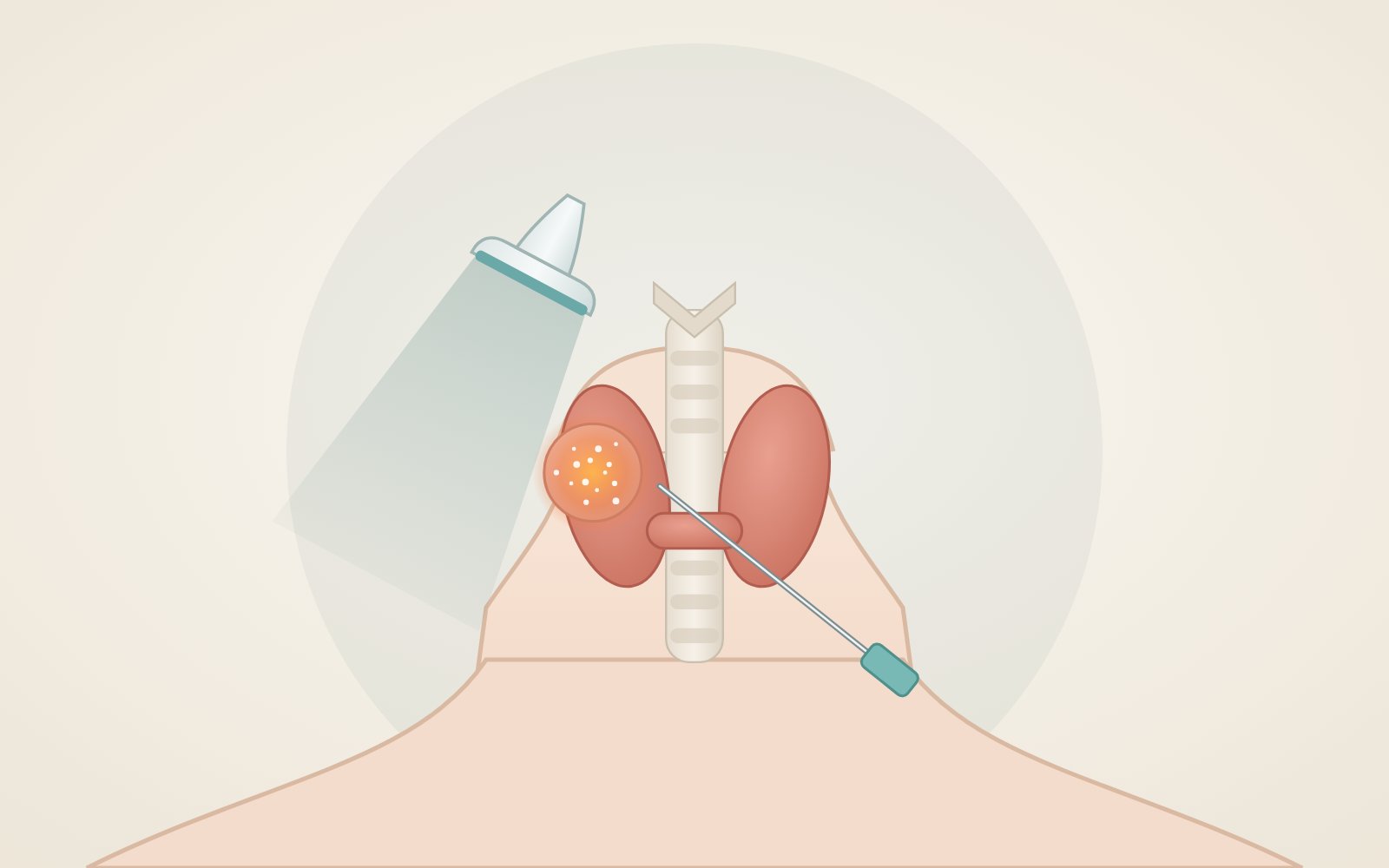
A nodule that makes itself felt
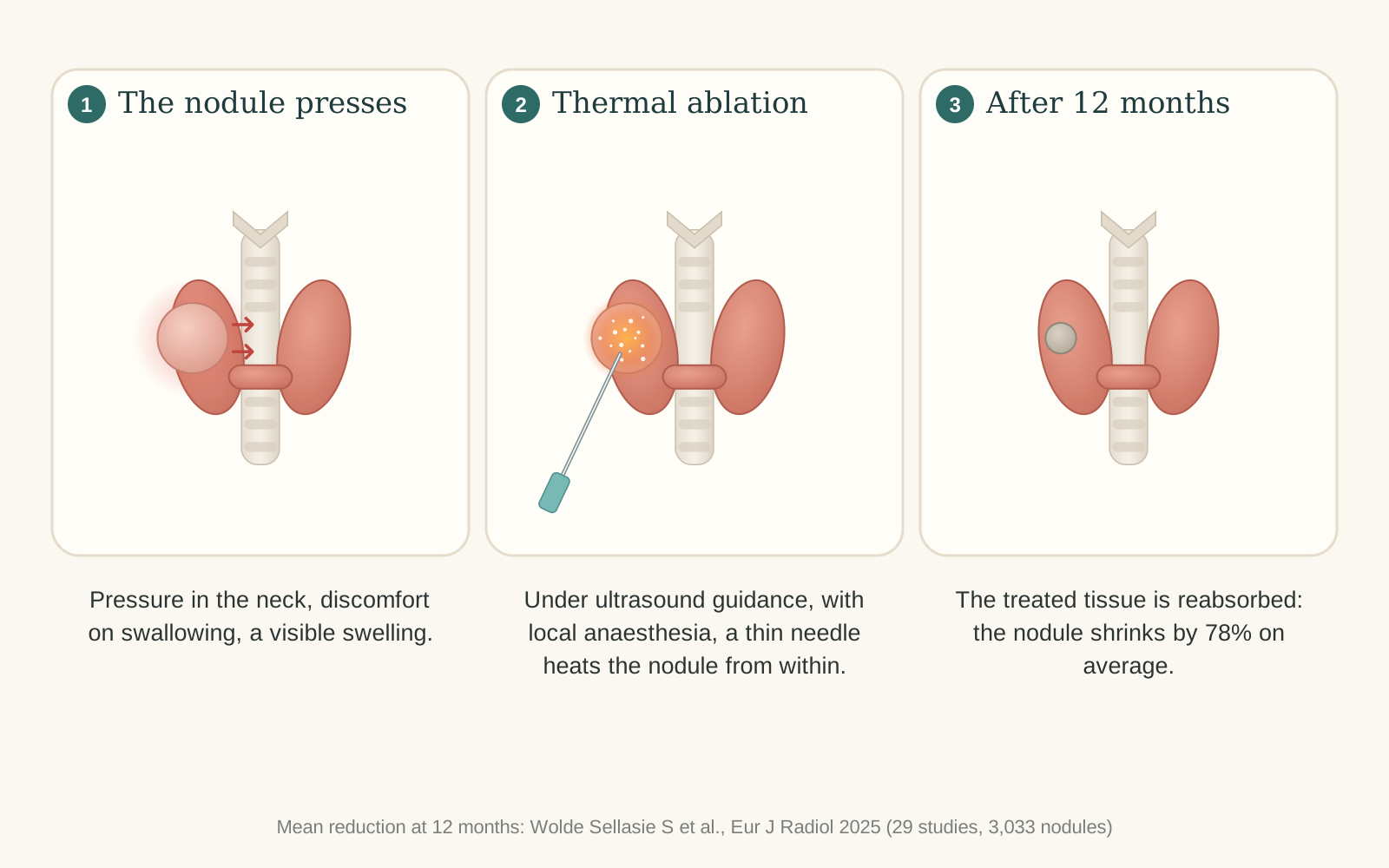
Thyroid nodules are very common and in the great majority of cases they are benign: they are often found by chance, on an ultrasound done for other reasons, and cause no trouble at all. Some, however, grow until they make themselves felt. The symptoms are hardly ever real pain, but a feeling of pressure or heaviness at the base of the neck, the sensation of a lump in the throat, discomfort on swallowing or when wearing collars and scarves, sometimes a change in the voice. In nodules with a fluid component, a small internal bleed can instead cause sudden pain and a rapid increase in size. And then there is the cosmetic concern: a visible swelling on the neck, which many people find hard to live with. When these problems become significant, until recently there was almost always a single answer: surgery.
First of all: is it really benign?
Everything starts here. A nodule is assessed with ultrasound, which describes its features, and with fine-needle aspiration, the sampling of cells with a thin needle, when its appearance calls for it. The 2020 European guidelines on thyroid nodule ablation require, before treating a solid nodule, two fine-needle aspirations with a benign result, a recent ultrasound and thyroid hormone tests; if the nodule produces excess hormones, that is if it is "hot", a scintigraphy is also needed. If the cytology is suspicious or indeterminate, the picture changes: in those cases surgery remains the right choice, because only a complete histological examination gives a definitive answer.
The classic routes: wait, operate, radioiodine
A benign nodule that causes no trouble should not be treated: it is enough to monitor it over time. When symptoms are bothersome, the traditional solution is removal of half the thyroid, a lobectomy, or of the whole gland. It is a safe operation in the hands of experienced surgeons, but it requires general anaesthesia, leaves a scar on the neck and carries small but real risks for the nerves of the voice and for the parathyroid glands; moreover, some patients will then have to take thyroid hormone for life. For hot nodules there is also radioiodine, which switches off the overactive tissue. In many cases these remain the best choices. But they are no longer the only ones.
But there is an alternative: thermal ablation
Thermal ablation treats the nodule without removing it. After local anaesthesia of the skin and of the thyroid capsule, a thin needle electrode is introduced under continuous ultrasound guidance and advanced into the nodule, usually through the isthmus of the gland, the route that keeps the needle away from the nerves and vessels of the neck. The energy, radiofrequency in the most studied technique, or laser or microwaves, heats the tissue to 60-100 degrees and coagulates it; the needle is moved several times, treating small portions, until the whole nodule has been covered. The patient is awake and talks during the procedure, so the voice is checked at every moment. The session lasts 30-60 minutes and you go home after a couple of hours of observation. The treated tissue does not disappear immediately: it is reabsorbed over the following months and the nodule shrinks progressively, while the healthy thyroid around it keeps working normally.
What the randomised trials show
The best evidence comes from two randomised trials, both with a strong Italian contribution. In the first, carried out in Turin and Seoul on 80 patients with compressive benign nodules of 10-20 millilitres, a single radiofrequency session reduced the volume from 15 to 4 millilitres in six months, with a clear improvement in symptoms and in the appearance of the neck and no side effects, while in untreated patients the nodule remained unchanged; the result was the same in the two centres, despite their different experience. In the second, 200 patients in four Italian centres were randomly assigned to a single laser session or to observation alone: at three years the treated nodule was 57% smaller and local symptoms had fallen from 38% to 8% of patients, while in the control group the nodule had grown by 25%. The procedure was well tolerated in 92% of cases and thyroid function did not change.
How much the nodule shrinks
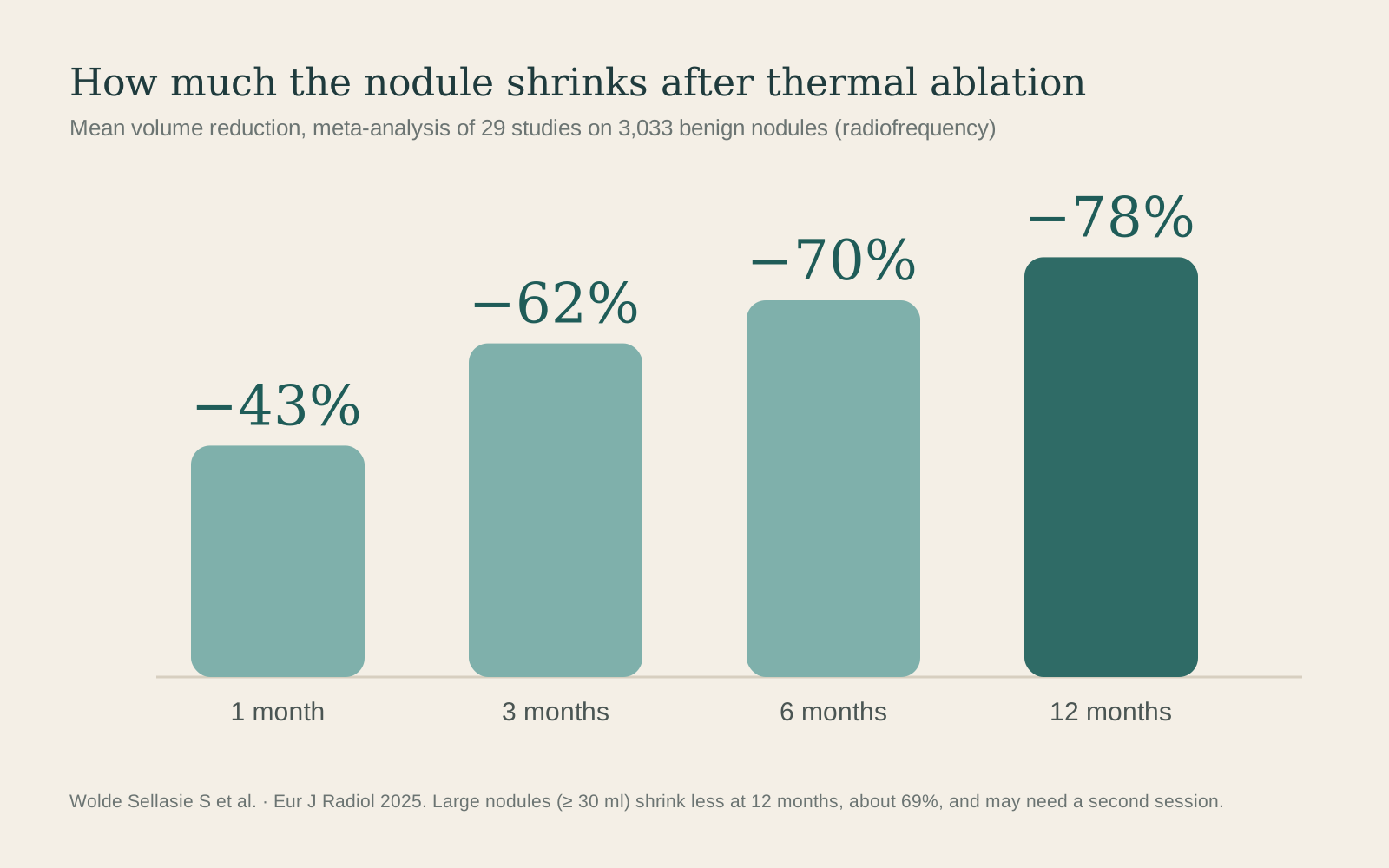
A 2025 meta-analysis, coordinated by Italian and Swiss groups, pooled 29 studies and 3,033 nodules treated with radiofrequency: the mean volume reduction is 43% at one month, 62% at three, 70% at six and 78% at twelve months. Small nodules, under 15 millilitres, respond best, with an 81% reduction at one year; large ones, over 30 millilitres, stop at around 69% and may need a second session: in a prospective study of nodules over 20 millilitres treated in two sessions, the reduction reached 83% at 18 months. In the prospective multicentre Korean study, 345 patients in five centres, success was 97.8% and the reduction continued over the years, from 80% at one year to over 90% in the patients followed longest.
Radiofrequency, laser, microwaves: which technique?
The European guidelines consider radiofrequency and laser the most thoroughly studied techniques, with similar clinical results, while microwaves and focused ultrasound are still being evaluated. A 2024 meta-analysis of nine head-to-head studies, 1,305 nodules treated with radiofrequency and 1,276 with microwaves, found a slightly greater reduction at one year with radiofrequency, 83% versus 77%, with the same rate of complications and the same improvement in symptoms. For cysts, that is nodules that are almost entirely fluid, thermal ablation is not the first choice: two randomised trials showed that ethanol ablation, the injection of alcohol after draining the cyst, reduces the volume as much as radiofrequency, by over 90%, at a much lower cost.
Does it hurt?
It is the most frequent question, and the honest answer is: not much. Local anaesthesia covers the skin and the thyroid capsule, and most of the session is painless. During heating you may feel warmth or pain in the neck, sometimes radiating to the jaw, the teeth or the ear, especially when the part of the nodule close to the capsule is being treated: at that point we pause and add anaesthetic. In the following days mild pain or a feeling of swelling in the neck are normal and settle with common painkillers; you can work the next day. In direct comparisons with open surgery, post-treatment pain scores were lower and the hospital stay shorter, and a 2026 study comparing 82 patients treated with ablation and 82 who had a lobectomy found, in the former, a better quality of life for voice, scar and concentration.
Safety
The largest series on complications comes from Korea: 1,459 patients treated in 13 centres. Complications occurred in 3.3% overall and major ones in 1.4%: mainly a voice change, in 15 patients, that is 1%, due to irritation of the laryngeal nerve, almost always resolving on its own; then three nodule ruptures, one brachial plexus injury and a single case of permanent hypothyroidism. Minor complications included haematomas, small skin burns and nausea. In the 2018 prospective multicentre study, major complications were 1%. An important point is that thyroid function, in non-hyperfunctioning nodules, remains normal: there is no need to take thyroid hormone after the treatment. The guidelines stress, however, that the procedure requires specific training and that possible problems must be discussed with the patient beforehand.
The weak point: regrowth
In the first two years the results are very consistent, but studies with longer follow-up show that some nodules can start growing again after 2-3 years, usually at the margins of the treated area, where viable tissue has remained. In a series followed for more than three years on average, regrowth affected about one nodule in four. It is not a return to the starting point: the nodule usually remains much smaller than before, and when it causes trouble again the treatment can be repeated, or surgery chosen, which remains possible. This is also why the guidelines recommend ultrasound checks over time and an ablation as complete as possible from the first session.
And hot nodules?
For nodules that produce excess hormones the picture is different. A meta-analysis of 411 hot nodules treated with thermal ablation reports TSH normalisation in 71% of patients and a 69% reduction in volume, with no cases of hypothyroidism. But in the comparison with radioiodine, the latter wins: a response in 94% of cases versus 59%. This is why the European guidelines indicate radioiodine as the first choice and reserve thermal ablation mainly for young patients with small hot nodules, who are more likely to return to normal function and prefer to avoid radiation.
Who it may suit
Thermal ablation is an option to consider when a benign nodule, confirmed by two fine-needle aspirations, causes a feeling of pressure, discomfort on swallowing or a real cosmetic concern, and you would rather avoid surgery and general anaesthesia, or cannot undergo them. It works best in small or medium-sized solid or mixed nodules; in very large nodules and in goitres with many nodules, surgery is usually more effective. It does not replace surgery when there is a suspicion of cancer. As with any thyroid treatment, the decision is made together with the endocrinologist, who will keep following the gland over time.
In summary
For a benign thyroid nodule that causes trouble, ultrasound-guided thermal ablation reduces the volume by 70-80% within a year and makes the symptoms disappear in the great majority of patients, with no scar, no general anaesthesia and with thyroid function preserved. Serious complications are rare, around 1%. The limits are clear: the nodule can regrow after a few years, large nodules respond less, cysts are better treated with ethanol and hot nodules with radioiodine. Within these boundaries, as the European guidelines and the 2022 international consensus state, it is a real alternative to surgery, to be discussed case by case.
Treatments discussed in this article
Scientific sources
- Papini E, Monpeyssen H, Frasoldati A, Hegedüs L. 2020 European Thyroid Association Clinical Practice Guideline for the Use of Image-Guided Ablation in Benign Thyroid Nodules. Eur Thyroid J. 2020;9(4):172-185.
- Orloff LA, Noel JE, Stack BC, et al. Radiofrequency ablation and related ultrasound-guided ablation technologies for treatment of benign and malignant thyroid disease: an international multidisciplinary consensus statement. Head Neck. 2022;44(3):633-660.
- Deandrea M, Sung JY, Limone P, et al. Efficacy and safety of radiofrequency ablation versus observation for nonfunctioning benign thyroid nodules: a randomized controlled international collaborative trial. Thyroid. 2015;25(8):890-896.
- Papini E, Rago T, Gambelunghe G, et al. Long-term efficacy of ultrasound-guided laser ablation for benign solid thyroid nodules. Results of a three-year multicenter prospective randomized trial. J Clin Endocrinol Metab. 2014;99(10):3653-3659.
- Wolde Sellasie S, Deandrea M, Amendola S, et al. Searching for optimized follow-up timing after radiofrequency ablation of benign thyroid nodules: systematic review and meta-analysis. Eur J Radiol. 2025;195:112529.
- Fung MHM, Luk Y, Lang BHH. A prospective comparison of sequential versus interval retreatment with radiofrequency ablation for predominantly solid, large-volume benign thyroid nodules. Surgery. 2025;189:109763.
- Jung SL, Baek JH, Lee JH, et al. Efficacy and safety of radiofrequency ablation for benign thyroid nodules: a prospective multicenter study. Korean J Radiol. 2018;19(1):167-174.
- Baek JH, Lee JH, Sung JY, et al. Complications encountered in the treatment of benign thyroid nodules with US-guided radiofrequency ablation: a multicenter study. Radiology. 2012;262(1):335-342.
- Lim H, Cho SJ, Baek JH. Comparative efficacy and safety of radiofrequency ablation and microwave ablation in benign thyroid nodule treatment: a systematic review and meta-analysis. Eur Radiol. 2025;35(2):612-623.
- Sung JY, Baek JH, Kim KS, et al. Single-session treatment of benign cystic thyroid nodules with ethanol versus radiofrequency ablation: a prospective randomized study. Radiology. 2013;269(1):293-300.
- Baek JH, Ha EJ, Choi YJ, et al. Radiofrequency versus ethanol ablation for treating predominantly cystic thyroid nodules: a randomized clinical trial. Korean J Radiol. 2015;16(6):1332-1340.
- Chen J, Gu X, Wang H, Bian J. Comparison of the efficacy and safety of thyroid microwave ablation and radiofrequency ablation versus open surgery for the treatment of benign thyroid nodules: a propensity score matching study. Ann Ital Chir. 2024;95(6):1108-1117.
- Li Y, Huo S, Wei Y, et al. Comparison of thyroid-specific quality of life after thermal ablation vs. thyroid lobectomy for benign thyroid nodules. BMC Endocr Disord. 2026;26(1).
- Sim JS, Baek JH. Long-term outcomes following thermal ablation of benign thyroid nodules as an alternative to surgery: the importance of controlling regrowth. Endocrinol Metab (Seoul). 2019;34(2):117-123.
- Sim JS, Baek JH, Lee J, Cho W, Jung SI. Radiofrequency ablation of benign thyroid nodules: depicting early sign of regrowth by calculating vital volume. Int J Hyperthermia. 2017;33(8):905-910.
- Kim HJ, Cho SJ, Baek JH, Suh CH. Efficacy and safety of thermal ablation for autonomously functioning thyroid nodules: a systematic review and meta-analysis. Eur Radiol. 2021;31(2):605-615.
- Giovanella L, Garo ML, Campenní A, Petranović Ovčariček P. Radioiodine versus radiofrequency ablation to treat autonomously functioning thyroid nodules: a systematic review and comparative meta-analysis. Eur J Nucl Med Mol Imaging. 2024;51(7):2050-2066.
Want to know if it applies to you?
At the first consultation we review your clinical history and previous imaging together.
More articles
The information on this page is for general education and does not replace a medical consultation. The indication for any treatment must always be assessed individually.