
16 October 2026
Hip osteoarthritis and embolization (TAME): one-year results of the Charité study
A new study from Charité in Berlin followed 41 people with hip osteoarthritis alone, treated with musculoskeletal embolization (TAME), for one year. Here is what it adds to what we knew, how the vessels to treat are chosen and why only temporary agents are used in the hip.
Why a study on osteoarthritis alone
Many of the studies published so far on hip embolization, including the HipE study I wrote about recently, enrolled patients with osteoarthritis together with patients with greater trochanteric pain syndrome. They are, however, two different problems: trochanteric pain syndrome is a disorder of the tendons around the hip, with partly different pain mechanisms. The Charité study from Berlin, published in 2026 in Cardiovascular and Interventional Radiology, instead included only people with hip osteoarthritis confirmed on examination and imaging, whose pain had not responded to conservative treatment for at least three months. Every case had been assessed by an orthopaedic surgeon and discussed in a multidisciplinary meeting. There were 41 patients with a median age of 65, half of them women, with mostly moderate or advanced osteoarthritis: Kellgren-Lawrence grade 3 in 68% and grade 4, the most severe, in 27%.
How the treatment site is chosen
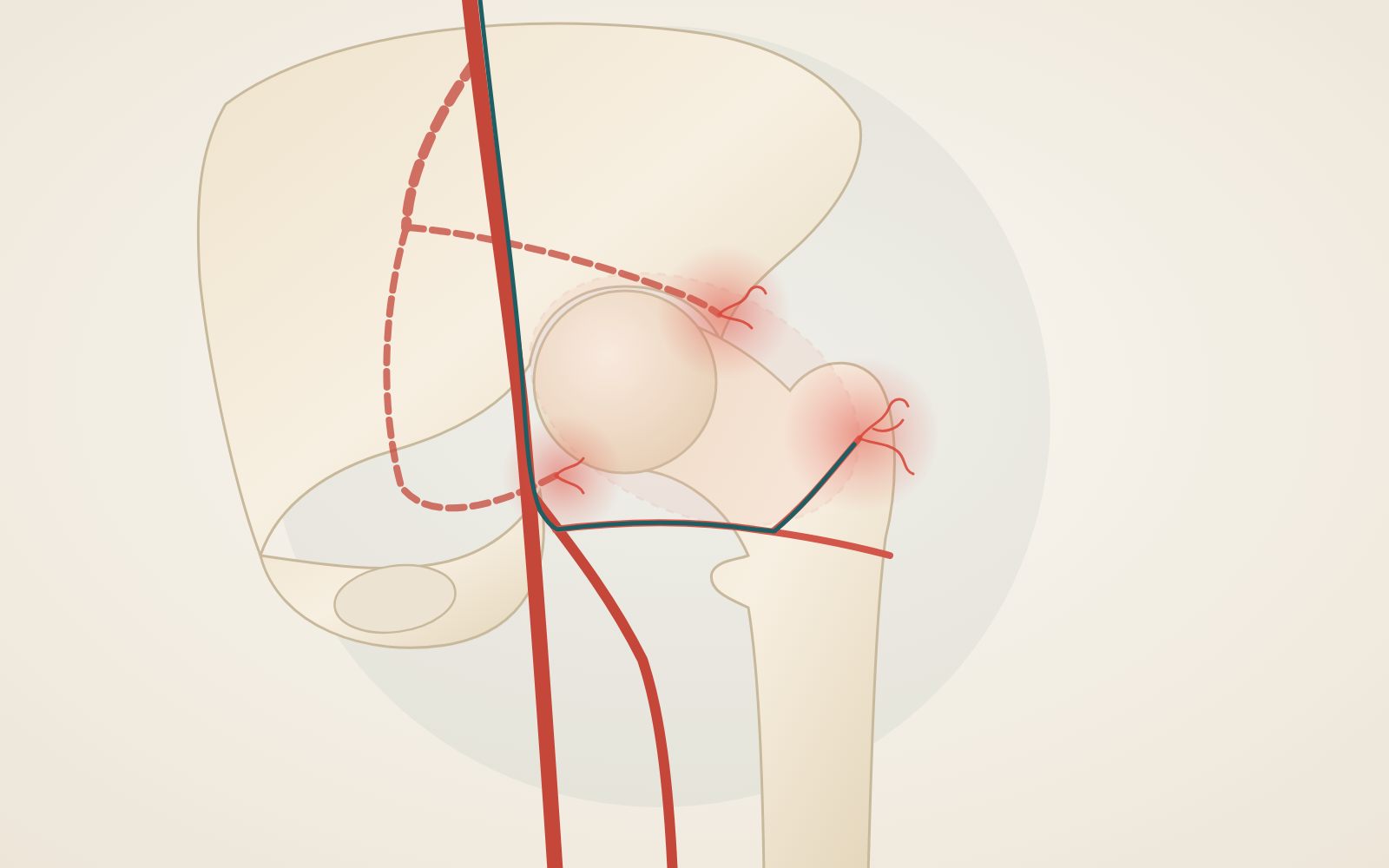
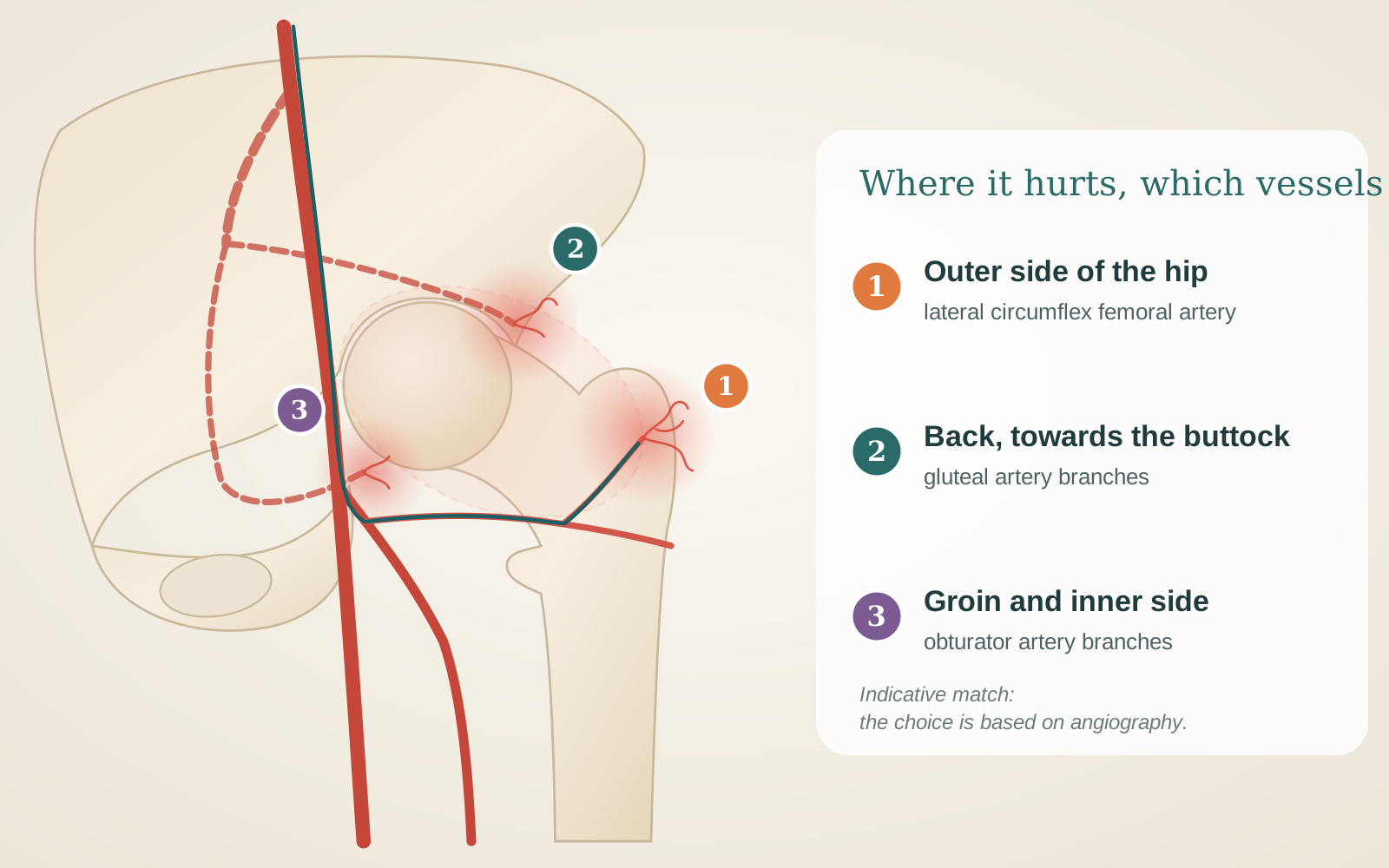
The procedure is performed awake, under local anaesthesia, through the femoral artery on the opposite side. A distinctive feature of this study is that the team explored not only the branches of the lateral circumflex femoral artery, the usual target, but also those of the internal iliac artery, namely the gluteal and obturator branches, which can also supply the inflamed synovium. A vessel is treated when angiography shows the typical blush of abnormal vessels or, if there is none, when contrast injection reproduces the patient's usual pain and the territory of the vessel matches the area that hurts. The authors indeed note that the site of pain can guide the search: pain on the outer side is more often linked to the lateral circumflex femoral artery, pain at the back to the gluteal branches, and pain in the groin or on the inner side to the obturator artery. In the study, the lateral circumflex femoral artery was treated in every case and, in just over one patient in four, gluteal or obturator branches as well. The procedure took about forty minutes on average and patients stayed in overnight for observation.
Why temporary agents are used in the hip
The femoral head receives blood almost exclusively from small arteries arising from the circumflex femoral arteries themselves: they are end vessels, with no real alternatives, and a permanent occlusion could in theory compromise its blood supply. This is why the study used only temporary agents: rapidly resorbable gelatin microspheres or imipenem/cilastatin. They close the abnormal vessels for the time needed and then dissolve, allowing normal flow to return. No clinically apparent cases of femoral head necrosis were observed in the 41 patients. The comparison between permanent and temporary agents is a topic we have also studied in the knee, in a meta-analysis of ours published in 2026.
The results at 12 months
Pain, measured on a 0 to 10 scale, fell from a median of 7 to 4 by six months and remained at 4 at one year. All HOOS questionnaire scores, which measure hip pain and function from 0 to 100, also improved clearly: the pain score went from 36 to 68, the activities of daily living score from 40 to 65 and the quality of life score from 25 to 38. Taking a reduction in pain of at least 2 points as clinically relevant, the benefit was meaningful in 64% of patients; across the different HOOS domains the proportion reached 85-92%.
Safety
There were no major or moderate complications. Three patients treated with imipenem/cilastatin (7%) developed skin discoloration that cleared on its own within 24 hours. No infections, skin damage or clinically apparent cases of osteonecrosis were recorded. This is consistent with the other studies on musculoskeletal embolization, which so far have not reported major complications.
Who responded less
Two patients (5%) needed a hip replacement, seven and nine months after embolization, because the benefit was not sufficient: both had grade 4 osteoarthritis, the most advanced form. The authors point out that in the knee, too, a small proportion of patients still end up with a replacement after embolization, and that the available data do not suggest the treatment makes the later operation more difficult. The practical message is that when the joint is badly worn, embolization can relieve pain but should be offered with cautious expectations: it does not replace a hip replacement.
The limitations
This is a retrospective, single-centre study of 41 patients without a control group: it therefore cannot separate the real effect of the treatment from a possible placebo effect. Data at 12 months are available for 28 of the 41 patients, and no systematic imaging follow-up was performed. This is an important limitation, because in knee osteoarthritis, where the technique has been studied most, our 2026 meta-analysis showed that the three randomised trials against a sham procedure did not demonstrate a significant benefit over placebo. The authors themselves conclude that larger, controlled studies are needed.
What it means for people with hip pain
This study strengthens the data on embolization for hip osteoarthritis: a benefit that holds at one year, with a good safety profile when temporary agents are used. It is an option to consider when pain persists despite exercise, medication and ultrasound-guided injections and a hip replacement is not yet indicated, not possible or the patient prefers to postpone it. First it is necessary to understand where the pain really comes from, with a consultation, an X-ray and possibly an MRI, because the cause sometimes lies in the tendons or the lumbar spine. The decision is made together with the orthopaedic surgeon.
Treatments discussed in this article
Scientific sources
- Fleckenstein FN, Maleitzke T, Oehme S, et al. Transarterial embolization for the treatment of symptomatic hip osteoarthritis. Cardiovasc Intervent Radiol. 2026;49(7):1352-1361.
- Cavalheiro F, Marinho Lopes P, Sousa F, Sousa P, Linhares D, Neves N. HipE study—hip embolization for pain control in hip osteoarthritis and greater trochanteric pain syndrome: 12 months follow-up. Cardiovasc Intervent Radiol. 2026;49(7):1295-1305.
- Correa MP, Motta-Leal-Filho JM, Junior EB, et al. 6-month follow-up of lateral femoral circumflex artery embolization to control pain related to hip osteoarthritis and greater trochanteric pain syndrome. Cardiovasc Intervent Radiol. 2022;45(11):1710-1715.
- Lanza E, Poretti D, Pedicini V, Kon E, Laghi A. Permanent vs. temporary embolic agents in genicular artery embolization for knee osteoarthritis: a systematic review and meta-analysis. Eur J Radiol. 2026;202:112968.
Want to know if it applies to you?
At the first consultation we review your clinical history and previous imaging together.
More articles
The information on this page is for general education and does not replace a medical consultation. The indication for any treatment must always be assessed individually.