
Thyroid
Thermal ablation of benign thyroid nodules
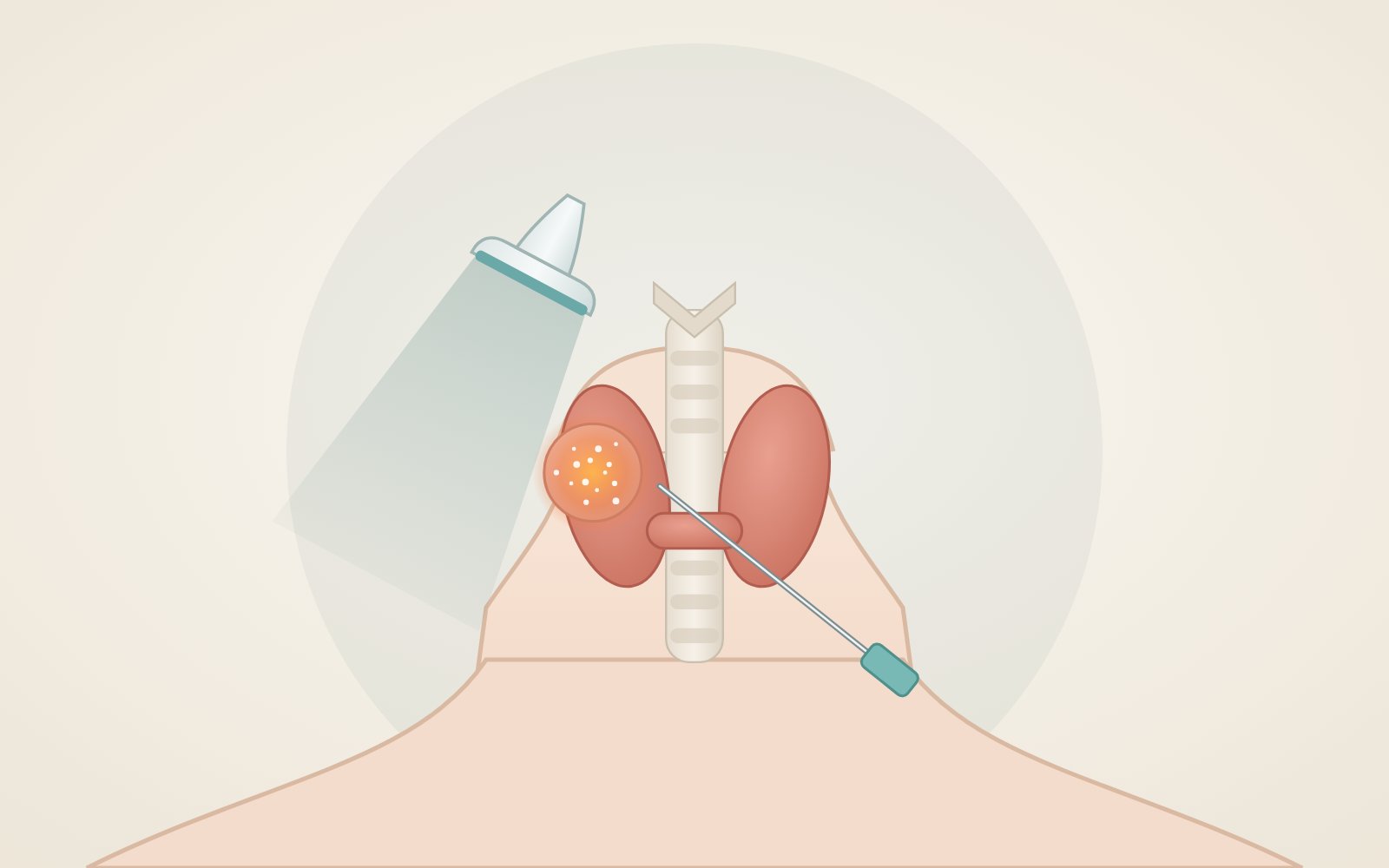
When a benign nodule presses on the neck, surgery is often proposed. But there is an alternative: under ultrasound guidance, with local anaesthesia, a thin needle heats the nodule from within and shrinks it, preserving the thyroid.
How it is performed
Thermal ablation treats the nodule without removing it. After local anaesthesia of the skin and of the thyroid capsule, a thin needle electrode is introduced under continuous ultrasound guidance and advanced into the nodule, usually through the isthmus of the gland, the route that keeps the needle away from the nerves and vessels of the neck. The energy, radiofrequency in the most studied technique, or laser or microwaves, heats the tissue to 60-100 °C and coagulates it; the needle is moved several times, treating small portions, until the whole nodule has been covered. The patient is awake and talks during the procedure, so the voice is checked at every moment. The treated tissue does not disappear immediately: it is reabsorbed over the following months and the nodule shrinks progressively, by about half within 1-3 months and by 70-80% within a year. The healthy thyroid around it keeps working normally.
Who it is for
- Solid or mixed benign nodule, confirmed by two fine-needle aspirations, causing a feeling of pressure, discomfort on swallowing or cosmetic concern
- Wish to avoid surgery and general anaesthesia, or contraindications to surgery
- Small hyperfunctioning ("hot") nodule in young patients, as an alternative to radioiodine
- Cystic nodule that recurs after ethanol ablation or has a significant solid component
Recovery
You go home after 1-2 hours of observation. Mild pain or a feeling of swelling in the neck is possible in the first days and is controlled with common anti-inflammatories; normal activities resume the next day. A lower or tired voice is rare and almost always resolves within a few weeks. The nodule shrinks over the following months: it is checked with ultrasound at 1-3 months and at 12 months, then once a year.
Conditions treated in this area: benign thyroid nodule with a feeling of pressure or discomfort in the neck, visible benign nodule, with cosmetic concern, hyperfunctioning ("hot") nodule in selected cases.
Before the procedure
Thermal ablation is performed only on benign nodules: the guidelines require two fine-needle aspirations with a benign result, a recent ultrasound and thyroid hormone tests; if the nodule is hyperfunctioning, a scintigraphy is also needed. The nodule must cause symptoms or a real cosmetic concern: a benign nodule that causes no trouble should not be treated. The decision is made together with the endocrinologist, who follows the thyroid over time.
Does it hurt?
Local anaesthesia covers the skin and the thyroid capsule. During heating you may feel warmth or pain in the neck, sometimes radiating to the jaw or ear: at that point we pause and add anaesthetic, and in the Italian laser trial the procedure was well tolerated in 92% of cases. In the following days mild pain or swelling in the neck is normal and settles with common painkillers. In direct comparisons with open surgery, post-treatment pain scores were lower and the hospital stay shorter.
When another route is better
If the cytology is suspicious or indeterminate, surgery remains the right choice, because a complete histological examination is needed. In very large multinodular goitres, with several large nodules, surgery is usually more effective. For pure cysts, ethanol ablation is the first-line treatment, simpler and cheaper, with equivalent results in randomised trials. For hot nodules radioiodine is the first option; thermal ablation is considered mainly in young patients with small nodules who prefer to avoid radiation.
Scientific evidence
In a randomised trial carried out in Turin and Seoul on 80 patients with compressive benign nodules of 10-20 ml, a single radiofrequency session reduced the volume from 15 to 4 ml in six months, with a clear improvement in symptoms and no side effects, while in untreated patients the nodule remained unchanged. In the Italian randomised trial on laser ablation, 200 patients in four centres, the reduction was 57% at three years and local symptoms fell from 38% to 8% of patients. A 2025 meta-analysis of 29 studies and 3,033 nodules estimates a mean reduction of 43% at one month, 62% at three, 70% at six and 78% at twelve months, smaller in larger nodules, which may need a second session. In a prospective multicentre Korean study of 345 patients, success was 97.8%, with major complications in 1%. In the largest series on complications, 1,459 patients in 13 centres, problems occurred in 3.3% and major ones in 1.4%: mainly a transient voice change (1%), with a single case of permanent hypothyroidism. The 2020 European guidelines and the 2022 international consensus recognise thermal ablation as an option for symptomatic benign nodules, with two caveats: the nodule can regrow after 2-3 years at the margins of the treated area, in which case the treatment can be repeated or surgery considered; and for hot nodules radioiodine remains the first choice, because it normalises function more often (94% versus 59%).
References on PubMed
- 2020 European Thyroid Association Clinical Practice Guideline for the Use of Image-Guided Ablation in Benign Thyroid Nodules
Papini E, Monpeyssen H, Frasoldati A, Hegedüs L — Eur Thyroid J, 2020 · PMID 32903999
- Radiofrequency ablation and related ultrasound-guided ablation technologies for treatment of benign and malignant thyroid disease: an international multidisciplinary consensus statement
Orloff LA, Noel JE, Stack BC, et al. — Head Neck, 2022 · PMID 34939714
- Efficacy and Safety of Radiofrequency Ablation Versus Observation for Nonfunctioning Benign Thyroid Nodules: A Randomized Controlled International Collaborative Trial
Deandrea M, Sung JY, Limone P, et al. — Thyroid, 2015 · PMID 26061686
- Long-term efficacy of ultrasound-guided laser ablation for benign solid thyroid nodules. Results of a three-year multicenter prospective randomized trial
Papini E, Rago T, Gambelunghe G, et al. — J Clin Endocrinol Metab, 2014 · PMID 25050903
- Searching for optimized follow-up timing after radiofrequency ablation of benign thyroid nodules: systematic review and meta-analysis
Wolde Sellasie S, Deandrea M, Amendola S, et al. — Eur J Radiol, 2025 · PMID 41289722
- Efficacy and Safety of Radiofrequency Ablation for Benign Thyroid Nodules: A Prospective Multicenter Study
Jung SL, Baek JH, Lee JH, et al. — Korean J Radiol, 2018 · PMID 29354014
- Complications encountered in the treatment of benign thyroid nodules with US-guided radiofrequency ablation: a multicenter study
Baek JH, Lee JH, Sung JY, et al. — Radiology, 2012 · PMID 21998044
- Comparative efficacy and safety of radiofrequency ablation and microwave ablation in benign thyroid nodule treatment: a systematic review and meta-analysis
Lim H, Cho SJ, Baek JH — Eur Radiol, 2024 · PMID 39046500
- Long-Term Outcomes Following Thermal Ablation of Benign Thyroid Nodules as an Alternative to Surgery: The Importance of Controlling Regrowth
Sim JS, Baek JH — Endocrinol Metab (Seoul), 2019 · PMID 31257739
- Radioiodine versus radiofrequency ablation to treat autonomously functioning thyroid nodules: a systematic review and comparative meta-analysis
Giovanella L, Garo ML, Campenní A, Petranović Ovčariček P — Eur J Nucl Med Mol Imaging, 2024 · PMID 38305893
- Single-session treatment of benign cystic thyroid nodules with ethanol versus radiofrequency ablation: a prospective randomized study
Sung JY, Baek JH, Kim KS, et al. — Radiology, 2013 · PMID 23616630
- Comparison of thyroid-specific quality of life after thermal ablation vs. thyroid lobectomy for benign thyroid nodules
Li Y, Huo S, Wei Y, et al. — BMC Endocr Disord, 2026 · PMID 42168933
Published data describe average results in groups of patients and are not a prediction of an individual outcome. The indication for treatment must always be assessed during a consultation.
Further reading on the blog
Risks, costs and opinions
The three questions patients ask most often before deciding, with clear answers.
What are the risks of thermal ablation of benign thyroid nodules?
It is an outpatient procedure performed with a thin needle under local anaesthesia and continuous ultrasound guidance, which makes it possible to see the needle, the target and the structures to avoid in real time. The most common issues are transient: pain or swelling for 24-48 hours, a small bruise. Joint infection is a rare event, prevented by sterile technique. In treatments with cortisone, facial flushing or a temporary rise in blood sugar may occur in diabetic patients. Personal risks and contraindications are assessed during the consultation.
How much does the thermal ablation of benign thyroid nodules cost?
The cost depends on the setting in which the procedure is performed: some treatments are available through the National Health Service or under agreement, others privately or through insurance. The quote is given clearly before scheduling the treatment, and includes the assessment, the procedure and the planned follow-up. During the consultation I tell you which pathway is available in your case: you do not have to decide before knowing the cost.
Does it really work? What patients and the literature say
The most frequent questions are "how long does the benefit last?" and "can I repeat it?". The answer depends on the diagnosis and the stage: some injections resolve the painful episode, others serve to open a window in which rehabilitation becomes effective. Experiences read in forums concern cases different from yours. During the consultation we review your imaging and I tell you frankly what to expect, how many sessions may be needed and when another approach is better.
Want to know if it is right for you?
At the first consultation we review your clinical history and previous imaging together.