
17 October 2026
Had an injection that didn't help? Maybe the drug never reached its target
Many patients come to clinic saying they have already had an injection and it didn't help. Sometimes the problem is not the drug, but where it ended up. Here is what the studies say about the accuracy of blind and ultrasound-guided injections, and when the difference really matters.
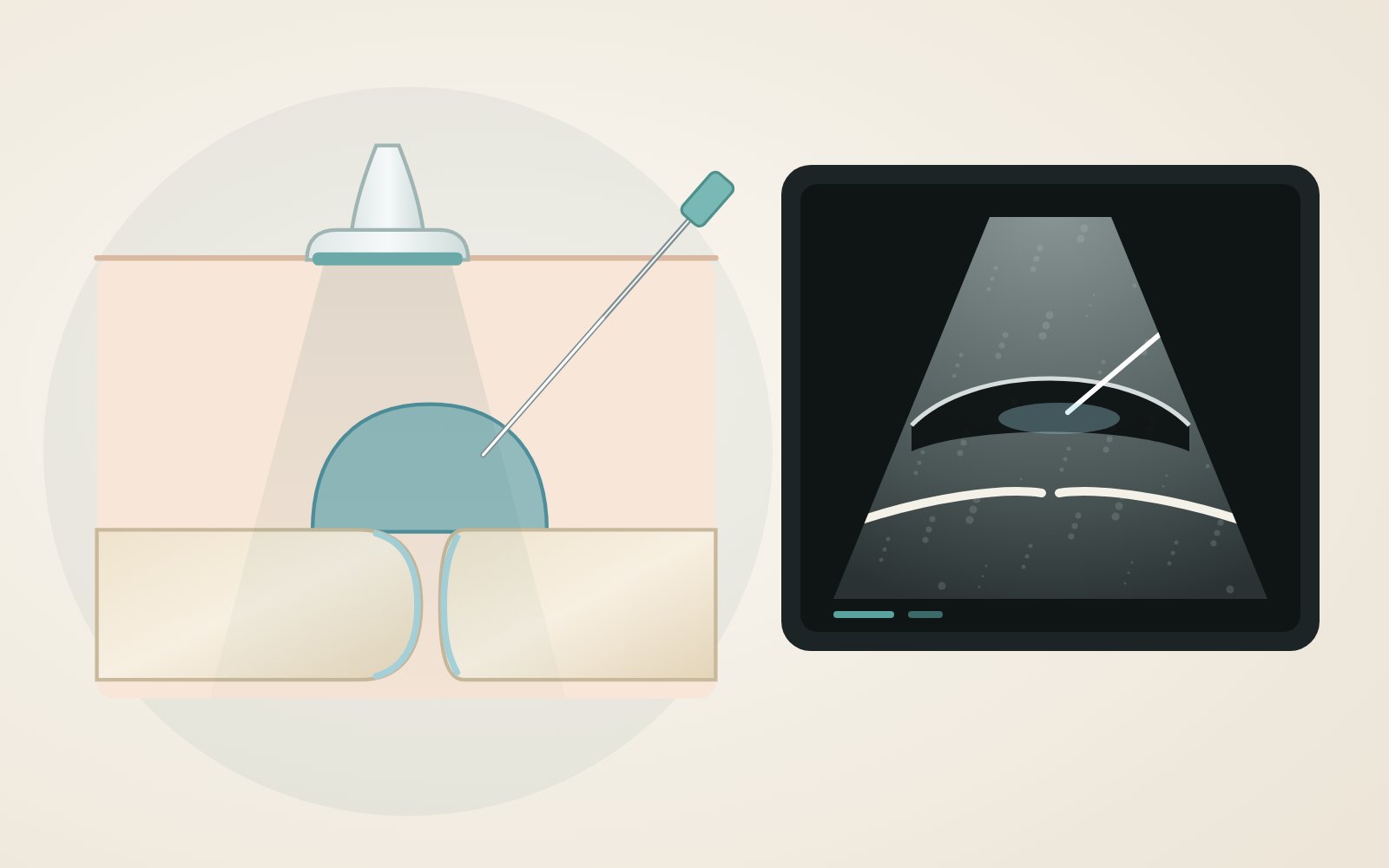
When an injection "doesn't work"
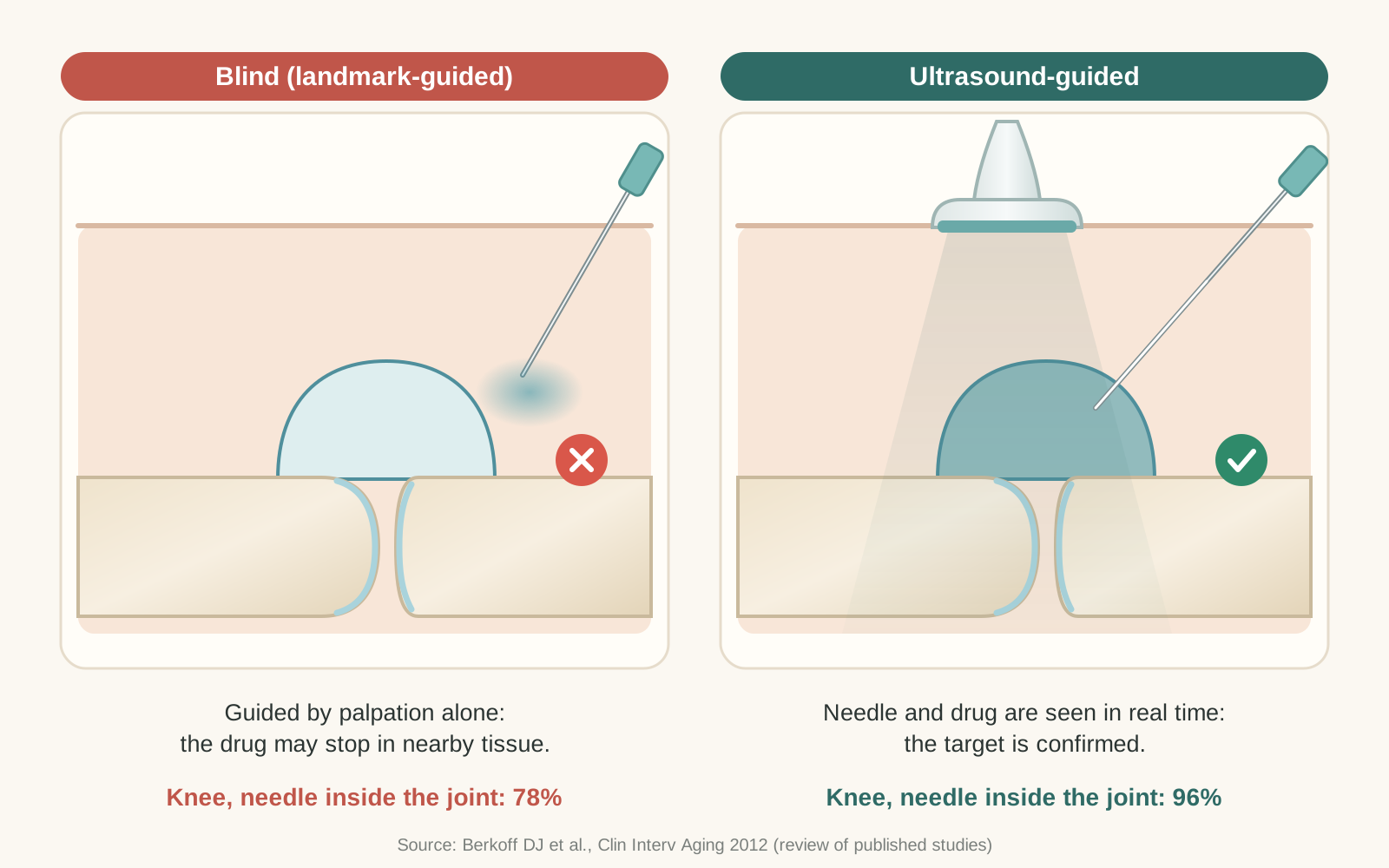
An injection may fail to give the hoped-for benefit for many reasons: the diagnosis was not the right one, the drug was not the most suitable, the disease was too advanced. There is, however, a cause that is rarely considered: the drug did not reach the place it was meant for. In the traditional technique, known as "blind" or landmark-guided, the doctor finds the entry point by feeling bones and tendons and inserts the needle without seeing what lies beneath the skin. If the drug ends up in fat, in a tendon or in the tissues around the joint, the person giving the injection usually does not notice. With ultrasound guidance, by contrast, the needle and the drug are seen on screen in real time as they go in.
How often the needle misses
The knee is the largest joint and the easiest to reach, yet even here the needle does not always get in. In a study published in the Journal of Bone and Joint Surgery, an experienced orthopaedic surgeon performed 240 injections in knees without effusion, checking each time with contrast where the drug went: depending on the approach, the needle was inside the joint on the first attempt in 71%, 75% or 93% of cases. A review of knee studies then compared the two techniques directly: the needle was inside the joint in 96% of ultrasound-guided injections and 78% of blind ones, meaning about one blind injection in five ended up outside. In the hip, which is deep and surrounded by muscle, the difference is even clearer: in a meta-analysis published in the British Journal of Sports Medicine, accuracy was 100% with ultrasound and 72% blind. In the shoulder the results vary with the target: 94% versus 68% for the acromioclavicular joint, 93% versus 73% for the glenohumeral joint and 87% versus 27% for the biceps tendon sheath; only for the subacromial bursa did the single available study find no difference in accuracy.
It is not just a matter of experience
One might think that an experienced doctor is enough. A randomised, double-blind trial published in Arthritis & Rheumatism tested exactly this idea in 184 patients with inflammatory arthritis: ultrasound-guided injections performed by a rheumatologist in training were more accurate than blind injections performed by more senior rheumatologists (83% versus 66%). In other words, one blind injection in three missed the target. There is an even more interesting finding: those using ultrasound could reliably tell whether the injection had gone in, while those working blind could not. Ultrasound guidance, then, not only helps hit the target but also lets you know you have hit it.
Does more accuracy also mean better results?
It is the right question, and the honest answer is: often yes, but not always. In a randomised study of knees with effusion, ultrasound guidance reduced pain during the procedure by 48%, allowed almost three times as much fluid to be drawn off (34 versus 12 millilitres) and at two weeks pain was lower (1.5 versus 2.8 out of 10). In the shoulder meta-analysis, ultrasound-guided injections of the subacromial bursa gave about one and a half points more pain reduction out of 10 at six weeks, as well as better function. In plantar fasciitis, too, a meta-analysis of five randomised trials found better results with ultrasound, but in few patients and still to be confirmed. Other studies, however, found no difference: in the inflammatory arthritis trial, results at six weeks were similar in the two groups, although injections that hit the target improved joint function more. And a Cochrane review on the shoulder, with five studies and 290 patients, did not show a clear advantage of ultrasound for cortisone: the authors suggest that part of the effect of cortisone also works through the bloodstream, and therefore depends less on the exact injection site.
When ultrasound guidance makes the most difference
The evidence suggests that accuracy matters most when the drug has to act exactly where it is placed. This is the case for hyaluronic acid, which only helps if it gets inside the joint, where it lubricates and cushions: if it stays in the fat around the knee it cannot do this job. It matters in deep joints such as the hip, and in small ones such as the base of the thumb or the facet joints of the spine, where the space is only a few millimetres wide and often distorted by osteoarthritis. It matters when there is an effusion to drain before injecting the drug, because ultrasound shows where the fluid collects. And it matters for safety: it helps avoid vessels and nerves and avoid injecting cortisone into a tendon, where it can weaken it, or into the fat pad of the heel, which can thin out. Then there are procedures that simply cannot be done blind, such as lavage of a shoulder calcification, where the needle has to enter the calcium deposit and stay there, or hydrodistension for frozen shoulder.
How an ultrasound-guided injection is performed
Before the injection, an ultrasound scan of the painful area is performed: it confirms the diagnosis, rules out other causes of pain and helps choose the safest path for the needle. The skin is disinfected, the probe is covered with a sterile sheath and, after a little local anaesthetic, the needle is followed on screen to the target. The drug can be seen spreading in the right place and, if needed, the needle position is corrected before injecting. The procedure usually takes 10-20 minutes, you go home straight away and resume normal activities with some care over the following days. The injection nonetheless remains one part of the treatment plan, which usually also includes exercise and physiotherapy.
In summary
Blind injections miss the target more often than you might think, even in the hands of experienced doctors: about one in five in the knee, more than one in four in the hip. Ultrasound guidance brings accuracy close to 100% and lets you know where the drug has gone. The clinical benefits are clearer for some targets, such as the knee, shoulder and plantar fascia, and when using drugs that must act locally, such as hyaluronic acid; for cortisone at some sites the evidence is less clear-cut. If a blind injection did not help, it is worth asking whether the drug really reached its target before concluding that the treatment does not work.
Treatments discussed in this article
Knee
Ultrasound-guided injections
Learn about the procedureHip
Ultrasound-guided hyaluronic acid injection in the hip
Learn about the procedureShoulder
Ultrasound-guided injection of the subacromial bursa
Learn about the procedureAnkle and foot
Ultrasound-guided injection for plantar fasciitis and heel pain
Learn about the procedureWrist and hand
Ultrasound-guided injection for rhizarthrosis
Learn about the procedureShoulder
Ultrasound-guided lavage of the calcification
Learn about the procedureScientific sources
- Jackson DW, Evans NA, Thomas BM. Accuracy of needle placement into the intra-articular space of the knee. J Bone Joint Surg Am. 2002;84(9):1522-1527.
- Berkoff DJ, Miller LE, Block JE. Clinical utility of ultrasound guidance for intra-articular knee injections: a review. Clin Interv Aging. 2012;7:89-95.
- Hoeber S, Aly AR, Ashworth N, Rajasekaran S. Ultrasound-guided hip joint injections are more accurate than landmark-guided injections: a systematic review and meta-analysis. Br J Sports Med. 2016;50(7):392-396.
- Aly AR, Rajasekaran S, Ashworth N. Ultrasound-guided shoulder girdle injections are more accurate and more effective than landmark-guided injections: a systematic review and meta-analysis. Br J Sports Med. 2015;49(16):1042-1049.
- Cunnington J, Marshall N, Hide G, et al. A randomized, double-blind, controlled study of ultrasound-guided corticosteroid injection into the joint of patients with inflammatory arthritis. Arthritis Rheum. 2010;62(7):1862-1869.
- Sibbitt WL, Kettwich LG, Band PA, et al. Does ultrasound guidance improve the outcomes of arthrocentesis and corticosteroid injection of the knee? Scand J Rheumatol. 2012;41(1):66-72.
- Li Z, Xia C, Yu A, Qi B. Ultrasound- versus palpation-guided injection of corticosteroid for plantar fasciitis: a meta-analysis. PLoS One. 2014;9(3):e92671.
- Bloom JE, Rischin A, Johnston RV, Buchbinder R. Image-guided versus blind glucocorticoid injection for shoulder pain. Cochrane Database Syst Rev. 2012;(8):CD009147.
- Daniels EW, Cole D, Jacobs B, Phillips SF. Existing evidence on ultrasound-guided injections in sports medicine. Orthop J Sports Med. 2018;6(2):2325967118756576.
Want to know if it applies to you?
At the first consultation we review your clinical history and previous imaging together.
More articles
The information on this page is for general education and does not replace a medical consultation. The indication for any treatment must always be assessed individually.