
12 November 2026
Morton's neuroma: when an ultrasound-guided injection makes sense and what to expect
Morton's neuroma causes burning pain between the toes that gets worse in shoes. An ultrasound-guided injection is often the first treatment after footwear and insoles: what studies show, how long the effect lasts and when to consider other options.
Article written by Prof. Ezio Lanza, Head of Interventional Radiology, Ospedale San Giuseppe - MultiMedica, Milan.
A pebble that isn't there
People with Morton's neuroma almost always describe it the same way: burning or an electric shock under the sole, at the level of the toes, radiating between the third and fourth toes, as if there were a pebble or a fold of sock in the shoe. The pain gets worse in tight shoes and heels and improves when the shoe is removed and the foot is massaged. It most often affects women between 40 and 60.
What it is
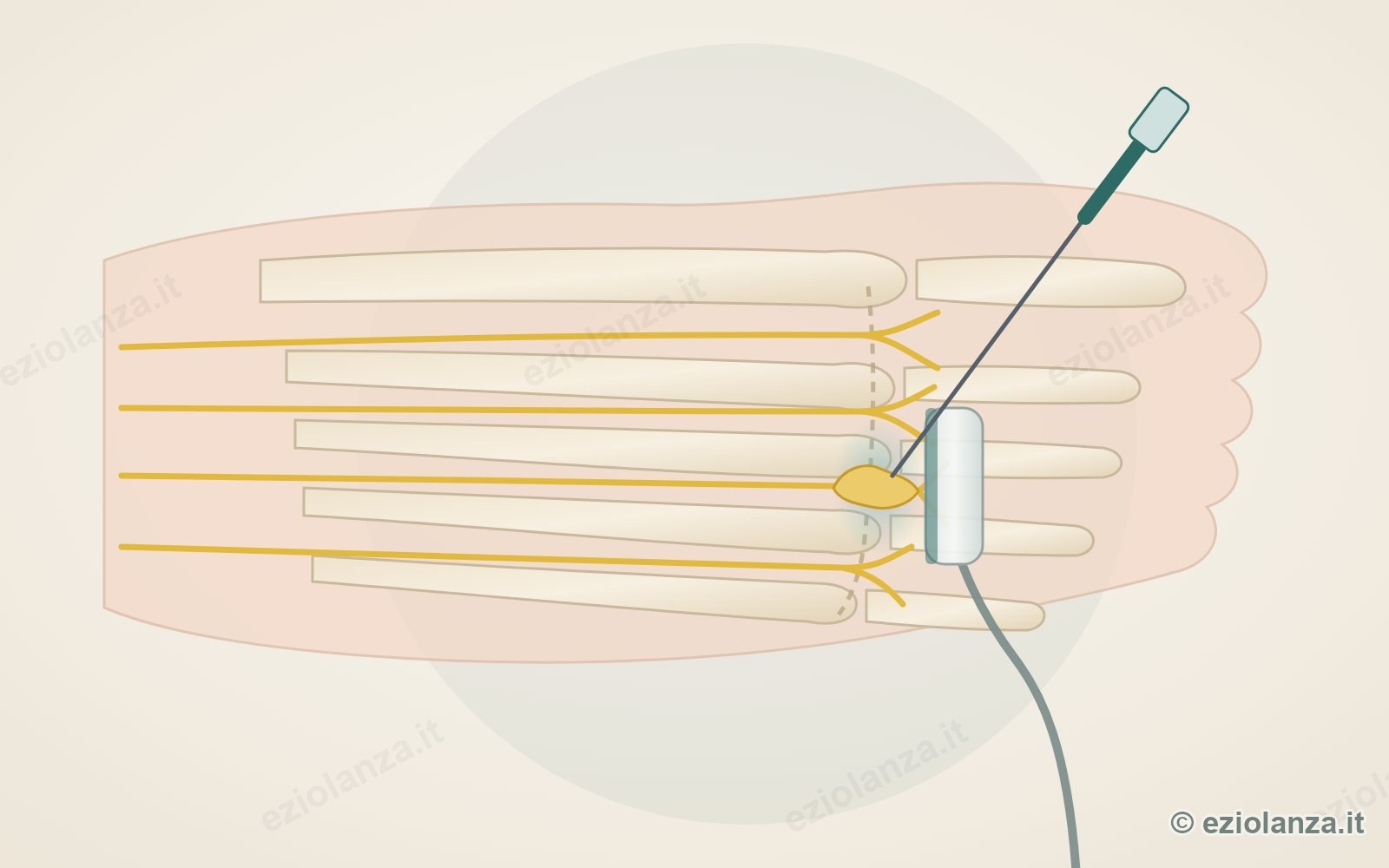
Despite its name, Morton's neuroma is not a tumour. It is a fibrous thickening of the nerve that runs between two metatarsal heads to supply sensation to the toes. At that point the nerve passes under a ligament, the deep transverse metatarsal ligament, and is compressed with every step; over time it thickens and becomes painful. The space most often affected is between the third and fourth toes, followed by the space between the second and third.
Diagnosis
The examination, with side-to-side squeezing of the forefoot that reproduces the pain, already says a lot. Ultrasound confirms the neuroma, measures it and above all rules out other causes of forefoot pain that can look similar: overload of the metatarsal heads, bursitis between the metatarsals, synovitis of the joint at the base of the toe or a stress fracture. MRI is used in doubtful cases. This step matters, because these conditions are treated differently.
Shoes come first
The first treatment is mechanical: shoes with a wide toe box and low heel, and an insole with a small pad just behind the metatarsal heads, which spreads them and takes pressure off the nerve. Many patients improve with this alone. An injection comes into play when pain continues despite these measures.
What studies show on injections
The largest randomised trial was carried out in Edinburgh on 131 patients, all treated under ultrasound guidance: those who received corticosteroid with anaesthetic had a greater improvement in pain and foot health than those who received anaesthetic alone, at one and three months. A smaller Spanish trial, on 41 patients treated with three injections without ultrasound, found no difference compared with anaesthetic alone. Systematic reviews conclude that corticosteroid injection gives a short- to medium-term benefit with very few side effects, but on evidence of still limited quality. As for duration, an English study followed patients for almost five years: a single injection was still effective in about one patient in three, and those who were well at one year tended to keep the result.
Why ultrasound guidance
The neuroma is small and deep, between two bones, and injecting freehand often means placing the drug in the wrong spot. In a randomised trial from Granada the same treatment was performed freehand by an experienced orthopaedic surgeon or under ultrasound guidance by a radiologist: with ultrasound, pain improved more from the first months and the advantage lasted up to three years, with satisfaction of 87% versus 59%. Ultrasound guidance also reduces minor skin side effects, such as lightening at the injection site.
Who responds less, and what to do if it is not enough
Larger neuromas respond less well: in a Korean study of 201 patients, above 6.3 millimetres the risk that the injection would not be enough was much higher. If the benefit is short-lived the injection can be repeated, without multiplying corticosteroid doses, which can thin the fat pad under the foot. For neuromas that do not respond there are percutaneous treatments such as radiofrequency and cryoablation, and finally surgical removal of the nerve, which remains the definitive solution but leaves a numb area between the toes.
Treatments discussed in this article
Scientific sources
- Thomson CE, Beggs I, Martin DJ, et al. Methylprednisolone injections for the treatment of Morton neuroma: a patient-blinded randomized trial. J Bone Joint Surg Am. 2013;95(9):790-798.
- Lizano-Díez X, Ginés-Cespedosa A, Alentorn-Geli E, et al. Corticosteroid injection for the treatment of Morton's neuroma: a prospective, double-blinded, randomized, placebo-controlled trial. Foot Ankle Int. 2017;38(9):944-951.
- Edwards SR, Fleming S, Landorf KB. Efficacy of a single corticosteroid injection for Morton's neuroma in adults: a systematic review. J Am Podiatr Med Assoc. 2021;111(4).
- Hau MYT, Thomson L, Aujla R, Mahadevan D, Bhatia M. Medium-term results of corticosteroid injections for Morton's neuroma. Foot Ankle Int. 2021;42(4):464-468.
- Santiago FR, Muñoz PT, Ramos-Bossini AJL, Martínez AM, Olleta NP. Long-term comparison between blind and ultrasound-guided corticoid injections in Morton neuroma. Eur Radiol. 2022;32(12):8414-8422.
- Park YH, Lee JW, Choi GW, Kim HJ. Risk factors and the associated cutoff values for failure of corticosteroid injection in treatment of Morton's neuroma. Int Orthop. 2018;42(2):323-329.

Who performs these treatments
Prof. Ezio Lanza, EBIR-certified diagnostic and interventional radiologist, Head of Interventional Radiology at Ospedale San Giuseppe - MultiMedica in Milan and Coordinator of Interventional Radiology for the MultiMedica Group. Over 12 years at IRCCS Humanitas Research Hospital, author of international studies on embolization and ultrasound-guided procedures. Consultations and procedures take place at Ospedale San Giuseppe.
Ospedale San Giuseppe - MultiMedica, Via San Vittore 12, 20123 Milano
Bookings: 02 99961999
Want to know if it applies to you?
At the first consultation we review your clinical history and previous imaging together.
More articles
The information on this page is for general education and does not replace a medical consultation. The indication for any treatment must always be assessed individually.