
12 November 2026
Back pain that persists after spine surgery: what we know about embolization
A case of back pain that improved after two embolizations sparked debate among radiologists and neurosurgeons. What the data actually show on embolization for chronic low back pain, and who might reasonably discuss it.
Article written by Prof. Ezio Lanza, Head of Interventional Radiology, Ospedale San Giuseppe - MultiMedica, Milan.
A case that sparked debate
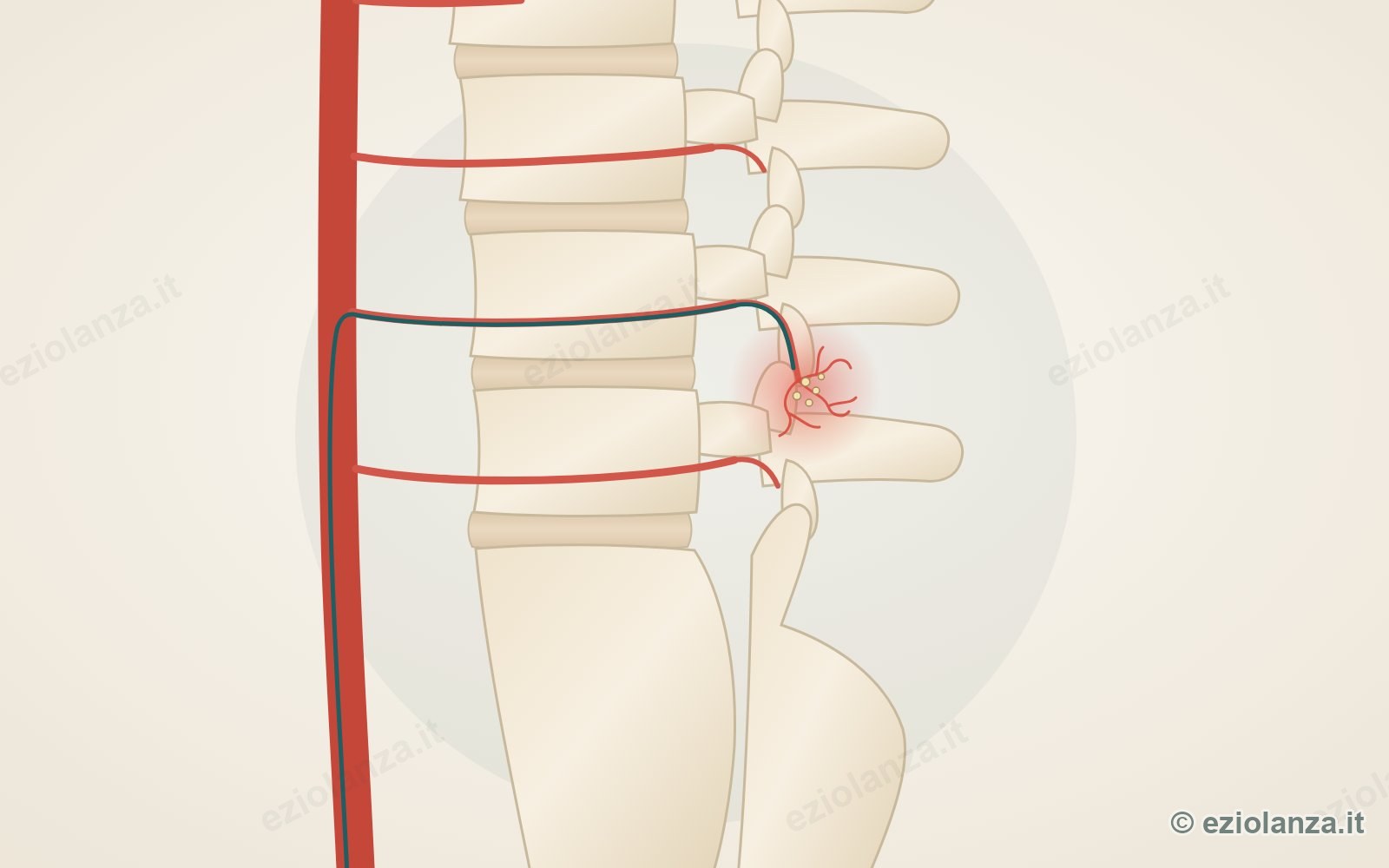
Yuji Okuno, the Japanese radiologist who developed embolization for musculoskeletal pain, recently described the case of a patient with back pain that had lasted for years after endoscopic lumbar spine surgery. The pain was worst in the morning and when sitting for long periods; after two embolizations it fell from 10 to 3 out of 10 and the patient returned to normal activities. Under the post, many radiologists and neurosurgeons asked for details: which arteries were treated, where exactly the abnormal vessels were, how patients are selected. These are the right questions, and in this article I try to answer them with what has been published so far.
Why pain can persist after surgery
Surgery for a herniated disc or spinal stenosis frees a compressed nerve and relieves leg pain well. Pain in the lower back, however, can have other sources that surgery does not address: the facet joints, small joints at the back of the spine that become arthritic and inflamed over the years; the sacroiliac joint; the paraspinal muscles and fasciae. Sometimes a slight forward slip of one vertebra over another, spondylolisthesis, overloads the facet joints. In these cases the spine can look fine on imaging while the pain continues.
How embolization works
The principle is the same as genicular artery embolization for knee osteoarthritis. Around a joint that has been inflamed for a long time, small abnormal vessels grow, together with nerve fibres that sustain and amplify the pain. A microcatheter inserted through an artery in the groin or wrist reaches the arteries supplying the painful area (in the back, the lumbar, iliolumbar, lateral sacral and gluteal arteries), and an agent is injected that closes these vessels temporarily, usually imipenem/cilastatin. The procedure is done under local anaesthesia as a day case. In the literature it is called TAME, transcatheter arterial micro-embolization.
What the published study shows
The reference study was published in 2021 in Cardiovascular and Interventional Radiology by Okuno's group. Fourteen patients were treated, with low back pain from the facet or sacroiliac joints lasting at least six months and resistant to at least three months of conservative treatment. Maximum pain fell on average from 7.6 to 4.3 out of 10 at one month, 3.4 at three months and 4.1 at two years. The Oswestry Disability Index, which measures how much back pain limits daily life, went from 41 to 24 at two years. Counting as success a drop of at least 2 points in pain and 10 points in disability, the procedure worked in 11 of 14 patients (79%) at three months and in 8 of 14 (57%) at two years. There were no major complications, and over time opioid use and the need for physiotherapy also decreased.
The limitations
These are 14 patients, treated at a single centre, the one that developed the technique, and analysed retrospectively without a comparison group. The editorial that accompanied the study in the journal called it promising but urged caution before extending it to routine practice. There are no randomised trials, and the study was not dedicated to patients who had already had spine surgery. In knee osteoarthritis, where embolization has been studied far more, our 2026 meta-analysis showed that randomised trials against a simulated procedure did not demonstrate a significant benefit over placebo. For the back we are one step earlier: an interesting hypothesis with early data, not yet an established treatment. A single case, however successful, does not change this picture.
Diagnosis comes first
In chronic back pain the most important question is where the pain comes from. This needs a careful examination, a recent MRI and often a diagnostic injection: if anaesthetic injected under ultrasound guidance into the facet or sacroiliac joints switches off the pain, we know that is the source. Many patients do well with injections and rehabilitation and need nothing more. Embolization comes into the discussion when the source of the pain is clear, injections work but only briefly, and further surgery is not indicated. Pain running down the leg to the foot, muscle weakness or spinal instability should instead be assessed by a spine surgeon.
Treatments discussed in this article
Scientific sources
- Fujiwara K, Inui S, Shibuya M, Sugihara E, Miyazaki K, Sakugawa T, Okuno Y. Transcatheter arterial embolization using imipenem/cilastatin sodium for chronic low back pain resistant to conservative treatment: a pilot study with 2-year follow-up. Cardiovasc Intervent Radiol. 2021;44(12):1964-1970.
- Padia SA. A potential transformation in the care of people with chronic low back pain. Cardiovasc Intervent Radiol. 2021;44(12):1971-1972.
- Lanza E, Poretti D, Pedicini V, Kon E, Laghi A. Permanent vs. temporary embolic agents in genicular artery embolization for knee osteoarthritis: a systematic review and meta-analysis. Eur J Radiol. 2026;202:112968.

Who performs these treatments
Prof. Ezio Lanza, EBIR-certified diagnostic and interventional radiologist, Head of Interventional Radiology at Ospedale San Giuseppe - MultiMedica in Milan and Coordinator of Interventional Radiology for the MultiMedica Group. Over 12 years at IRCCS Humanitas Research Hospital, author of international studies on embolization and ultrasound-guided procedures. Consultations and procedures take place at Ospedale San Giuseppe.
Ospedale San Giuseppe - MultiMedica, Via San Vittore 12, 20123 Milano
Bookings: 02 99961999
Want to know if it applies to you?
At the first consultation we review your clinical history and previous imaging together.
More articles
The information on this page is for general education and does not replace a medical consultation. The indication for any treatment must always be assessed individually.