
Ankle and foot
Ultrasound-guided injection for Morton's neuroma
The thickened nerve between the metatarsal heads, causing burning and electric pain towards the toes, is reached under ultrasound guidance with local anaesthetic and corticosteroid.
Procedure performed by Prof. Ezio Lanza, Head of Interventional Radiology, Ospedale San Giuseppe - MultiMedica, Milan.
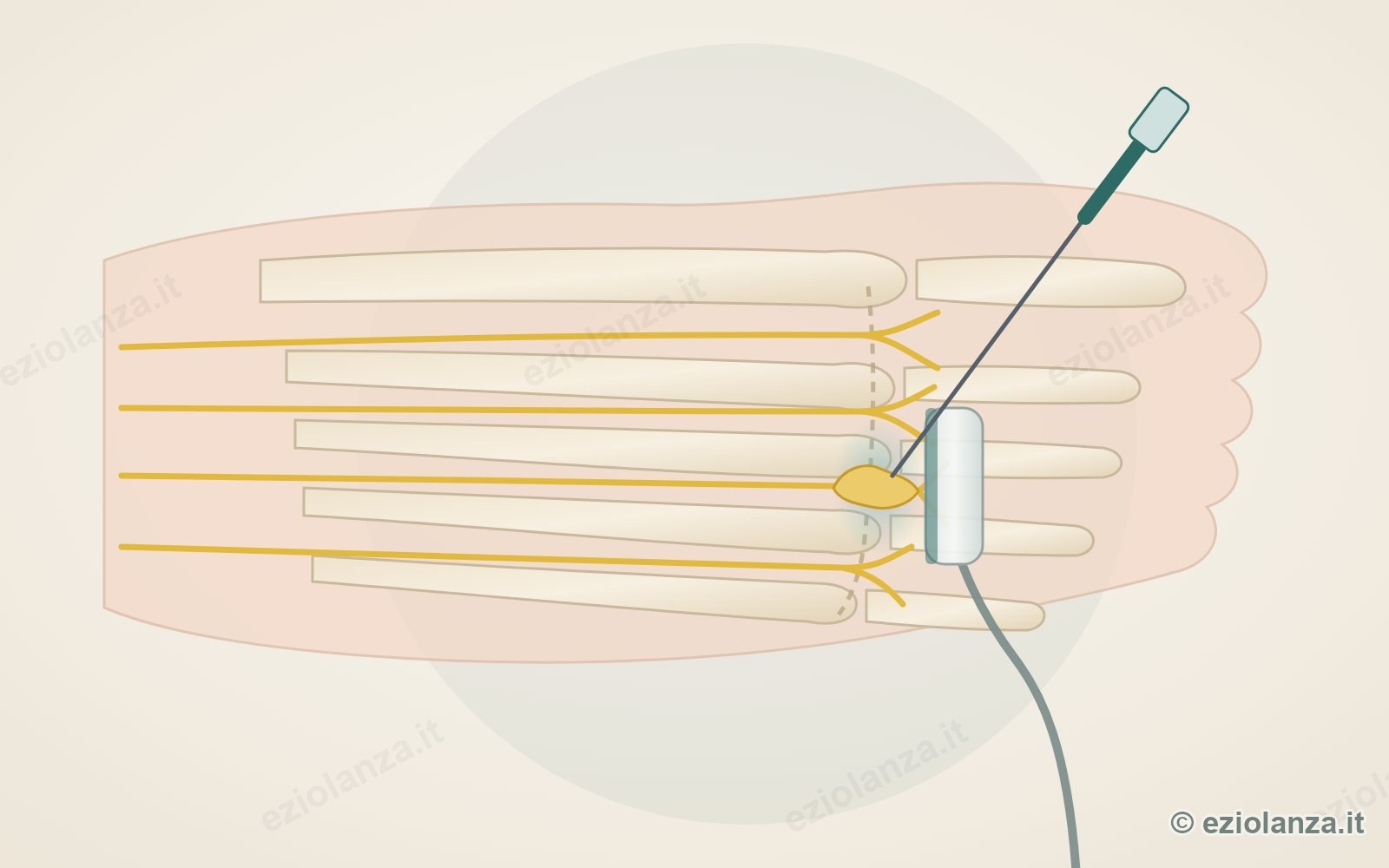
How it is performed
Morton's neuroma is not a tumour: it is a fibrous thickening of the nerve that runs between two metatarsal heads to reach the toes, almost always between the third and fourth toes, less often between the second and third. It causes burning or electric-shock pain under the forefoot radiating into the toes, often with the feeling of a pebble or a fold of sock under the foot; it gets worse in tight shoes and heels and improves when the shoe is removed and the foot is massaged. Ultrasound confirms the diagnosis, measures the neuroma and distinguishes it from bursitis between the metatarsals or a problem in the neighbouring joint. With the needle inserted from the top of the foot and followed in real time on the screen, local anaesthetic and corticosteroid are placed around the neuroma, avoiding tendons and vessels.
Who it is for
- Burning or electric pain between the third and fourth toes (or second and third) that gets worse in shoes
- Neuroma confirmed on ultrasound or MRI
- Symptoms persisting despite wide shoes and an insole with support behind the metatarsal heads
- Wish to postpone or avoid surgical removal of the nerve
Recovery
You walk straight away. For a few hours the neighbouring toes may stay numb from the anaesthetic. For the first two or three days wear comfortable, wide shoes and avoid running and jumping. The corticosteroid usually takes effect within one or two weeks; if the benefit is only partial, a second injection can be considered after a few weeks.
Conditions treated in this area: ankle (tibiotalar) osteoarthritis, sinus tarsi / subtalar joint osteoarthritis, plantar fasciitis and heel pain, achilles tendinopathy and tendon sheath disorders (posterior tibial, peroneal), morton's neuroma (burning and electric pain between the toes).
Before the injection
The first step is footwear: a wide toe box, low heel and an insole with a small pad behind the metatarsal heads, which widens the space the nerve runs through. Many patients improve with this alone. At the consultation the foot is examined and an ultrasound is performed to confirm that the pain comes from the neuroma and not from other common causes of forefoot pain, such as overload of the metatarsal heads, bursitis between the metatarsals, synovitis of the neighbouring joint or a stress fracture, which are treated differently.
What if it is not enough?
If the injection gives only short-lived relief it can be repeated, without multiplying corticosteroid injections, which can thin the fat pad under the foot. For neuromas that do not respond there are percutaneous treatments such as radiofrequency and cryoablation, which act on the nerve through a needle, and surgical removal of the neuroma, which remains the definitive solution but leaves a numb area between the toes.
Scientific evidence
In the largest randomised trial, carried out in Edinburgh on 131 patients injected under ultrasound guidance, corticosteroid with anaesthetic improved pain and foot health more than anaesthetic alone at one and three months. A smaller Spanish trial, with three injections without ultrasound guidance, found no difference compared with anaesthetic alone: the evidence is therefore favourable but not unanimous. Ultrasound guidance matters: in a randomised trial from Granada, at three years the improvement was greater and satisfaction was 87% versus 59% for freehand injections. Almost five years on, a single injection is still effective in about one patient in three, and those who are well at one year are likely to keep the result. Neuromas larger than about 6 mm respond less well.
References on PubMed
- Methylprednisolone injections for the treatment of Morton neuroma: a patient-blinded randomized trial.
Thomson CE, Beggs I, et al. — J Bone Joint Surg Am, 2013 · PMID 23636185
- Long-term comparison between blind and ultrasound-guided corticoid injections in Morton neuroma.
Santiago FR, Muñoz PT, et al. — Eur Radiol, 2022 · PMID 35726101
- Corticosteroid Injection for the Treatment of Morton's Neuroma: A Prospective, Double-Blinded, Randomized, Placebo-Controlled Trial.
Lizano-Díez X, Ginés-Cespedosa A, et al. — Foot Ankle Int, 2017 · PMID 28617064
- Medium-Term Results of Corticosteroid Injections for Morton's Neuroma.
Hau MYT, Thomson L, et al. — Foot Ankle Int, 2021 · PMID 33106028
- Risk factors and the associated cutoff values for failure of corticosteroid injection in treatment of Morton's neuroma.
Park YH, Lee JW, et al. — Int Orthop, 2018 · PMID 29230531
Published data describe average results in groups of patients and are not a prediction of an individual outcome. The indication for treatment must always be assessed during a consultation.
Further reading on the blog
Risks, costs and opinions
The three questions patients ask most often before deciding, with clear answers.
What are the risks of ultrasound-guided injection for Morton's neuroma?
It is an outpatient procedure performed with a thin needle under local anaesthesia and continuous ultrasound guidance, which makes it possible to see the needle, the target and the structures to avoid in real time. The most common issues are transient: pain or swelling for 24-48 hours, a small bruise. Joint infection is a rare event, prevented by sterile technique. In treatments with cortisone, facial flushing or a temporary rise in blood sugar may occur in diabetic patients. Personal risks and contraindications are assessed during the consultation.
How much does the ultrasound-guided injection for Morton's neuroma cost?
The consultation is private, also with health insurance or health funds. The cost of the procedure depends on the setting in which it is performed: some treatments are available through the National Health Service or under agreement, others privately or through insurance. The quote is given clearly before scheduling the treatment, and includes the assessment, the procedure and the planned follow-up. During the consultation I tell you which pathway is available in your case: you do not have to decide before knowing the cost.
Does it really work? What patients and the literature say
The most frequent questions are "how long does the benefit last?" and "can I repeat it?". The answer depends on the diagnosis and the stage: some injections resolve the painful episode, others serve to open a window in which rehabilitation becomes effective. Experiences read in forums concern cases different from yours. During the consultation we review your imaging and I tell you what to expect, how many sessions may be needed and when another approach is better.

Who performs these treatments
Prof. Ezio Lanza, EBIR-certified diagnostic and interventional radiologist, Head of Interventional Radiology at Ospedale San Giuseppe - MultiMedica in Milan and Coordinator of Interventional Radiology for the MultiMedica Group. Over 12 years at IRCCS Humanitas Research Hospital, author of international studies on embolization and ultrasound-guided procedures. Consultations and procedures take place at Ospedale San Giuseppe.
Ospedale San Giuseppe - MultiMedica, Via San Vittore 12, 20123 Milano
Bookings: 02 99961999
Want to know if it is right for you?
At the first consultation we review your clinical history and previous imaging together.