
25 October 2026
Knee embolization that did not work: does it make sense to repeat it?
When a first knee embolization does not reduce the pain, the small inflamed vessels have often reopened. A 2026 German study shows that a second procedure can recover more than half of these patients.
A question I am often asked
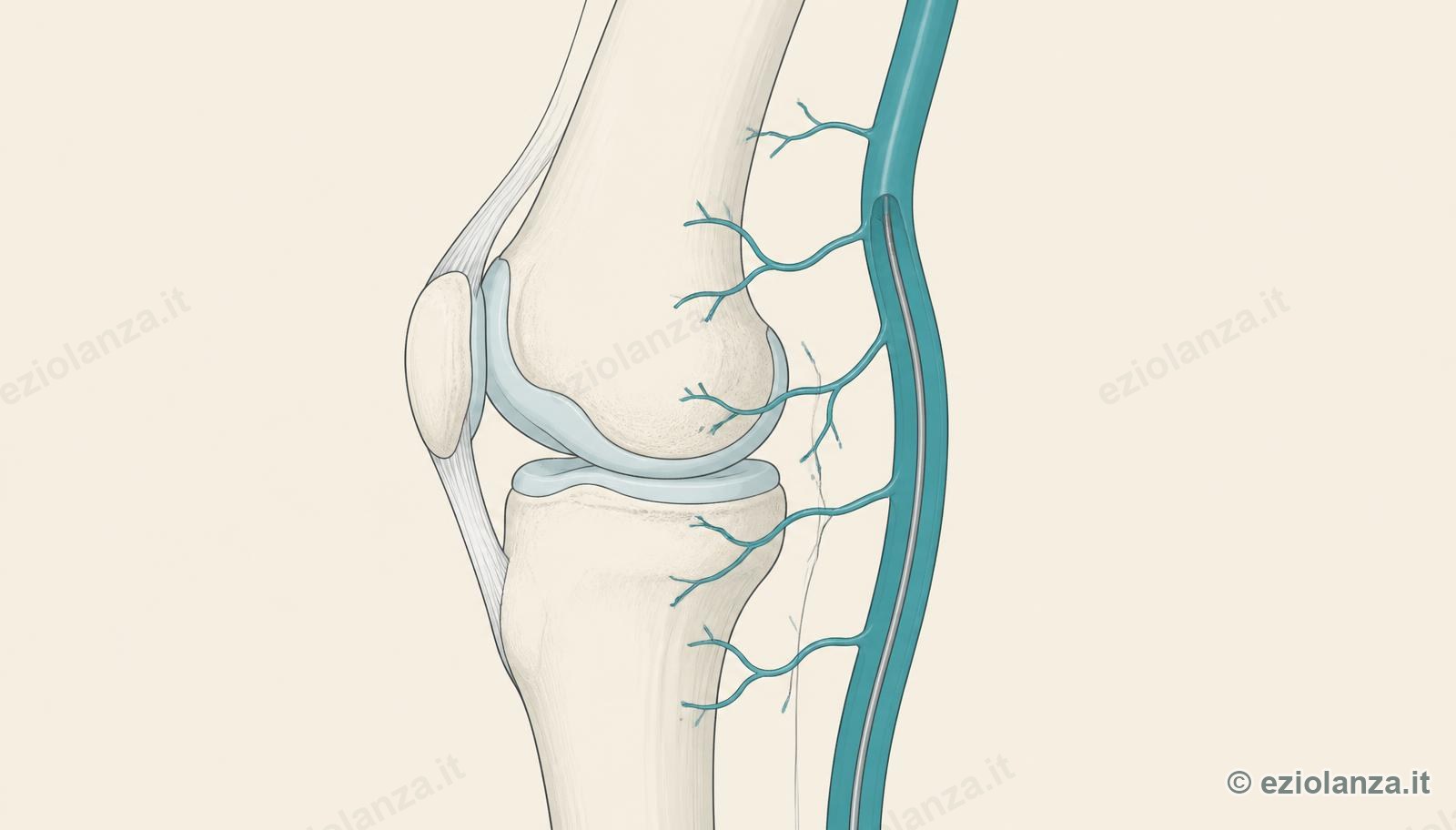
Genicular artery embolization reduces knee osteoarthritis pain by closing the small abnormal vessels that feed inflammation of the synovium. It does not work for everyone, though, and results are less predictable when osteoarthritis is very advanced or when pain persists after a knee replacement. The next question is always the same: if it did not work the first time, is it worth trying again? A study from Düsseldorf University Hospital and the Charité in Berlin, published in March 2026 in Cardiovascular and Interventional Radiology, looked for an answer in exactly these patients.
What they did
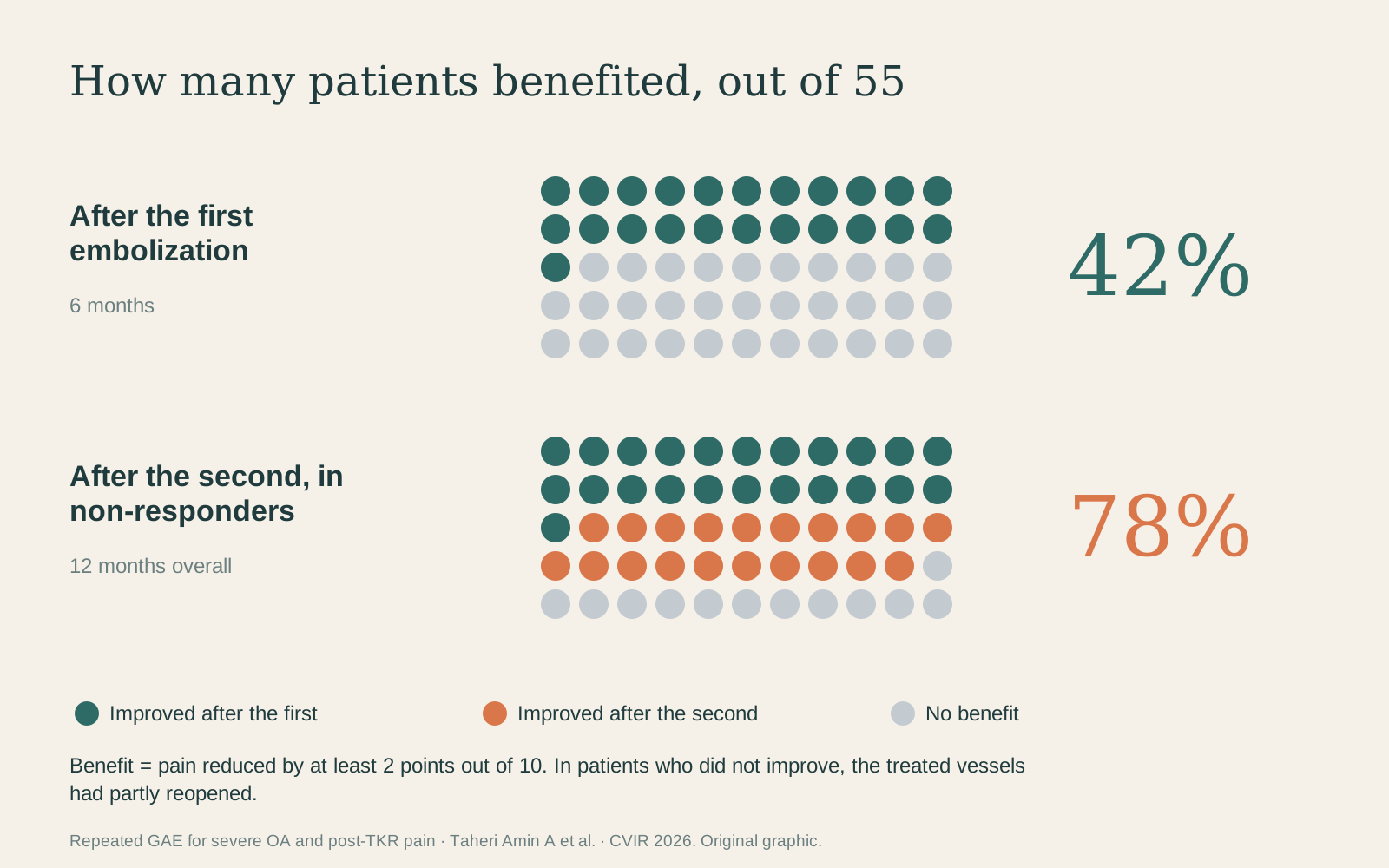
The study followed 55 patients with knee pain lasting despite at least six months of treatment: 33 had severe osteoarthritis (the highest grade, 4 out of 4) and 22 had persistent pain after a total knee replacement, once infection and mechanical problems of the implant had been ruled out. The median age was 69. Embolization was performed with permanent microspheres, treating on average four genicular arteries. Pain was measured on a 0–10 scale at six weeks and at 3, 6, 9 and 12 months, and a reduction of at least 2 points counted as a benefit. Patients without this benefit at six months had a second embolization with the same technique.
The results
After the first procedure, at six months, 23 of 55 patients (42%) had significantly less pain. Of the 32 who had not improved, 20 benefited after the second embolization, and the result held for the following six months. At one year, then, 43 of 55 patients had benefited, 78%. In 12 patients, 22%, pain did not improve even after the second procedure.
Why the pain comes back: the vessels reopen
The most interesting part of the study is the explanation. The authors measured on the angiograms the area of the inflammatory vessels, the so-called blush, before and after each procedure. In patients who had not improved, by the time of the second embolization the blush had grown again in the same vessels already treated, even though permanent microspheres had been used. The knee has a dense network of small arteries connected to each other that can reopen the way, and the inflammation of osteoarthritis is an ongoing, chronic process. The same phenomenon has long been known in prostate artery embolization, where a second procedure is an accepted option.
Safety
After the first embolization 47% of patients had temporary spots or redness of the skin of the knee, after the second 41%: in every case they disappeared within six weeks. No other complications were recorded, vascular or otherwise.
The limits of the study
The patients are few, treated at a single centre by a single, very experienced interventional radiologist. There is no comparison group with a sham procedure, so part of the improvement may be a placebo effect. After the second procedure patients were followed for only six months, and pain was assessed with a single scale. Finally, in the 12 patients who did not respond no characteristic made it possible to predict this in advance: knowing who will benefit remains the open question.
What it means in practice
If a first knee embolization did not reduce the pain, especially with severe osteoarthritis or a painful knee replacement, the road is not necessarily closed: in this study a second procedure about six months later helped more than half of the patients who had not improved, with only temporary side effects. It is not a guarantee, though, and with very advanced osteoarthritis a knee replacement remains an option to discuss with the orthopaedic surgeon. At the consultation we review how the first procedure went, the scans and your current pain, and decide together whether a second embolization makes sense in your case.
Treatments discussed in this article
Scientific sources
- Taheri Amin A, Hübner A, Abu-Gharbieh L, et al. Repeated genicular artery embolization using permanent microspheres for severe osteoarthritis and postsurgical pain. Cardiovasc Intervent Radiol. 2026;49:1370-1381.
- Lanza E, Poretti D, Pedicini V, Kon E, Laghi A. Permanent vs. temporary embolic agents in genicular artery embolization for knee osteoarthritis: a systematic review and meta-analysis. Eur J Radiol. 2026;202:112968.
- Konduru N, Hnatov A, Joshua SP, et al. Genicular artery embolization as a treatment option for refractory knee pain post total knee arthroplasty: a prospective series. Cardiovasc Intervent Radiol. 2026;49:1384-1390.
- Okuno Y, Korchi AM, Shinjo T, Kato S. Transcatheter arterial embolization as a treatment for medial knee pain in patients with mild to moderate osteoarthritis. Cardiovasc Intervent Radiol. 2015;38(2):336-343.
Want to know if it applies to you?
At the first consultation we review your clinical history and previous imaging together.
More articles
The information on this page is for general education and does not replace a medical consultation. The indication for any treatment must always be assessed individually.