
Varicocele: embolization without surgery and without general anaesthesia in Milan
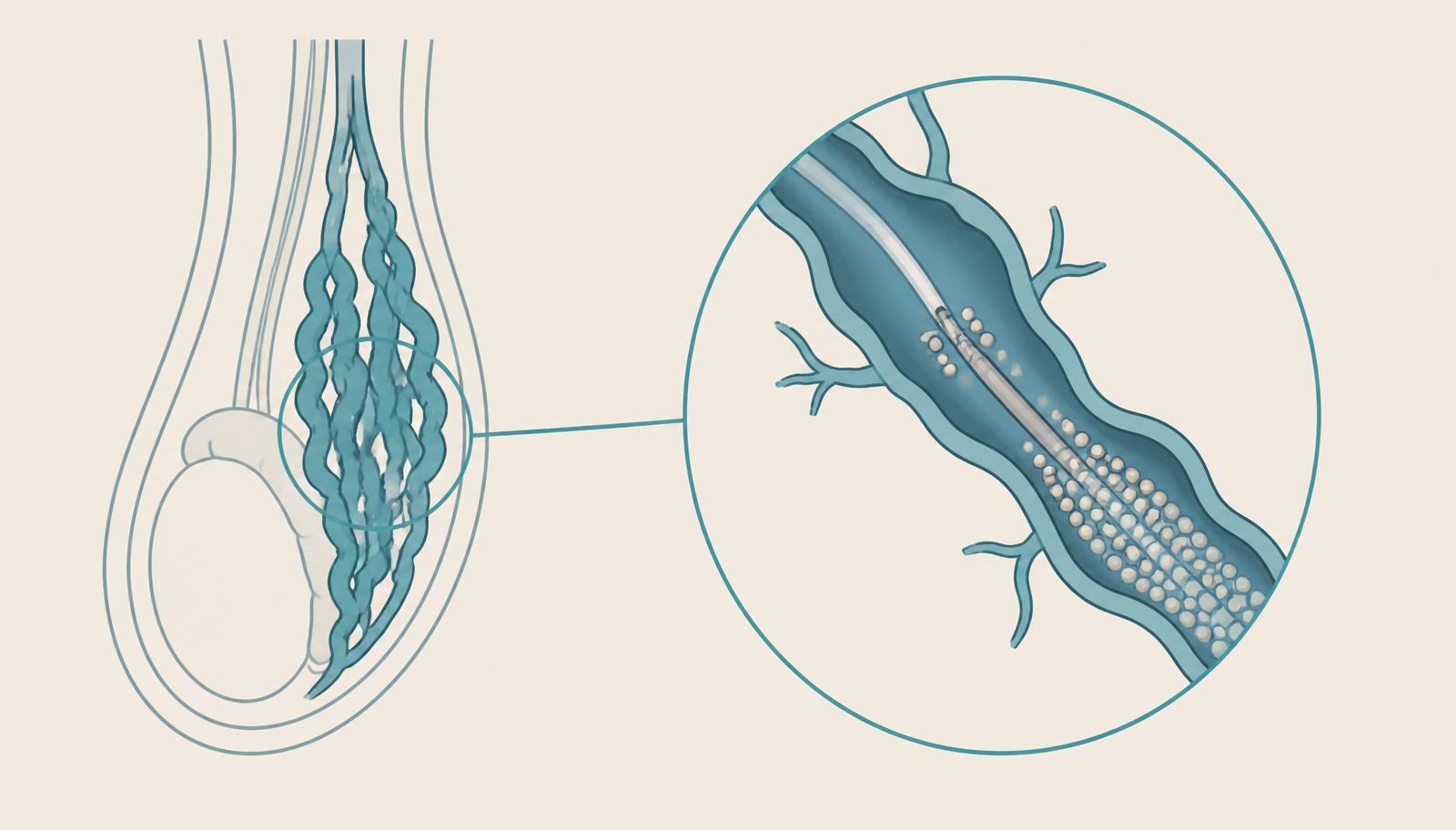
Varicocele is the dilation of the veins of the testicle, usually on the left. It can cause a feeling of heaviness, pain that increases towards the end of the day and changes on the semen analysis. Embolization makes it possible to treat it through a venous puncture, without a surgical incision and without general anaesthesia.
Do you recognise these symptoms?
- Feeling of heaviness or dull testicular pain, more intense in the evening
- Palpable veins, described as a "bag of worms"
- Worsening with prolonged standing or after sport
- Semen analysis changes found during a fertility work-up
How embolization works
Through a venous access the internal spermatic vein is reached with a microcatheter and closed, so the blood stops pooling towards the testicle. Everything happens under radiological guidance, under local anaesthesia, with an access of a few millimetres that leaves no surgical scar.
Why we use cyanoacrylate
As an embolic agent we use cyanoacrylate, a glue that occludes the vessel immediately and stably. Compared with metal coils and sclerosing agents it has proven superior in terms of efficacy and durability of the result, with shorter procedure times.
After the procedure
It is performed as a day-case: you come in the morning and go home in the afternoon, with someone accompanying you. In the following days intense sport is avoided; sedentary work usually resumes very quickly.
Varicocele and fertility
In fertility pathways varicocele treatment is assessed together with the andrologist, with a follow-up semen analysis after a few months, the time needed for a new spermatogenesis cycle to complete.
Treatments we can perform
Frequently asked questions
Is it painful?
It is done under local anaesthesia at the access point; the discomfort is generally modest and transient.
Does it leave a scar?
No: the access is a puncture of a few millimetres, not a surgical incision.
Can the varicocele recur?
Recurrence is possible but uncommon; the use of cyanoacrylate reduces the risk compared with other methods.
Want to know if it is your case?
At the first consultation we review your clinical history and previous imaging together.
Other guides
The information on this page is for general guidance and does not replace a medical consultation. The indication for treatment must always be assessed individually.