
Chronic low back pain: ultrasound-guided injections in Milan
Low back pain that has lasted for months is not all the same. Before talking about surgery it is essential to understand which structure generates the pain: the facet joints, the sacroiliac joint, tight paraspinal muscles, the piriformis muscle or the iliopsoas. From this distinction depends the treatment, and often the targeted ultrasound-guided injection is at once diagnostic and therapeutic.
Do you recognise these symptoms?
- Low back pain that worsens arching the back or standing for long
- Pain on one side of the sacrum, increasing on stairs or rising from a chair
- Buttock pain descending along the thigh (without a clear hernia)
- Persistent tightness of the lumbar muscles
- Hip or groin pain when walking
Finding the structure that generates the pain
MRI and X-rays show anatomical alterations, but do not always tell which structure hurts: many people have altered images without pain. The consultation, clinical tests and ultrasound allow a precise hypothesis; the targeted injection confirms it, because if the pain decreases after treating that structure, the origin is identified.
Facet joints and sacroiliac joint
The lumbar facet joints are small posterior joints that become arthritic over the years and give pain typically worsened by extension. The sacroiliac joint instead gives lateral sacral pain, often confused with sciatica. Both are injected under ultrasound guidance, as outpatient procedures.
Piriformis, iliopsoas and trochanteric bursitis
When pain starts in the buttock and descends along the thigh without a hernia justifying it, the culprit may be the piriformis muscle. Groin pain that appears while walking can arise from the iliopsoas, while pain on the side of the hip, which prevents sleeping on that side, is often trochanteric bursitis: all conditions treatable with ultrasound-guided injection.
What happens afterwards
The injection does not replace therapeutic exercise: it reduces pain and creates the window in which rehabilitation can work. The goal is to get the back moving again, not to anaesthetize it repeatedly.
Treatments we can perform
Lumbar spine
Lumbar facet joint injection
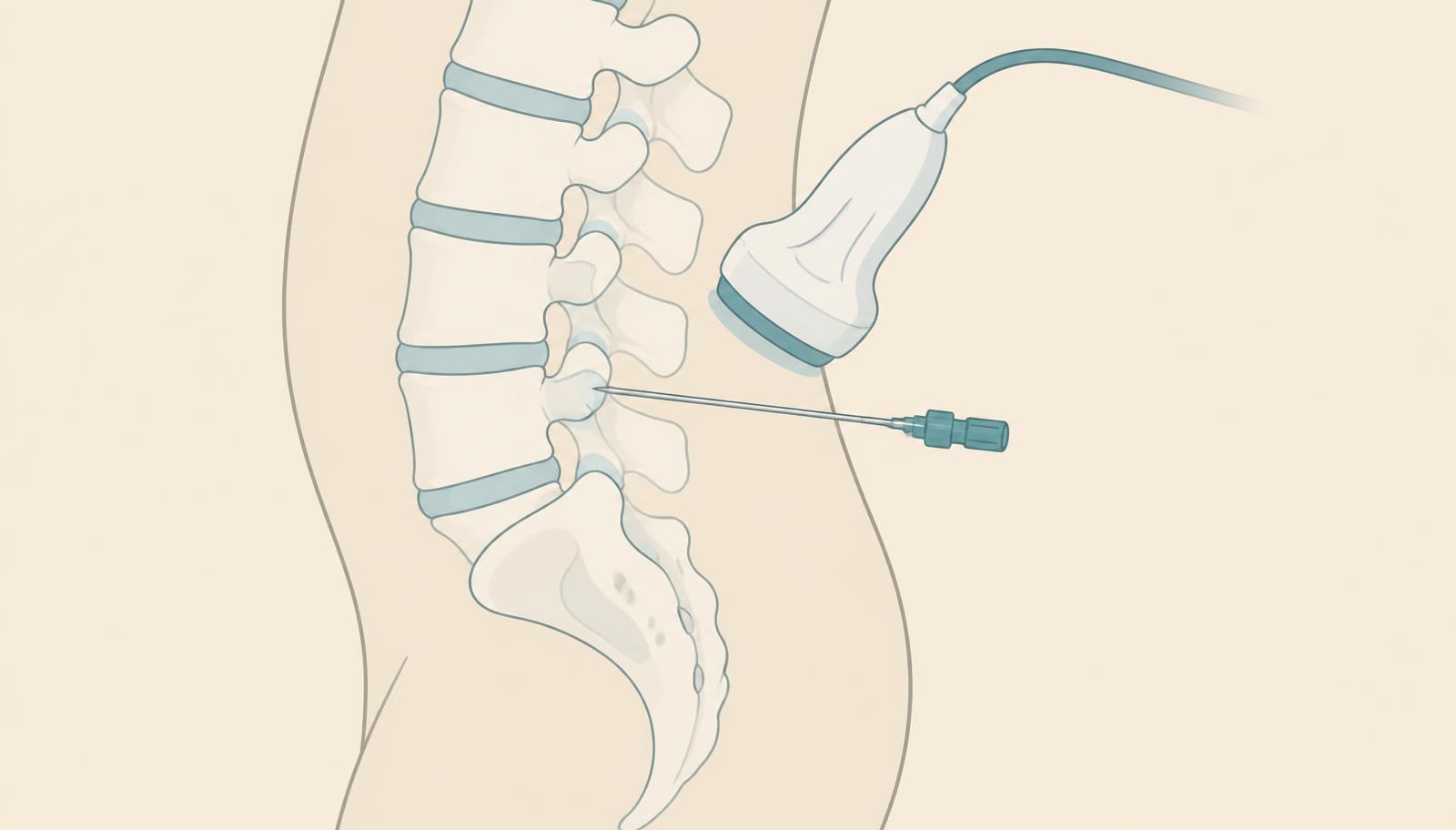
The small joints located on either side of the spine, often involved in chronic back pain, are visible on ultrasound in most patients and can be treated with precision under direct needle guidance.
Read about the procedureLumbar spine
Sacroiliac joint injection
The joint that connects the base of the spine to the pelvis is a well-established site for ultrasound-guided treatment, with good visibility even in patients with a larger build.
Read about the procedureLumbar spine
Blocks and injections of the paraspinal muscles and quadratus lumborum
Painful muscle points and fascial planes are well visualised and lend themselves to a targeted treatment.
Read about the procedureLumbar spine
Injection of the piriformis and iliopsoas muscles, trochanteric bursitis
The deep muscles of the lumbar and pelvic region and the greater trochanter bursa can be reached with an ultrasound-guided needle to treat referred pain and local inflammation.
Read about the procedureFrequently asked questions
How many injections are needed?
It depends on the structure treated and the response; it is always assessed after the first one, avoiding automatic cycles.
Why ultrasound-guided and not freehand?
Ultrasound guidance lets you see the needle, the medication and the nerve structures in real time, increasing precision and safety, without ionizing radiation.
Can I drive afterwards?
Usually yes, but it is advisable to be accompanied the first time, especially if you received a generous local anaesthetic.
Want to know if it is your case?
At the first consultation we review your clinical history and previous imaging together.
Other guides
The information on this page is for general guidance and does not replace a medical consultation. The indication for treatment must always be assessed individually.