
Knee pain from osteoarthritis: what to do before a prosthesis in Milan
Knee pain from osteoarthritis (gonarthrosis) is one of the most common reasons for a consultation. When anti-inflammatory drugs, physiotherapy and standard injections are no longer enough, many people are told that the only option is a prosthesis. In reality, between drug therapy and surgery there is a range of minimally invasive treatments performed with a needle or a small percutaneous access, without cuts and without scars.
Do you recognise these symptoms?
- Pain that worsens going up or down stairs
- Stiffness in the morning or after sitting for a long time
- Recurrent swelling of the knee
- Night pain that disturbs sleep
- Reduced distance you can walk
Why an arthritic knee hurts
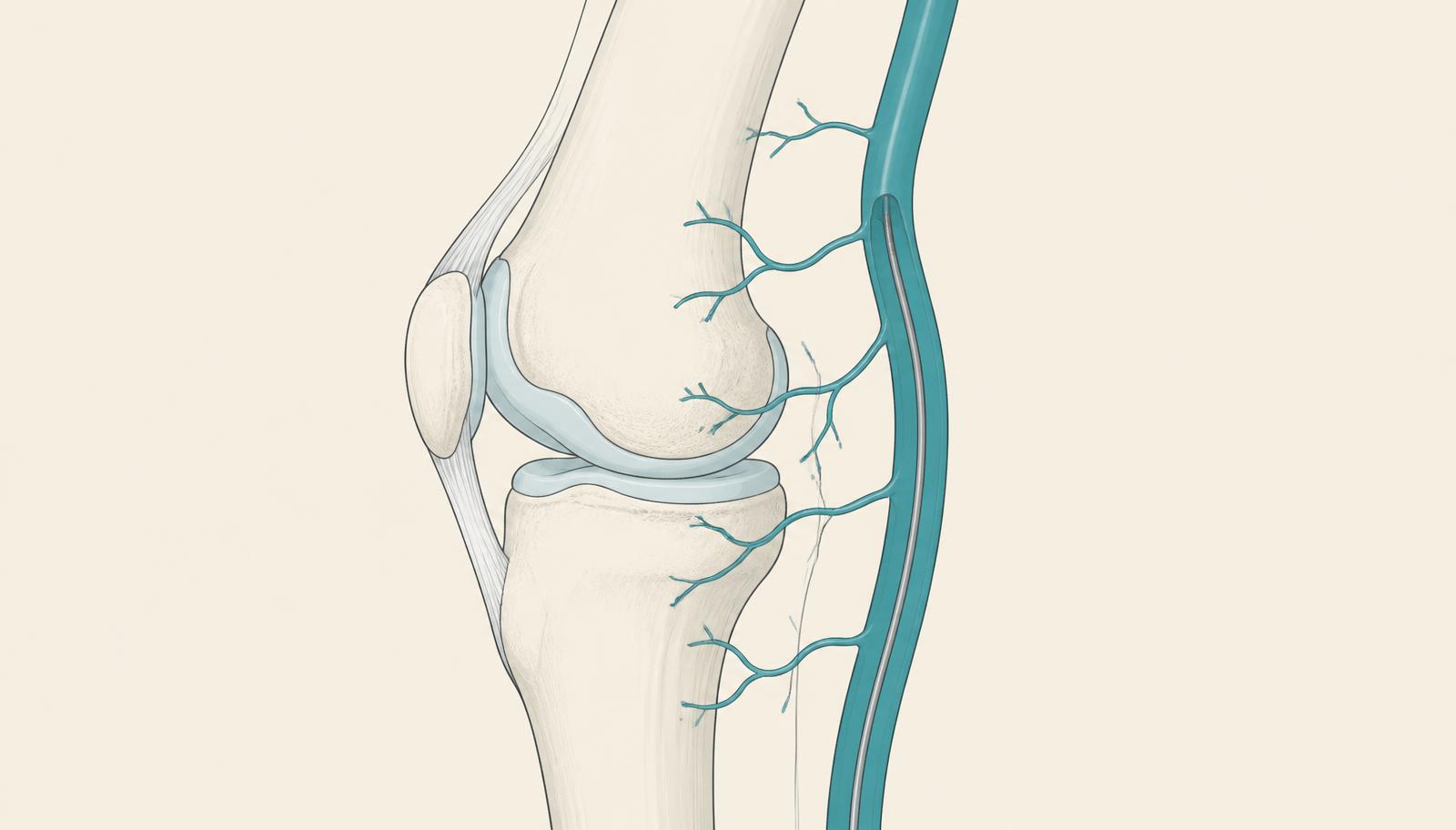
In osteoarthritis the cartilage thins, but pain does not come only from the cartilage: the synovial membrane becomes inflamed and develops new small blood vessels accompanied by nerve endings. This chronic inflammation, called neoangiogenesis, is now considered one of the main causes of persistent pain and explains why pain can be intense even when an X-ray shows only moderate osteoarthritis.
When it makes sense to consider a minimally invasive treatment
Usually when the pain has lasted more than three to six months, limits daily life and no longer responds to drugs, physiotherapy and standard injections, but a prosthesis is not indicated or not desired: because you are too young, because the osteoarthritis is not yet end-stage, because of other medical conditions, or simply because you want to postpone surgery.
What we can do
Ultrasound-guided injections make it possible to deliver the medication exactly where it is needed, under direct visual control, with much greater precision than a freehand injection. Genicular artery embolization instead acts on the vascular cause of pain: through a percutaneous access at the groin, the small arterial branches feeding the inflamed synovium are reached and closed with microparticles, reducing inflammation and therefore pain. It is a day-case procedure: you come in the morning and go home in the afternoon.
What to realistically expect
These treatments aim to reduce pain and improve function, not to rebuild cartilage. They do not replace a prosthesis when the joint is completely destroyed: they postpone it or offer an option for those who cannot undergo surgery. Published data describe average results in groups of patients; the indication must always be assessed during a consultation, with X-rays and MRI to hand.
Treatments we can perform
Knee
Genicular artery embolization (GAE)
A minimally invasive procedure for osteoarthritis: the small inflammatory vessels of the knee are closed. Indicated when injections and physiotherapy are not enough and replacement surgery is not yet indicated.
Read about the procedureKnee
Ultrasound-guided injections
Hyaluronic acid placed with ultrasound precision inside the joint.
Read about the procedureKnee
Saphenous nerve block
The saphenous nerve, a sensory branch of the femoral nerve, is blocked with ultrasound-guided local anaesthesia for anteromedial knee pain not responding to standard treatments.
Read about the procedureFrequently asked questions
Do I have to stop working?
Ultrasound-guided injections are performed as outpatient procedures and you usually resume activity almost immediately. For embolization, which is a day-case procedure, a couple of days of reduced activity are recommended.
Is it painful?
It is done under local anaesthesia. During embolization a transient sensation of warmth at the knee may occur.
Which examinations should I bring?
Recent weight-bearing X-rays and, if available, an MRI of the knee, together with the list of medications you take.
Want to know if it is your case?
At the first consultation we review your clinical history and previous imaging together.
Other guides
The information on this page is for general guidance and does not replace a medical consultation. The indication for treatment must always be assessed individually.