
Painful shoulder and tendon calcification: available treatments in Milan
A painful shoulder that stops you sleeping on your side, fastening your bra behind your back or reaching an object on a high shelf often has a clearly identifiable cause on ultrasound: a calcification of the rotator cuff tendon, subacromial bursitis or adhesive capsulitis (the so-called frozen shoulder). All are conditions treatable with a needle, under ultrasound guidance.
Do you recognise these symptoms?
- Sudden, sharp shoulder pain, even at rest
- Inability to sleep on the painful side
- Difficulty raising the arm overhead
- Progressive loss of movement in all directions (frozen shoulder)
- Pain radiating along the outer side of the arm
Rotator cuff calcification
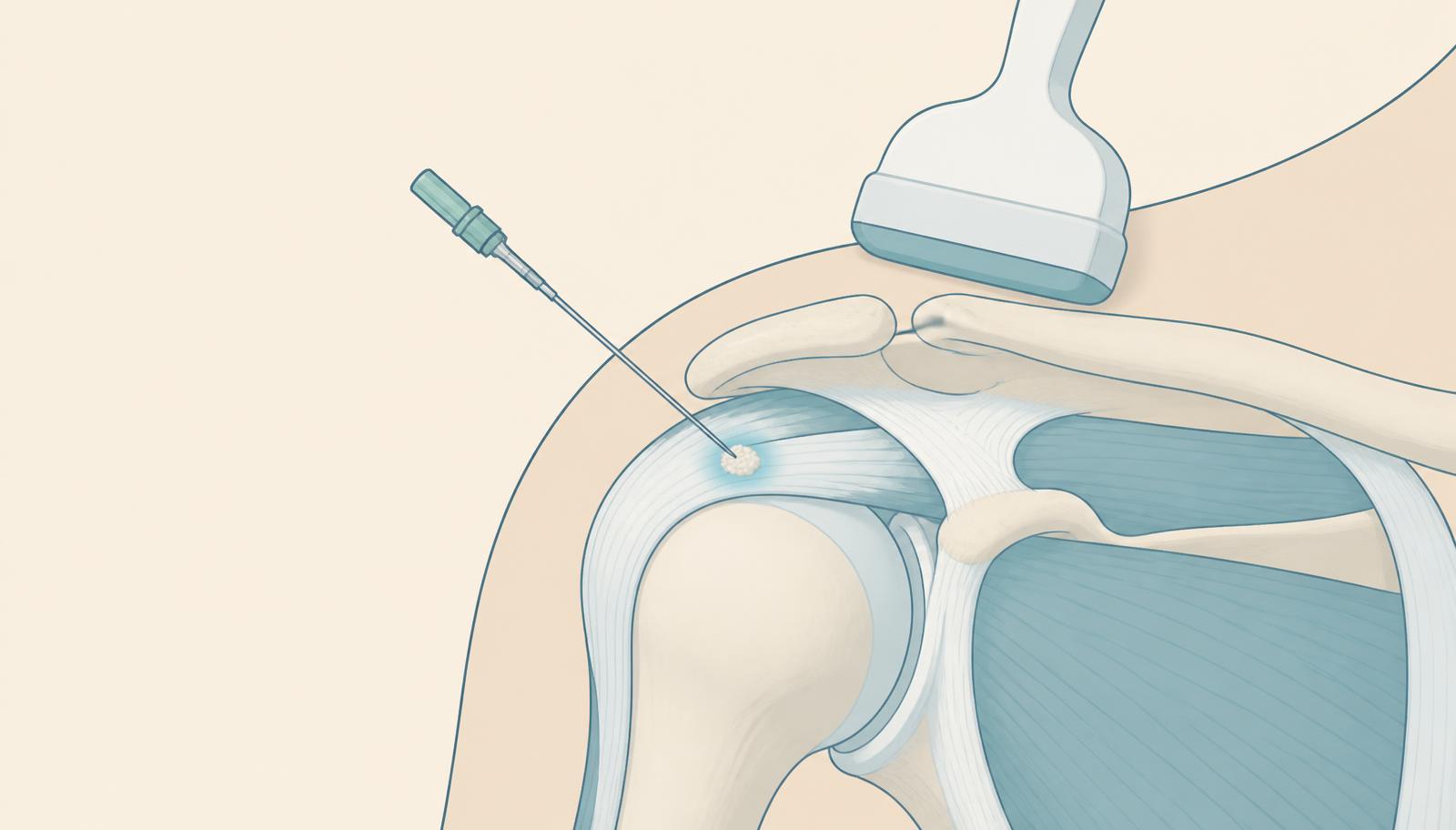
A calcium deposit forms within the tendon and, when it begins to reabsorb, can trigger very intense pain. With ultrasound-guided lavage the calcification is reached with thin needles under real-time ultrasound control, dissolved with saline and aspirated. It is an outpatient procedure, under local anaesthesia.
Bursitis and subacromial impingement
When the subacromial bursa becomes inflamed, arm movement becomes painful in a specific range. Ultrasound-guided injection of the bursa deposits the medication exactly in the inflamed space, with a control that a freehand injection cannot provide.
Frozen shoulder (adhesive capsulitis)
Here the problem is the joint capsule, which retracts and blocks movement. Hydrodilatation consists of injecting, under ultrasound guidance, a volume of fluid into the joint to distend the retracted capsule, combined with rehabilitation to recover range of motion.
The pathway in practice
It always starts with a consultation and ultrasound: in many cases the diagnosis is made at that moment, watching the tendon while you move your arm. If there is an indication, treatment can be scheduled quickly and does not require admission.
Treatments we can perform
Shoulder
Ultrasound-guided lavage of the calcification
Under ultrasound guidance, the calcification is aspirated and dissolved through a needle: pain often decreases within the following days.
Read about the procedureShoulder
Ultrasound-guided injection of the subacromial bursa
An anti-inflammatory medication is placed with ultrasound precision inside the inflamed bursa, reducing pain during arm movement.
Read about the procedureShoulder
Intra-articular injection / hydrodilatation for adhesive capsulitis
The stiff joint of the frozen shoulder is gently distended with fluid under ultrasound guidance, to regain mobility and reduce pain.
Read about the procedureShoulder
Shoulder arterial embolization
The microvessels feeding chronic inflammation are closed with microparticles, reducing pain when medications are not enough.
Read about the procedureFrequently asked questions
Can the calcification come back?
In most cases removal is stable, but recurrence is possible; a follow-up ultrasound at a distance allows it to be checked.
Do I need physiotherapy afterwards?
Yes, especially in adhesive capsulitis: the treatment opens a window in which rehabilitation becomes effective and tolerable.
How long does the procedure take?
Usually 20 to 30 minutes, under local anaesthesia, and you go home straight afterwards.
Want to know if it is your case?
At the first consultation we review your clinical history and previous imaging together.
Other guides
The information on this page is for general guidance and does not replace a medical consultation. The indication for treatment must always be assessed individually.