
Heel pain and plantar fasciitis: options without surgery in Milan
Heel pain that strikes with the first step in the morning, eases as you walk and returns at the end of the day is the typical picture of plantar fasciitis. It is a condition that can last months and resist orthotics, stretching and shockwave therapy: in these cases there are image-guided minimally invasive treatments.
Do you recognise these symptoms?
- Sharp heel pain with the first steps in the morning
- Pain that returns after sitting for a long time
- Discomfort that worsens with prolonged standing or after running
- A precise tender point under the heel, on pressure
What happens in the plantar fascia
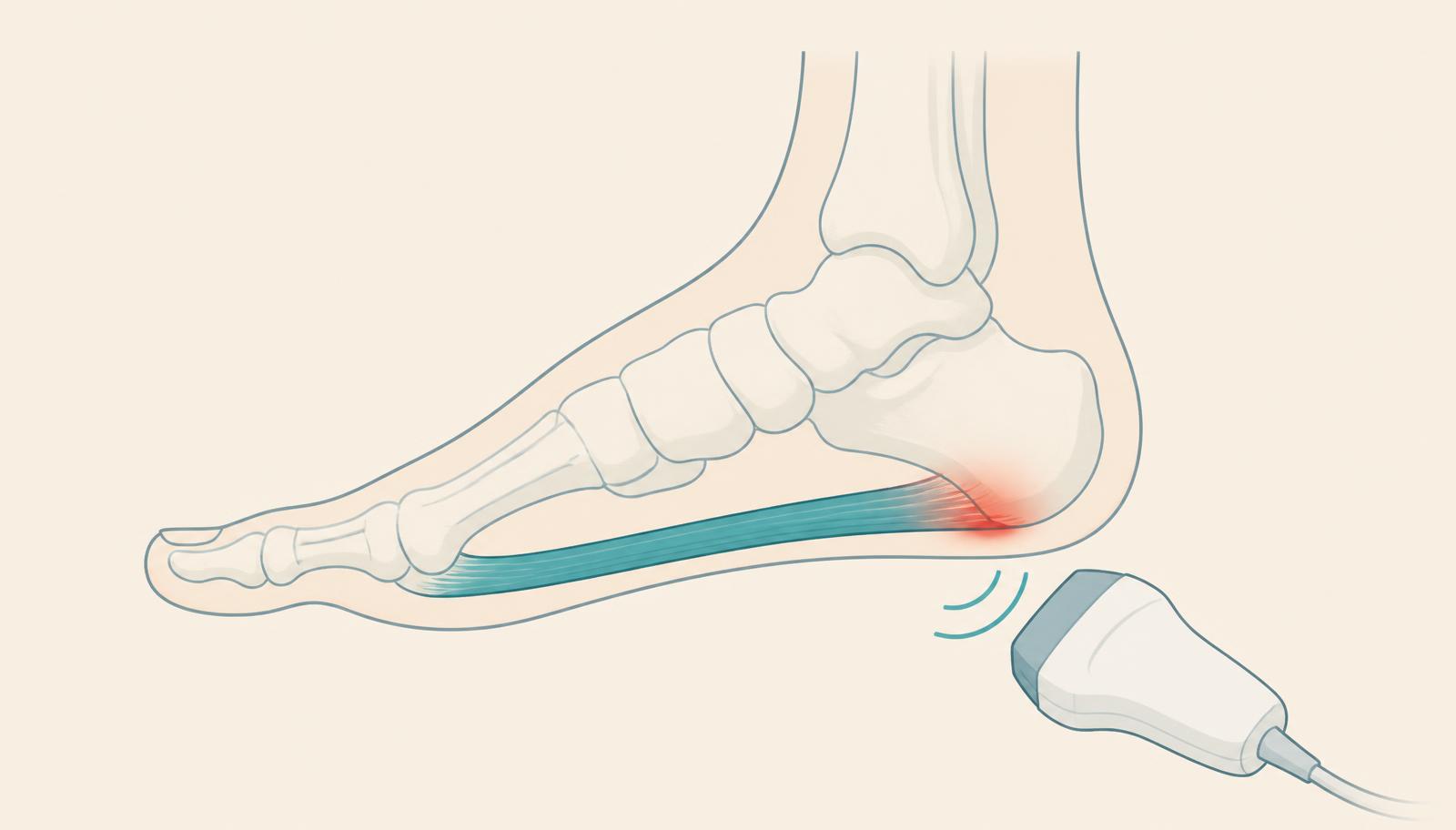
The plantar fascia is the tough fibrous band that supports the arch of the foot. With repeated overload it degenerates at its insertion on the calcaneus and becomes chronically inflamed. As in other chronic tendinopathies, small abnormal vessels develop alongside nerve fibres: this is one reason the pain persists.
The ultrasound-guided treatment
Ultrasound shows the thickening of the fascia and the exact point of suffering. The ultrasound-guided injection deposits the medication right there, sparing the structures to be avoided, as an outpatient procedure under local anaesthesia.
Embolization for resistant cases
When pain resists repeated conservative treatments, embolization of the small arteries feeding the inflamed area — also known as TAME (transcatheter arterial micro-embolization) — acts on the vascular component of chronic pain through a percutaneous access. It is performed as a day-case and does not require immobilization.
Not only the heel
In the same region we treat, with the same logic, the pain of the ankle joint, the sinus tarsi and ankle tendinopathies, which often coexist with the heel problem and should be assessed together.
Treatments we can perform
Ankle and foot
Ultrasound-guided injection for plantar fasciitis and heel pain
Inflammation of the plantar aponeurosis and the heel is treated with ultrasound precision, depositing the medication within the thickness of the fascia rather than on its surface.
Read about the procedureAnkle and foot
Plantar fasciitis embolization
A minimally invasive treatment for refractory chronic plantar fasciitis: microspheres occlude the small abnormal vessels (neovessels) that feed the inflammation of the fascia, without incisions or injections into the heel.
Read about the procedureAnkle and foot
Ultrasound-guided intra-articular injection of the ankle (tibiotalar joint)
Corticosteroid or hyaluronic acid placed with ultrasound precision inside the ankle joint, for osteoarthritic pain that worsens with weight-bearing.
Read about the procedureAnkle and foot
Ultrasound-guided injection of the sinus tarsi (subtalar joint)
The subtalar joint, often responsible for lateral and posterior ankle pain, is reached with precision under ultrasound guidance.
Read about the procedureFrequently asked questions
Do I have to stop walking?
No: absolute rest worsens stiffness. Sporting load is temporarily reduced and work is done on stretching and footwear.
Does the heel spur need to be removed?
Almost never: the spur is a consequence, not the cause of pain, and many people have it without symptoms.
How long does it take to see a result?
Benefit is assessed over a few weeks, together with the rehabilitation programme.
Want to know if it is your case?
At the first consultation we review your clinical history and previous imaging together.
Other guides
The information on this page is for general guidance and does not replace a medical consultation. The indication for treatment must always be assessed individually.