
Ultrasound-guided lavage or shockwave therapy for shoulder calcification? What the literature says
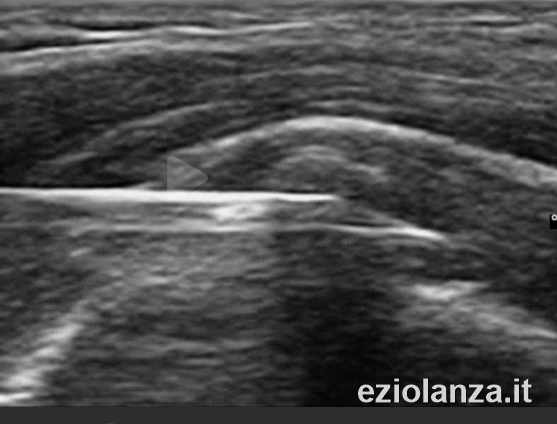
For rotator cuff calcification, two minimally invasive treatments are often compared: ultrasound-guided lavage (barbotage) and extracorporeal shockwave therapy (ESWT). They are not equivalent: the scientific literature and the UK's NICE guidance point to meaningful differences in the strength of the efficacy evidence and in safety. This article summarises what the sources say, with citations.
Do you recognise these symptoms?
- Sharp shoulder pain, even at rest
- Inability to sleep on the painful side
- Difficulty raising the arm
- Calcification visible on ultrasound or X-ray
What NICE says about shockwave therapy
In 2022 the UK's National Institute for Health and Care Excellence (NICE) published a dedicated appraisal of shockwave therapy for shoulder calcification (HTG645). Its conclusion is clear-cut: the efficacy evidence is judged "inadequate", which is why NICE recommends the procedure be used only in the context of research, not as routine treatment in the UK's health system. The committee also flagged 2 published case reports of humeral head osteonecrosis in patients treated with shockwave therapy — a serious complication, although it is unclear whether it was directly caused by the procedure — and noted that the mechanism of action of shockwave therapy on this type of calcification remains unclear.
What the studies on ultrasound-guided lavage show
A classic randomised controlled trial (Krasny et al., 2005, Journal of Bone and Joint Surgery) directly compared ultrasound-guided needling plus shockwave therapy against shockwave therapy alone, in 80 patients: the needling group achieved calcium dissolution in 60% of cases versus 32.5% in the shockwave-only group (a statistically significant difference), better clinical outcomes, and fewer arthroscopic surgeries needed afterwards.
What the more recent systematic reviews show
A network meta-analysis of randomised trials (Arirachakaran et al., 2016) concluded that ultrasound-guided percutaneous lavage (UGPL, the same technique as barbotage) is "the treatment of choice" among non-surgical options for rotator cuff calcification. A more recent and larger network meta-analysis (Moggio et al., 2025, covering 19 studies and 1,160 patients) offers a more nuanced picture: needle aspiration has a 65% probability of being among the most effective options for function, versus 57% for shockwave therapy — so lavage still ranks above shockwave therapy, though it is not the only valid option (platelet-rich plasma and disodium EDTA also perform well in this broader comparison).
The bottom line
No study shows that ultrasound-guided lavage is, in absolute terms, the "definitive cure" for every case of calcification. What the literature suggests most clearly is an asymmetry in the quality of the available evidence: shockwave therapy has efficacy evidence judged insufficient by an independent regulatory body, with a real, if rare, safety signal, while ultrasound-guided lavage has a stronger evidence base, including systematic reviews that rank it as the first-choice option among non-surgical treatments. For this reason, in clinical practice I tend to favour ultrasound-guided lavage over shockwave therapy when both options are in principle applicable.
Treatments we can perform
Frequently asked questions
Has shockwave therapy been approved by NICE?
No: NICE recommends it be used only in the context of research, because the evidence on its efficacy was judged inadequate in the 2022 HTG645 appraisal.
Are there studies directly comparing the two techniques?
Yes. A 2005 randomised trial (Krasny et al.) showed that adding ultrasound-guided needling to shockwave therapy nearly doubles the calcium dissolution rate compared with shockwave therapy alone (60% vs 32.5%).
What do the more recent systematic reviews show?
A 2016 network meta-analysis identifies ultrasound-guided lavage as the treatment of choice among non-surgical options. A more recent one, from 2025, confirms that needle aspiration outperforms shockwave therapy in terms of probability of improving function, although other options such as platelet-rich plasma perform just as well.
Is ultrasound-guided lavage therefore always the right choice?
Not necessarily for every patient: the choice depends on the location, consistency and stage of the calcification, as well as on treatments already tried. But for a comparable indication, the evidence supporting ultrasound-guided lavage is stronger than that supporting shockwave therapy.
Scientific sources
- NICE HTG645 — Extracorporeal shockwave therapy for calcific tendinopathy in the shoulder (2022)
- Krasny et al., J Bone Joint Surg Br 2005 — Ultrasound-guided needling combined with shock-wave therapy
- Arirachakaran et al., Eur J Orthop Surg Traumatol 2016 — Network meta-analysis of RCTs
- Moggio et al., Orthopaedic Surgery 2025 — Systematic review and network meta-analysis
- Moosmayer et al., BMC Musculoskeletal Disorders 2017 — KALK trial protocol on barbotage
Want to know if it is your case?
At the first consultation we review your clinical history and previous imaging together.
Other guides
The information on this page is for general guidance and does not replace a medical consultation. The indication for treatment must always be assessed individually.