
Shoulder calcification lavage: questions and answers
Calcification lavage, also called barbotage, is the ultrasound-guided treatment that literally dissolves rotator cuff calcification in water. Here are the answers to the questions patients ask most often, before and after the procedure.
Do you recognise these symptoms?
- Sudden, sharp shoulder pain, even at rest
- Inability to sleep on the painful side
- Difficulty raising the arm overhead
- Pain radiating along the outer side of the arm
What is calcification lavage?
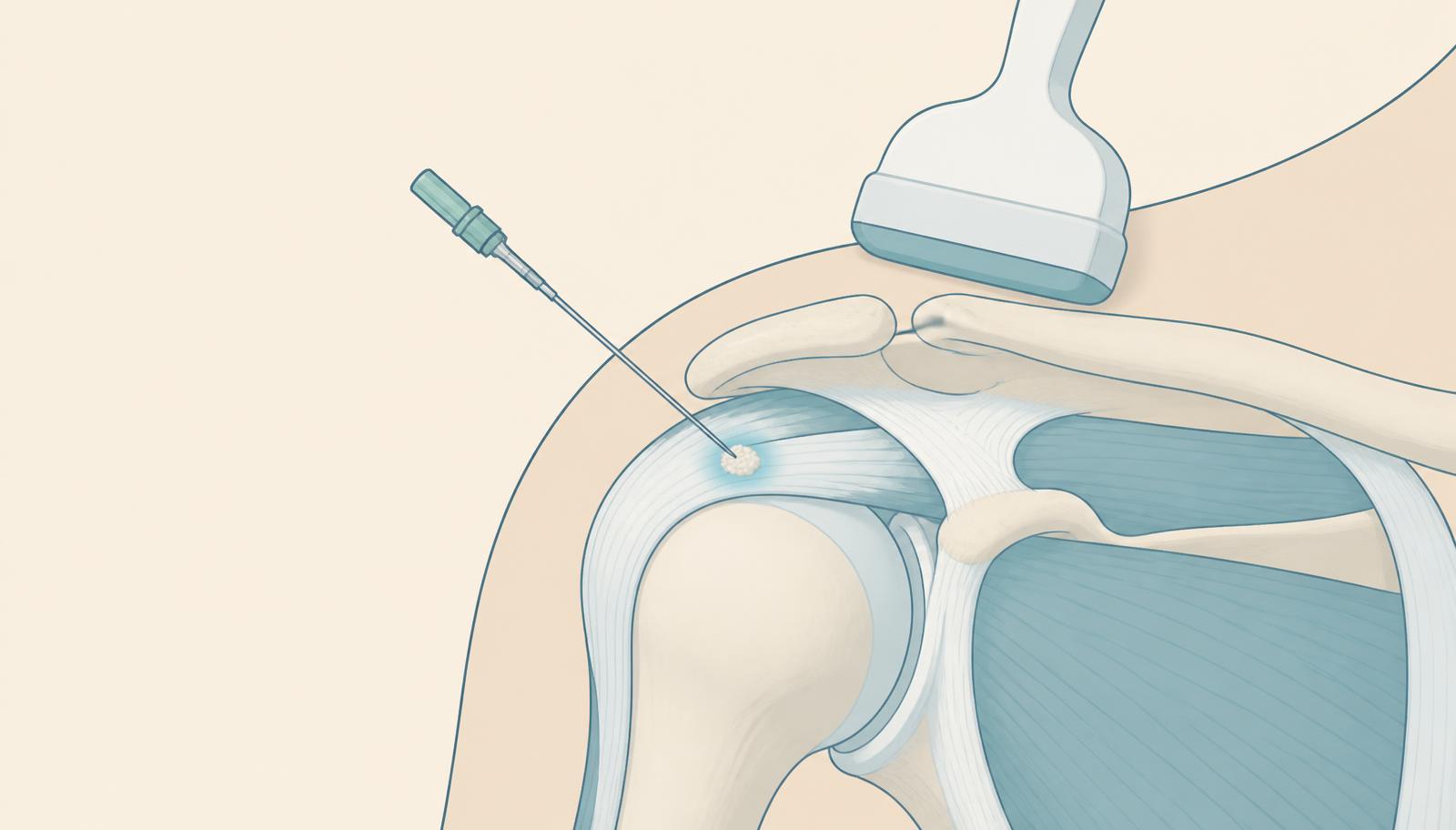
It is an outpatient procedure that treats rotator cuff calcification without surgery, literally dissolving it in water. Under real-time ultrasound guidance, two thin needles are positioned with millimetric precision inside the calcium deposit: saline is injected through one while debris is aspirated through the other as it dissolves. An anti-inflammatory can then be injected into the subacromial bursa to reduce residual pain.
Why does the calcification form, and why does it hurt?
Calcium deposits inside the tendon through a process that is not fully understood, often without symptoms for years. Acute pain typically appears during the resorption phase, when the deposit becomes more fluid and inflames the surrounding tissue: this is precisely the phase in which ultrasound-guided lavage is most effective, because the calcific material is easier to aspirate.
How does the procedure work, step by step?
After an ultrasound scan confirming the location and consistency of the calcification, local anaesthesia is given to the skin. The two needles are positioned in the calcific deposit under ultrasound and two-way irrigation begins: saline in, calcific debris out, until as much material as possible has been removed. The small, controlled bleeding this generates in the tendon helps activate the growth factors involved in its natural repair. The procedure takes about 30 minutes, is precise and painless, and does not require hospital admission: you go home on your own right after.
What happens after the procedure?
In the first 1-3 days a temporary increase in pain is normal, related to residual local inflammation and manageable with anti-inflammatory drugs. The tendon completes its natural repair within 7-30 days; in this window, a mobilisation programme, and physiotherapy if indicated, helps recover full range of motion. In our studies, 80% of treated patients reported a significant improvement in pain.
Treatments we can perform
Shoulder
Ultrasound-guided lavage of the calcification
Under ultrasound guidance, the calcification is aspirated and dissolved through a needle: pain often decreases within the following days.
Read about the procedureShoulder
Ultrasound-guided injection of the subacromial bursa
An anti-inflammatory medication is placed with ultrasound precision inside the inflamed bursa, reducing pain during arm movement.
Read about the procedureFrequently asked questions
Does calcification lavage hurt?
It is performed under local anaesthesia, so pain during the procedure is minimal. In the days immediately after, transient pain may occur, generally manageable with standard anti-inflammatory drugs.
How long does the procedure take, and is admission needed?
It takes about 30 minutes, as an outpatient procedure: no hospital admission is needed and you go home on your own right after.
Is the calcification removed completely?
In most cases the amount of calcium removed is enough to resolve the pain, even though the calcification does not always disappear completely on follow-up imaging: what matters clinically is symptom relief, not a perfect radiological picture.
How soon will I feel an improvement?
The tendon completes its natural repair within 7-30 days. In this window most patients notice a progressive improvement: in our studies, 80% reported a significant reduction in pain.
Can the calcification come back?
It is possible, although not common. A follow-up ultrasound allows the outcome to be checked and, if necessary, the treatment to be repeated.
Is it an alternative to surgery?
Yes, in the large majority of cases: surgery is reserved for calcifications that do not respond to ultrasound-guided treatment or for particular anatomical situations, and is assessed case by case.
Is physiotherapy needed after the lavage?
Often yes, especially if the shoulder has lost mobility because of pain: the treatment creates a window in which rehabilitation becomes effective and well tolerated.
Who is a good candidate for this procedure?
Someone with a symptomatic calcification confirmed on ultrasound, with pain that limits daily life and no longer responds satisfactorily to medication and physiotherapy alone. The precise indication is assessed during a consultation.
Want to know if it is your case?
At the first consultation we review your clinical history and previous imaging together.
Other guides
The information on this page is for general guidance and does not replace a medical consultation. The indication for treatment must always be assessed individually.