
2 October 2026
Injections for thumb base osteoarthritis
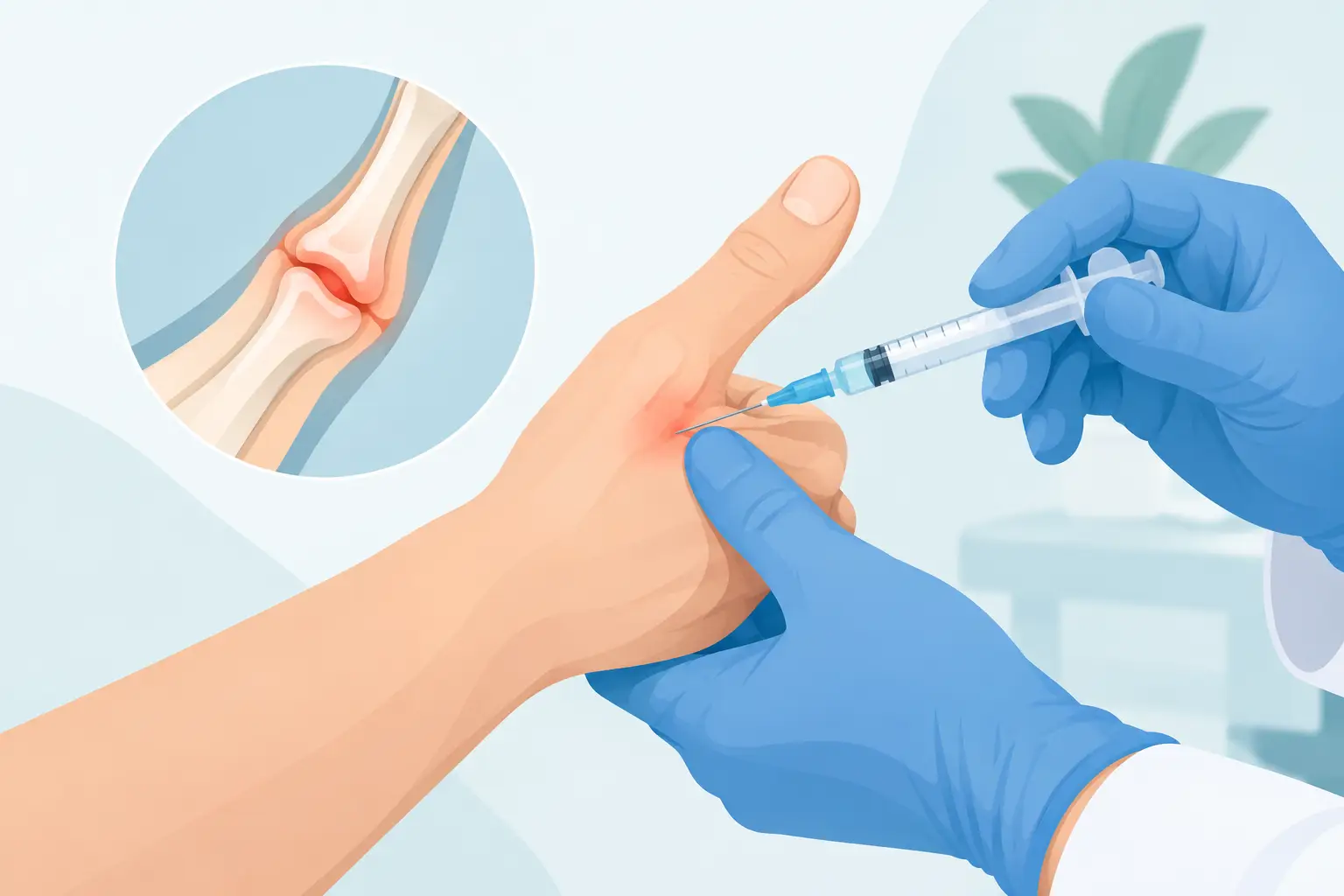
Pain at the base of the thumb can make very simple actions tiring: opening a jar, turning a key, using your phone, writing or picking up a cup. An injection for thumb base (trapeziometacarpal) osteoarthritis can reduce pain and restore better function when a splint, medication and physiotherapy are not enough. It does not, however, rebuild worn cartilage: it is a targeted treatment of the symptoms, to be offered after a careful assessment of the degree of osteoarthritis and the person's needs.
What thumb base osteoarthritis is and why it hurts
Thumb base osteoarthritis is osteoarthritis of the trapeziometacarpal joint, that is, the point where the first metacarpal meets the trapezium bone at the base of the thumb. It is a small joint but one subjected to constant stress, and it is essential for the opposition movement that allows us to grasp objects.
Over time, the cartilage can thin and the joint can become inflamed, unstable or deformed. The pain is typically located at the base of the thumb and gets worse with pinch grip and twisting movements. In some cases there is swelling, loss of strength, joint crepitus and a progressive deviation of the thumb.
The condition is more common in women after the menopause, but it can also affect men and younger people, especially in the presence of predisposition, repetitive manual work, ligament laxity or previous injuries. X-rays show the degree of osteoarthritis; ultrasound adds useful information about the soft tissues, inflammation and the correct target for any procedure.
When to consider an injection for thumb base osteoarthritis
An injection is not automatically the first treatment. In early forms or during periods of moderate pain, useful measures may include modifying the activities that cause pain, a specific splint for the base of the thumb, exercises recommended by the physiotherapist and painkillers or anti-inflammatory drugs prescribed by the doctor.
The procedure is considered when pain remains limiting despite these measures, when it prevents work or sleep, or when the aim is to delay or avoid surgery that is not yet necessary. It may also be reasonable during an inflammatory flare-up, if clinical examination and imaging confirm that the pain comes mainly from the trapeziometacarpal joint.
The choice depends on several factors: the intensity of the symptoms, the radiographic stage, joint instability, the person's activities, previous treatments and realistic expectations. A severely deformed joint with constant pain and marked loss of function may obtain only temporary benefit from an injection. In that case, it is correct and transparent to discuss the surgical options as well.
Which substance is injected
The most commonly used drug in painful and inflammatory phases is a corticosteroid, usually combined with a small amount of local anaesthetic. The corticosteroid reduces joint inflammation and can ease the pain for weeks or months. The duration of the effect varies greatly from person to person: there is no guarantee of a response, nor an identical interval for everyone.
Hyaluronic acid is another option. It aims to improve the joint environment and, in some patients, to control pain with a different profile from the corticosteroid. However, the results available in the literature do not allow it to be considered superior in absolute terms: the response is individual and also depends on the degree of thumb base osteoarthritis.
Injections with biological preparations, such as platelet-rich plasma, are sometimes offered. These are options to be considered with caution: clinical interest is growing, but the evidence is still heterogeneous in terms of preparation, technique and patient selection. It is worth asking which substance is being proposed, with what goal and what results are realistic in your own case.
Why ultrasound guidance makes the difference
The joint at the base of the thumb is small and close to tendons, superficial nerve branches and vessels. Injecting without visual guidance can make the position of the needle less certain and increase the risk of the drug being deposited outside the joint.
With ultrasound, the doctor sees the joint in real time, plans the safest route and monitors the needle as it enters until it reaches the target. This allows more precise treatment, without a surgical incision and generally without general anaesthesia. Precision does not eliminate every risk nor guarantee the clinical result, but it improves the technical accuracy of a procedure performed in a narrow joint space.
Ultrasound also makes it possible to check whether the pain really comes from the trapeziometacarpal joint or whether nearby structures are involved, such as tendon sheaths or other joints of the thumb. Treating the wrong site means exposing the patient to an unnecessary procedure.
How the procedure is performed
After the consultation and a review of the available tests, the hand is positioned so that the base of the thumb is accessible. The skin is carefully disinfected. The doctor performs an initial ultrasound scan, identifies the anatomical landmarks and introduces a fine needle under ultrasound guidance.
The injection takes a few minutes. You may feel a brief prick and a sensation of pressure in the joint. If local anaesthetic is used, the pain may ease immediately for a few hours; the effect of the injected substance, on the other hand, takes longer to appear. In most cases the patient goes home the same day.
Complex preparation is not normally required. However, it is essential to tell the doctor about the use of anticoagulants or antiplatelet drugs, allergies, diabetes, current treatments, recent infections or wounds on the hand. Stopping medication that affects blood clotting must never be decided on your own.
Expected benefits and limitations to be aware of
The main benefit is pain reduction, with an easier return to daily activities and the possibility of doing rehabilitation exercises with fewer limitations. For some people this means getting through an inflammatory phase; for others, gaining a period of symptom control that allows a decision on surgery to be postponed.
The central limitation is equally clear: an injection does not permanently halt the progression of osteoarthritis and does not correct an advanced deformity. Repeating injections too frequently, especially with corticosteroids, is not a strategy without consequences. The decision must therefore take into account the benefit already obtained, the time elapsed since the previous procedure and the condition of the local tissues.
When pain persists despite well-performed treatments, the specialist consultation also serves to avoid persisting with a solution that is no longer offering a real advantage.
Risks and precautions after the injection
Joint injections are generally well-tolerated procedures, but they are not without risks. In the following hours there may be local pain, mild swelling or a temporary feeling of stiffness. After a corticosteroid, some people experience a temporary flare-up of pain in the first one to two days.
The more significant complications, although rare if the procedure is performed under sterile conditions, include infection, bleeding or haematoma, allergic reaction and changes in the skin or subcutaneous tissue near the injection site. In patients with diabetes, the corticosteroid can cause a temporary rise in blood sugar and should be planned with particular care.
After the procedure it is sensible to avoid strenuous exertion, repetitive gripping and heavy manual work for one or two days, following the instructions received. This does not mean completely immobilising the hand for a long time: a guided, gradual recovery helps preserve mobility and function. Fever, increasing pain, marked redness or significant swelling require prompt medical contact.
Injection, splint or surgery: there is no one-size-fits-all choice
A splint can be particularly useful when symptoms are linked to loading activities and when the joint retains reasonable stability. Physiotherapy can improve hand use, strength and joint-protection strategies, but it should not systematically increase pain. An injection is a tool for controlling the painful and inflammatory component, not an automatic alternative to every other pathway.
Surgery is considered in advanced forms, with resistant pain, significant functional limitation and failure of conservative treatments. It can offer a more lasting solution in selected patients, but it involves an incision and longer recovery and rehabilitation times. The best choice is the one proportionate to the real problem in the hand, not simply the quickest or the most invasive.
Pain at the base of the thumb deserves a precise diagnosis before any treatment. If the procedure is indicated, an ultrasound-guided injection allows accurate treatment of a very small joint, preserving the anatomy and leaving room for future decisions. The practical goal is not just to reduce pain for a few days, but to regain everyday movements with a treatment plan that fits your hand and your life.
Want to know if it applies to you?
At the first consultation we review your clinical history and previous imaging together.
More articles
The information on this page is for general education and does not replace a medical consultation. The indication for any treatment must always be assessed individually.