
5 October 2026
Uterine fibroids and the wish for pregnancy: is embolization an option?
It is the question I am asked most often by women with fibroids who want a child. The honest answer is that pregnancy after embolization is possible and documented, but the evidence is weaker than for surgery: here is what we know and how to find your way.
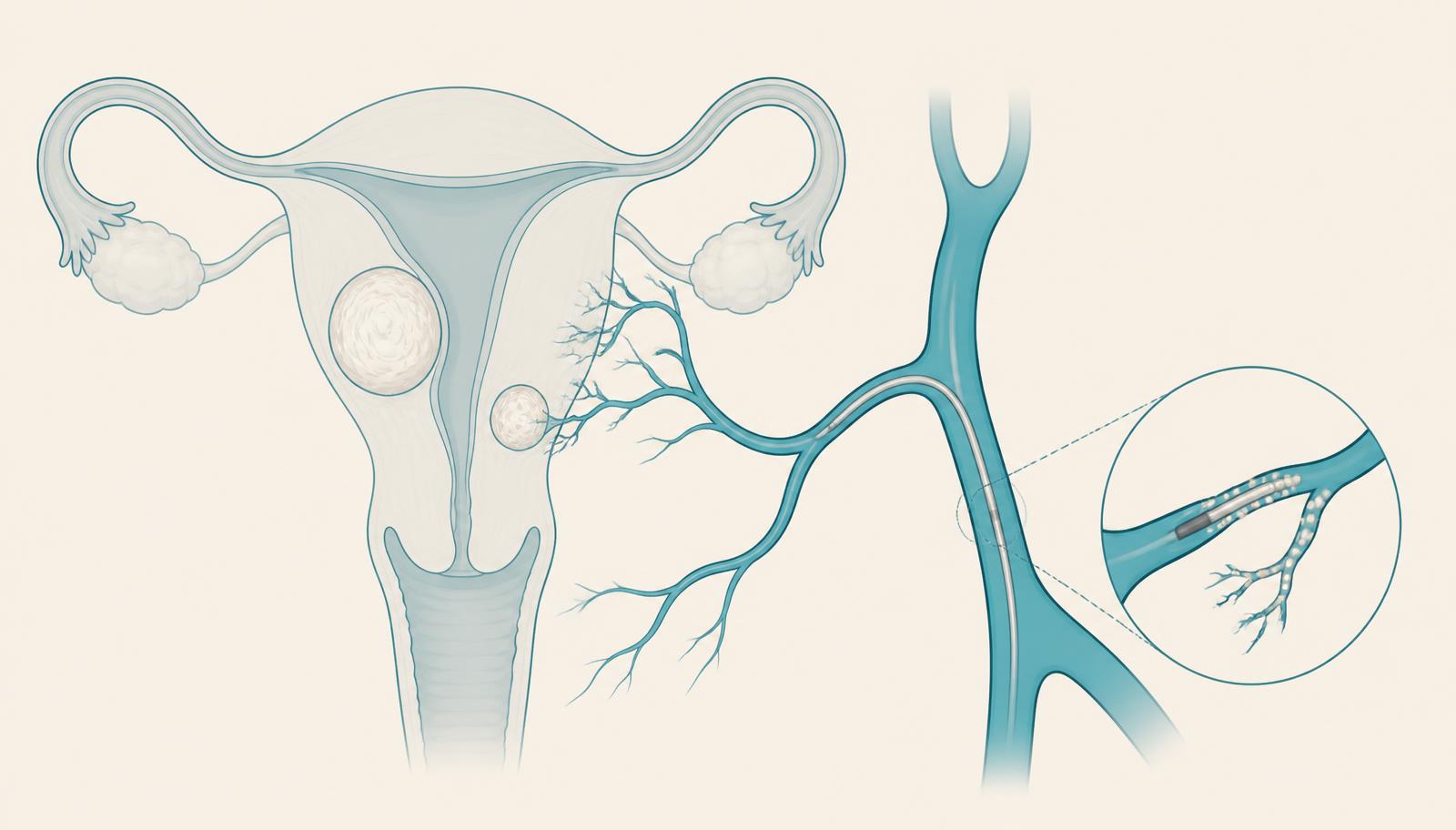
The most common question
Uterine artery embolization (UAE) treats fibroids without incisions: through a small puncture the arteries of the uterus are reached and the blood supply to the fibroids is reduced, so that they shrink. It works well for symptoms such as heavy periods and pelvic pressure. When a woman wishes to become pregnant, however, the question changes: does embolization put the chance of having a child at risk? In short, pregnancy after embolization is possible and well documented, but there is still no randomised study designed specifically to measure fertility. This is why the choice has to be made case by case.
Why fibroids can get in the way of pregnancy
Not all fibroids carry the same weight. Those that bulge towards the outside of the uterus (subserosal) generally have minimal effect. Those within the thickness of the wall (intramural) can reduce the chance of conception, while those that distort the inner cavity (submucosal) reduce it markedly and increase complications in pregnancy. For these, surgical removal, often hysteroscopically without abdominal incisions, remains the reference treatment for women seeking pregnancy.
What the supportive studies show
The largest series comes from Lisbon: 359 women with fibroids or adenomyosis who had been unable to conceive, followed for about six years after embolization. There were 149 pregnancies and 150 live-born babies; the probability of a spontaneous pregnancy was 29.5% at one year and 40.1% at two years. In 160 of these patients a partial embolization had been used, designed precisely to preserve fertility. An earlier study by the same group, of 74 women who wished to have a child, had already observed a pregnancy in 59.5% of cases, with live births in 84.6% of completed pregnancies. A French study published in an obstetrics journal followed 398 women under 43 who were not candidates for myomectomy, treated with a fertility-oriented technique that protects the ovaries when needed: 148 pregnancies, 109 live births and no major complications. A meta-analysis of 24 studies calculated that 40.5% of women who wished to have a child had at least one pregnancy after embolization, with rates of preterm birth (12.8%) and low birth weight (10%) that the authors consider similar to those of the general population.
Women with no other fertility problems
Many of the patients studied also had other obstacles to pregnancy, which makes the numbers hard to interpret. This is why a prospective French study is useful: it selected only women up to 40 years of age with multiple fibroids, an immediate wish for pregnancy and no other infertility factor, treated with a limited embolization. Over about three and a half years of follow-up there were 10 live births in 8 patients, and ovarian reserve remained stable. The British FEMME randomised trial, which compared embolization and myomectomy although it was not designed for fertility, also showed no disadvantage for embolization: over four years there were 12 pregnancies in the embolization group versus 6 in the surgery group, with 7 and 5 live births. These are, however, small numbers.
The evidence that calls for caution
There are also less favourable data, and it is right to know them. The same meta-analysis quoted above reports a pregnancy loss rate of 33.5%, mostly miscarriages. The 2014 Cochrane review suggests worse fertility outcomes than myomectomy, but the figure comes from a subgroup of only 66 women in a single study and is rated as very low quality. Two systematic reviews report fewer pregnancies and more miscarriages after embolization than after surgery (in one, live births in 60.6% versus 75.6% and miscarriages in 27.4%), again with low-quality evidence. A third meta-analysis, comparing embolization with other minimally invasive techniques, finds similar live birth rates (70.8% after embolization) but the highest miscarriage rate precisely with embolization (19.2%). A French study of women with very extensive fibroid disease, often previously operated on and with other infertility factors, observed only one pregnancy among 31 women who were trying, which then ended in miscarriage. Finally, a 2026 review published in the official journal of FIGO, the International Federation of Gynecology and Obstetrics, concludes that embolization is not recommended for women who wish to become pregnant.
How to read such different data
The key point is that the women treated with embolization in these studies are often not comparable with those who had surgery: many had multiple fibroids, recurrence after previous surgery or were not candidates for an operation, so they started from a more difficult situation. Without a randomised study dedicated to fertility we cannot say whether the difference depends on the technique or on the patients. This is the same conclusion reached by an expert panel of the Society of Interventional Radiology, which described reproductive outcomes after embolization as an open question and a research priority: not a proven contraindication, but an area that is still under-studied. A 2025 editorial in Cardiovascular and Interventional Radiology, tellingly entitled “Pregnancy and Uterine Artery Embolisation: Myth Busted”, points in the same direction.
When embolization makes sense for women hoping to conceive
If myomectomy is feasible and low-risk, especially with a fibroid that distorts the cavity and can be removed hysteroscopically, surgery generally remains the first choice. Embolization becomes a reasonable option when myomectomy is not feasible or is high-risk: multiple fibroids, recurrence after previous operations, or an informed choice to avoid surgery. In these cases it should be performed with a fertility-oriented technique, limited to the fibroids and with attention to the ovaries, and it must be said clearly that after embolization it is more common to need further treatment in the following years. The decision is made together with the gynaecologist and, when needed, the fertility specialist, after an MRI scan and an assessment of ovarian reserve.
Treatments discussed in this article
Scientific sources
- Pisco JM, Duarte M, Bilhim T, et al. Spontaneous pregnancy with a live birth after conventional and partial uterine fibroid embolization. Radiology. 2017;285(1):302-310.
- Serres-Cousine O, Kuijper FM, Curis E, Atashroo D. Clinical investigation of fertility after uterine artery embolization. Am J Obstet Gynecol. 2021;225(4):403.e1-403.e22.
- Ghanaati H, Sanaati M, Shakiba M, et al. Pregnancy and its outcomes in patients after uterine fibroid embolization: a systematic review and meta-analysis. Cardiovasc Intervent Radiol. 2020;43(8):1122-1133.
- Pisco JM, Duarte M, Bilhim T, Cirurgião F, Oliveira AG. Pregnancy after uterine fibroid embolization. Fertil Steril. 2011;95(3):1121.e5-1121.e8.
- Torre A, Fauconnier A, Kahn V, et al. Fertility after uterine artery embolization for symptomatic multiple fibroids with no other infertility factors. Eur Radiol. 2017;27(7):2850-2859.
- Daniels J, Middleton LJ, Cheed V, et al. Uterine artery embolisation versus myomectomy for premenopausal women with uterine fibroids wishing to avoid hysterectomy: the FEMME RCT. Health Technol Assess. 2022;26(22):1-74.
- Akhatova A, Aimagambetova G, Bapayeva G, et al. Reproductive and obstetric outcomes after UAE, HIFU, and TFA of uterine fibroids: systematic review and meta-analysis. Int J Environ Res Public Health. 2023;20(5):4480.
- Gupta JK, Sinha A, Lumsden MA, Hickey M. Uterine artery embolization for symptomatic uterine fibroids. Cochrane Database Syst Rev. 2014;(12):CD005073.
- Karlsen K, Hrobjartsson A, Korsholm M, et al. Fertility after uterine artery embolization of fibroids: a systematic review. Arch Gynecol Obstet. 2018;297(1):13-25.
- Khaw SC, Anderson RA, Lui MW. Systematic review of pregnancy outcomes after fertility-preserving treatment of uterine fibroids. Reprod Biomed Online. 2020;40(3):429-444.
- Torre A, Paillusson B, Fain V, et al. Uterine artery embolization for severe symptomatic fibroids: effects on fertility and symptoms. Hum Reprod. 2014;29(3):490-501.
- Mocanu E, Tarlatzis B, Feldberg D, et al. Fibroids and infertility. Int J Gynaecol Obstet. 2026;174(1):11-16.
- Stewart JK, Myers E, Petrozza J, et al. Reproductive outcomes of patients undergoing uterine artery embolization for uterine fibroids: proceedings from the Dr. James B. Spies Summit for Uterine Fibroid Research. J Vasc Interv Radiol. 2024;35(9):1288-1295.
- Clements W, Goh GS, Lukies MW. Pregnancy and uterine artery embolisation: myth busted. Cardiovasc Intervent Radiol. 2025;48(5):583-584.
Want to know if it applies to you?
At the first consultation we review your clinical history and previous imaging together.
More articles
The information on this page is for general education and does not replace a medical consultation. The indication for any treatment must always be assessed individually.