
2 October 2026
Genicular artery embolization: are resorbable microspheres a new option?
A new Italian study and a commentary in Cardiovascular and Interventional Radiology bring resorbable particles for genicular artery embolization back into focus. What we really know, and what we do not yet know.
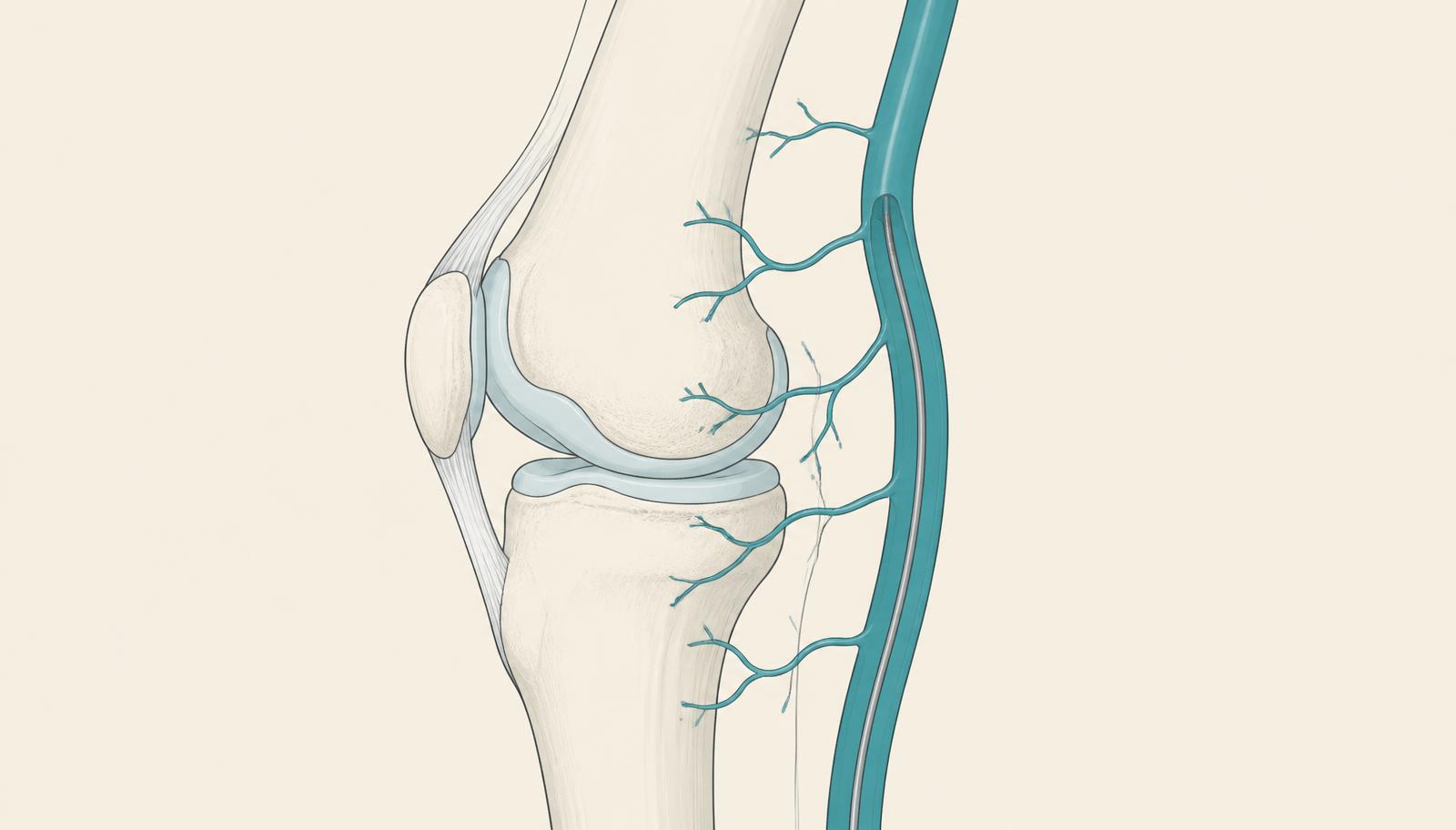
What we are talking about
Genicular artery embolization (GAE), also known in the literature as TAME (transcatheter arterial micro-embolization), is a minimally invasive procedure for knee osteoarthritis pain that no longer responds to medication, physiotherapy and injections. Through an arterial access of a few millimetres, the small abnormal vessels that feed the inflammation of the synovial membrane are reached and selectively closed. For knee osteoarthritis the technique was first described by the Japanese group of Yuji Okuno, in a study published in 2015, and it has since been adopted in many centres.
Why the embolic material matters
Different materials can be used to close those vessels: permanent microspheres, which stay where they are released, or temporary agents, which dissolve within hours or days and allow the vessel to reopen. The aim of GAE is not to permanently deprive the tissue of blood, but to switch off the excess of inflammatory vascularisation. This is why it has long been asked whether a merely transient occlusion could achieve the same benefit with a greater safety margin. In addition, some of the temporary agents used so far are used off-label or are not available everywhere.
Degradable starch microspheres
Degradable starch microspheres (DSM) are particles of about 50 microns that temporarily close the vessel and are then broken down by an enzyme present in the blood, amylase, allowing blood flow to be progressively restored. They have been used for years in other areas of interventional radiology, for example in liver oncology. In 2026 a group from Sapienza University in Rome published the first prospective experience with DSM in genicular artery embolization.
1. Release
The microspheres, about 50 microns in size, are injected into the small arteries feeding the inflammation.
2. Temporary occlusion
They lodge in the vessel and reduce blood flow to the inflamed synovium.
3. Degradation
A blood enzyme, amylase, breaks down the starch and the particles dissolve.
4. The vessel reopens
Blood flow is restored: the aim is to switch off the inflammation, not to cut off blood supply for good.
What the study showed
Zolovkins and colleagues treated 16 patients, 19 knees in total, with osteoarthritis resistant to conventional treatment. There were no complications: the only effect observed was a transient reddening of the skin around the knee, which resolved spontaneously within two hours. Counting as a success an improvement of at least 50% in both pain and function, the procedure worked in 89% of knees at 48 hours, in 84% at one month and in 68% at six and twelve months. Average pain fell from 7.2 to 2.5 out of 10 at one month and settled at around 3.3 between six and twelve months.
The limitations, read honestly
In the commentary published in the same issue of Cardiovascular and Interventional Radiology, Ali Dablan describes DSM as a promising option but points out important limitations: the sample is small, there is no comparison group with other materials, synovial perfusion was not measured with imaging, and the duration of the benefit beyond the first year remains to be shown. It is worth adding that another resorbable material, alginate microspheres, had shown encouraging results in 2025 in a first study of 15 patients: a sign that interest in temporary agents is real, but the numbers are still small.
What our meta-analysis says
The comparison between permanent and temporary agents was precisely the subject of a systematic review and meta-analysis that I published in 2026 in the European Journal of Radiology, analysing 22 studies with 633 patients and 719 knees. Pain decreases markedly and similarly both with permanent microspheres and with the most studied temporary agent (imipenem/cilastatin). The three randomised trials against a simulated (sham) procedure, however, taken together did not show a significant benefit over placebo: this is the highest-quality evidence available today, and it must be stated clearly. In terms of safety the materials are not equivalent: small areas of asymptomatic bone damage (focal osteonecrosis) have been described only with permanent microspheres.
What it means if your knee hurts
Genicular artery embolization remains an option to consider when osteoarthritis pain limits daily life despite conservative treatment, especially if knee replacement is not yet indicated or you would rather postpone it. Temporary agents, including the new resorbable microspheres, are interesting because they aim to achieve the same effect with fewer long-term risks, but larger studies with a control group are needed to understand which material is best. At the consultation we assess together whether you are a good candidate and which approach makes most sense in your case, with realistic expectations.
Treatments discussed in this article
Scientific sources
- Okuno Y, Korchi AM, Shinjo T, Kato S. Transcatheter arterial embolization as a treatment for medial knee pain in patients with mild to moderate osteoarthritis. Cardiovasc Intervent Radiol. 2015;38(2):336-343.
- Little MW, Agarwal S, Khikmatovich IM, et al. First-in-human evaluation of a new resorbable microspherical embolic agent for genicular artery embolization to treat pain secondary to knee osteoarthritis. J Vasc Interv Radiol. 2025;36(11):1658-1666.
- Zolovkins A, Orgera G, Campagna G, et al. Safety and feasibility of genicular artery embolization with degradable starch microspheres for knee osteoarthritis: a one year experience and preliminary clinical results. Cardiovasc Intervent Radiol. 2026;49(7):1285-1292.
- Dablan A. Genicular artery embolization for knee osteoarthritis: do degradable starch microspheres offer a new therapeutic option? Cardiovasc Intervent Radiol. 2026;49:1293-1294.
- Lanza E, Poretti D, Pedicini V, Kon E, Laghi A. Permanent vs. temporary embolic agents in genicular artery embolization for knee osteoarthritis: a systematic review and meta-analysis. Eur J Radiol. 2026;202:112968.
Want to know if it applies to you?
At the first consultation we review your clinical history and previous imaging together.
More articles
The information on this page is for general education and does not replace a medical consultation. The indication for any treatment must always be assessed individually.