
20 October 2026
Knee embolization: is it safe? Data from 2,335 procedures in Germany
After "does it work?", the most common question about knee embolization is "is it safe?". A German national registry of 2,335 procedures answers with the largest series ever collected, and with limits that need to be stated clearly.
Why this study matters
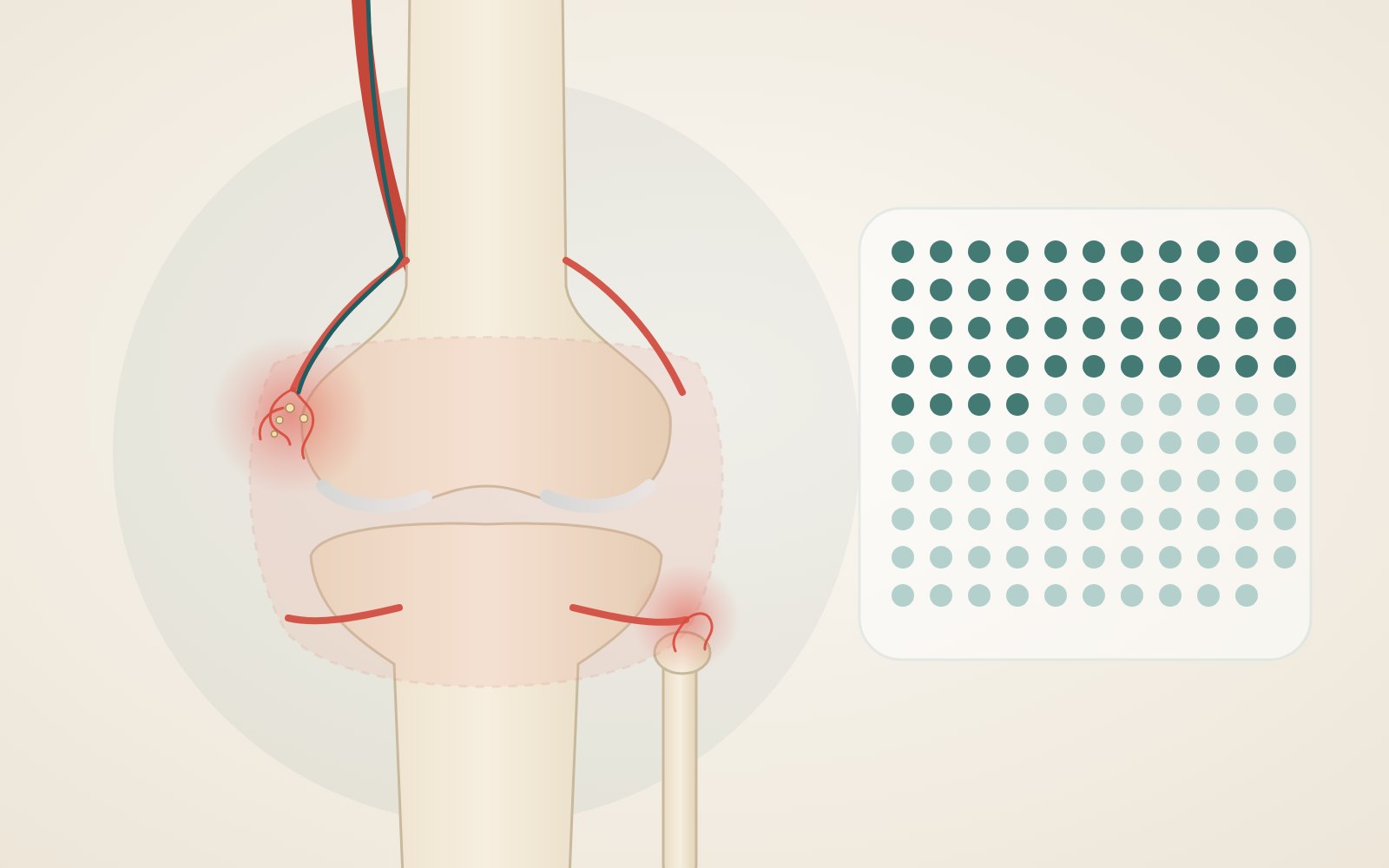
Genicular artery embolization is a minimally invasive procedure for knee osteoarthritis pain when exercise, medication and injections no longer help and a knee replacement is not yet indicated, or the patient prefers to postpone it. Through an arterial access of a few millimetres, the small abnormal vessels feeding the inflamed synovium are reached and selectively closed. Until now, safety data came mainly from single-centre series of a few dozen to a few hundred patients. On 19 October 2026, Cardiovascular and Interventional Radiology published the first nationwide analysis: the quality-assurance registry of the German Society for Interventional Radiology (DeGIR), which collects procedures from more than 300 centres in Germany.
What was analysed
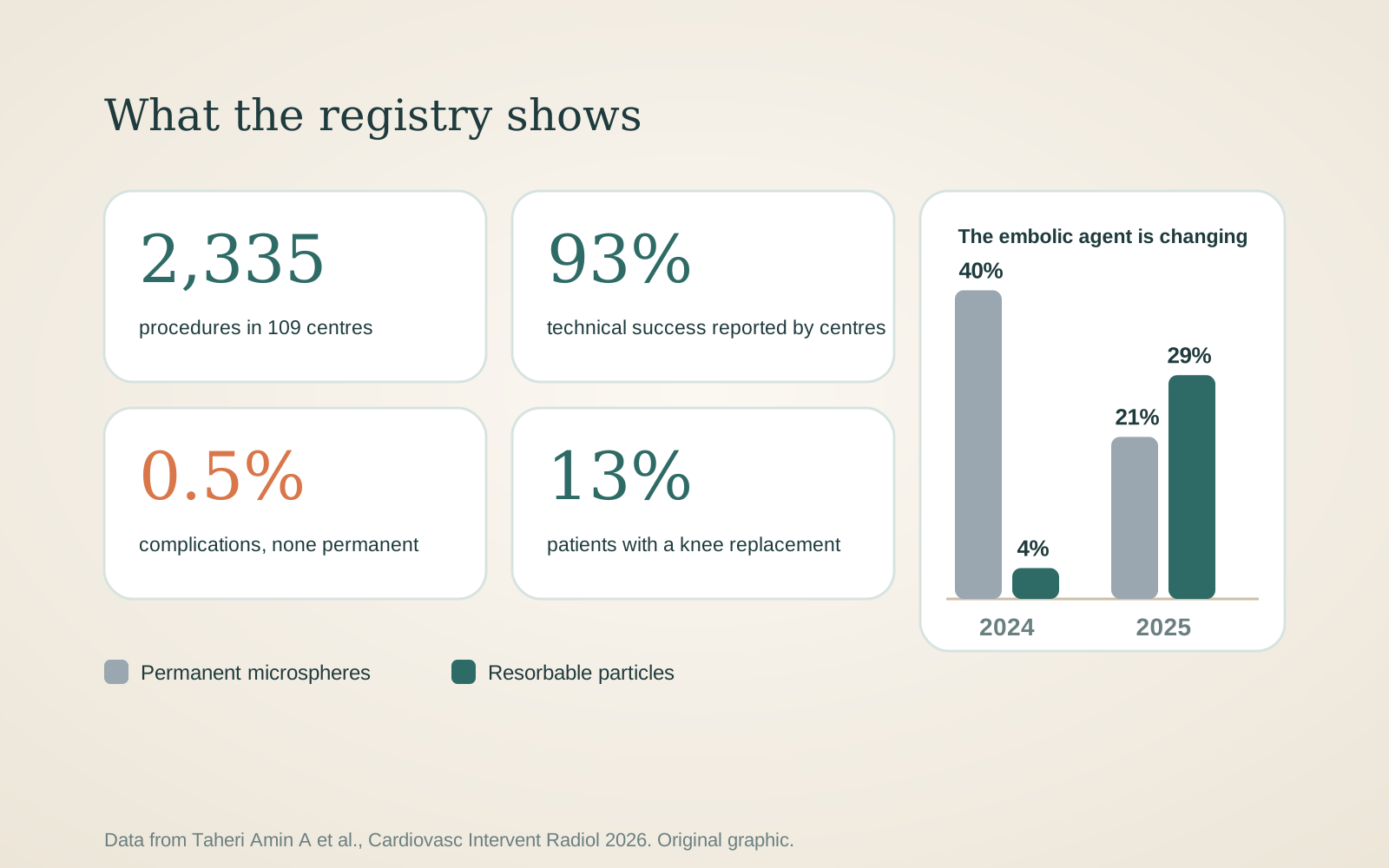
Taheri Amin and colleagues examined every knee embolization recorded between January 2024 and December 2025: 2,335 procedures in 2,209 patients, performed at 109 centres in 15 German states. Median age was 67 years and 57% of patients were women. In 300 procedures, 13%, the patient already had a knee replacement with pain persisting after surgery. The analysis is descriptive: it shows how the procedure is performed in everyday practice, with which materials, how many complications and how much radiation exposure.
A procedure spreading fast
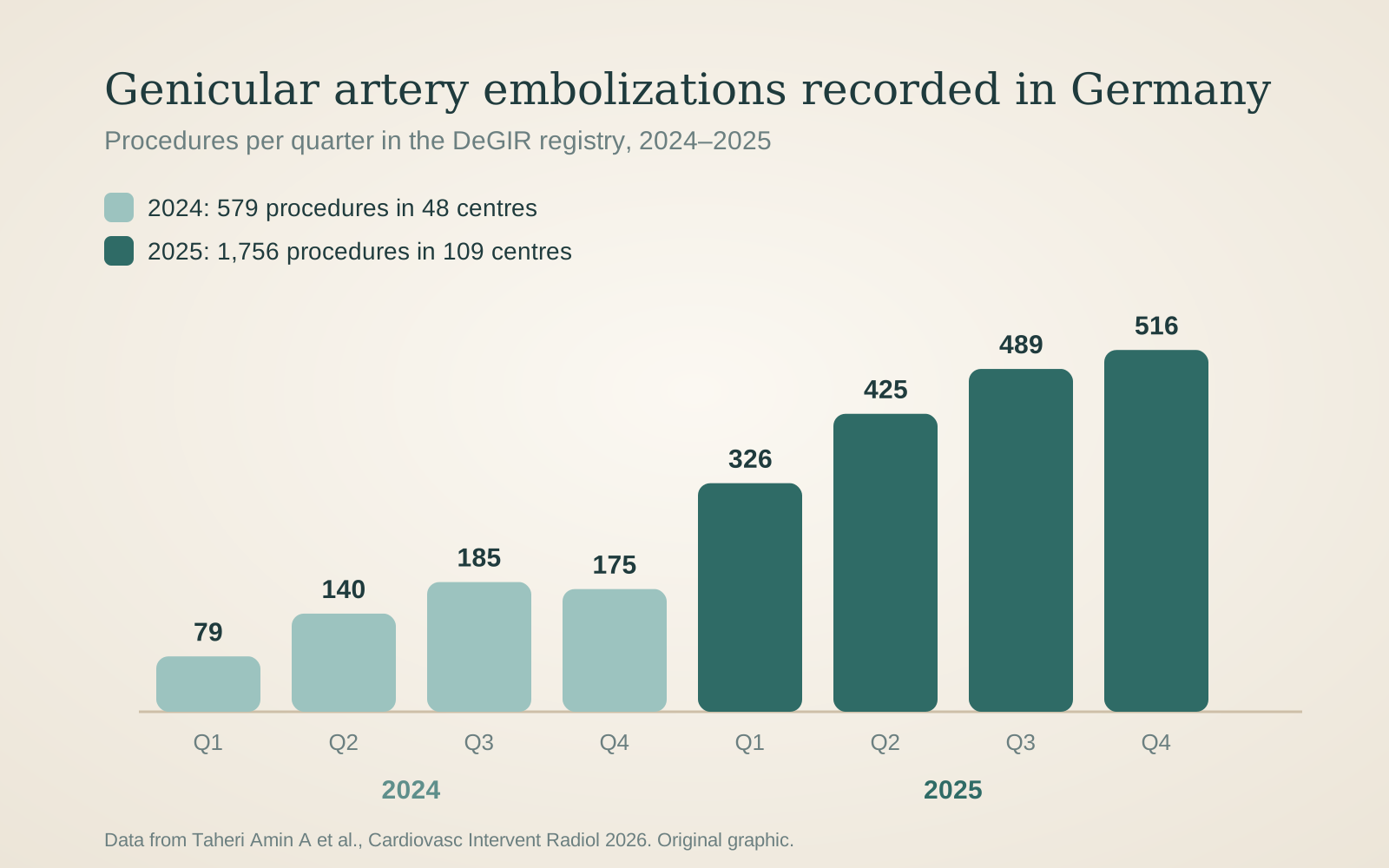
Numbers changed a lot in two years. In 2024, 579 procedures were recorded at 48 centres; in 2025 there were 1,756, three times as many, at 109 centres. Quarter by quarter, volume rose from 79 to 516 procedures. It reflects growing interest in an option that sits between conservative care and surgery. The authors themselves note, however, that this adoption is moving faster than the randomised evidence, which remains limited and not entirely consistent.
How safe it is
Across 2,335 procedures, 11 complications were recorded, 0.5%: four arterial bleeds, two arterial occlusions, one tissue bleed, one allergic reaction and three not further specified. All were grade 1 to 3 on the scale of the Cardiovascular and Interventional Radiological Society of Europe (CIRSE); none left permanent sequelae and there were no deaths. Technical success, meaning closure of the inflamed vessels according to the operator, was 93%, rising from 87% in 2024 to 94% in 2025. Radiation exposure was also low: a median dose of 1,536 cGy·cm² with 24 minutes of fluoroscopy, below the values reported in prospective studies.
Also when pain persists after a knee replacement
Up to one person in five still has pain after a successful knee replacement. The registry included 300 such patients: older, 71 years on average, and more often women. The procedure took slightly more time and radiation, because of the altered anatomy and metal artefacts, but technical success (95%) and complications (0.3%) were similar to patients without a replacement. In these cases the orthopaedic surgeon must always rule out infection or a mechanical problem with the implant first.
The material is changing
The vessels can be closed with permanent microspheres or with resorbable particles, which dissolve and let the vessel reopen. In the registry, permanent microspheres fell from 40% of procedures in 2024 to 21% in 2025, while resorbable particles rose from 4% to 29%. To explain this shift, the authors cite the systematic review and meta-analysis I published in 2026 in the European Journal of Radiology, in which permanent and temporary agents showed similar pain reduction, while small areas of asymptomatic bone injury were described only with permanent microspheres.
The limits, stated clearly
A registry measures safety and feasibility, not effectiveness: it does not record pain, knee function or follow-up in the following months, so it does not tell us how much better patients felt. Data are entered voluntarily by the centres and are not audited: the 0.5% complication rate should be read as a minimum estimate, and mild, temporary effects such as a bruise or skin redness over the knee, described in prospective studies in 11–18% of cases, are not recorded here. Technical success is also reported by the treating centre. On clinical benefit, the highest-quality evidence remains the randomised trials against a sham procedure, which so far have not given consistent results.
What it means if your knee hurts
This study does not say whether embolization works, but it gives a solid answer to another important question: performed at many different centres, in everyday practice, the procedure has few relevant complications and a low radiation dose. It remains an option to consider when osteoarthritis pain limits daily life despite conservative care, with mild or moderate osteoarthritis, when it is too early for a replacement or when pain persists after one. At the visit we review your imaging and symptoms together, and I tell you frankly whether you are a good candidate and what is reasonable to expect.
Treatments discussed in this article
Scientific sources
- Taheri Amin A, Martínez Safar IE, Collettini F, et al. Technique, safety and adoption of genicular artery embolization for knee osteoarthritis: a nationwide analysis of the German quality-assurance registry. Cardiovasc Intervent Radiol. 2026.
- Okuno Y, Korchi AM, Shinjo T, Kato S. Transcatheter arterial embolization as a treatment for medial knee pain in patients with mild to moderate osteoarthritis. Cardiovasc Intervent Radiol. 2015;38(2):336-343.
- Amin AT, Safar IEM, Trujillo RB, et al. Outcome and safety of genicular artery embolization for knee osteoarthritis: a systematic review and meta-analysis. Cardiovasc Intervent Radiol. 2026;49:1682-1697.
- Lanza E, Poretti D, Pedicini V, Kon E, Laghi A. Permanent vs. temporary embolic agents in genicular artery embolization for knee osteoarthritis: a systematic review and meta-analysis. Eur J Radiol. 2026;202:112968.
- Konduru N, Hnatov A, Joshua SP, et al. Genicular artery embolization as a treatment option for refractory knee pain post total knee arthroplasty: a prospective series. Cardiovasc Intervent Radiol. 2026;49:1384-1390.
- Ahmed O, Taslakian B, Okuno Y, et al. Society of Interventional Radiology position statement on genicular artery embolization for symptomatic knee osteoarthritis. J Vasc Interv Radiol. 2026;37:108803.
- Filippiadis D, Pereira PL, Hausegger KA, Ryan AG, Binkert CA. CIRSE standards of practice for the classification of complications: the modified CIRSE classification system. Cardiovasc Intervent Radiol. 2025;49:2-6.
Want to know if it applies to you?
At the first consultation we review your clinical history and previous imaging together.
More articles
The information on this page is for general education and does not replace a medical consultation. The indication for any treatment must always be assessed individually.