
6 October 2026
A knee replacement that still hurts: the role of embolization (TAME)
After a knee replacement about one person in five still has pain, even when the operation has gone well. In some cases the cause is persistent inflammation of the tissues around the prosthesis: this is where musculoskeletal embolization may have a role.
When the knee replacement still hurts
Knee replacement is one of the most effective operations in orthopaedics, but it does not relieve pain in everyone. A systematic review of prospective studies in unselected patients found an unfavourable long-term pain outcome in 10-34% of people after knee replacement, and around 20% in the best-quality studies. These patients are often frustrated: the X-rays show a well-positioned prosthesis, yet the knee keeps hurting, swelling or limiting walking.
First of all: rule out causes that need different treatment
Pain after knee replacement must always be investigated together with the orthopaedic surgeon, because some causes require specific treatment: infection of the prosthesis, loosening of the components, instability, incorrect positioning or patellar problems. This is why an orthopaedic assessment, X-rays, blood tests for inflammation and, when indicated, aspiration of joint fluid or other imaging are needed. Embolization comes into play only once these causes have been excluded, when pain persists despite a stable prosthesis with no infection.
Why embolization can help
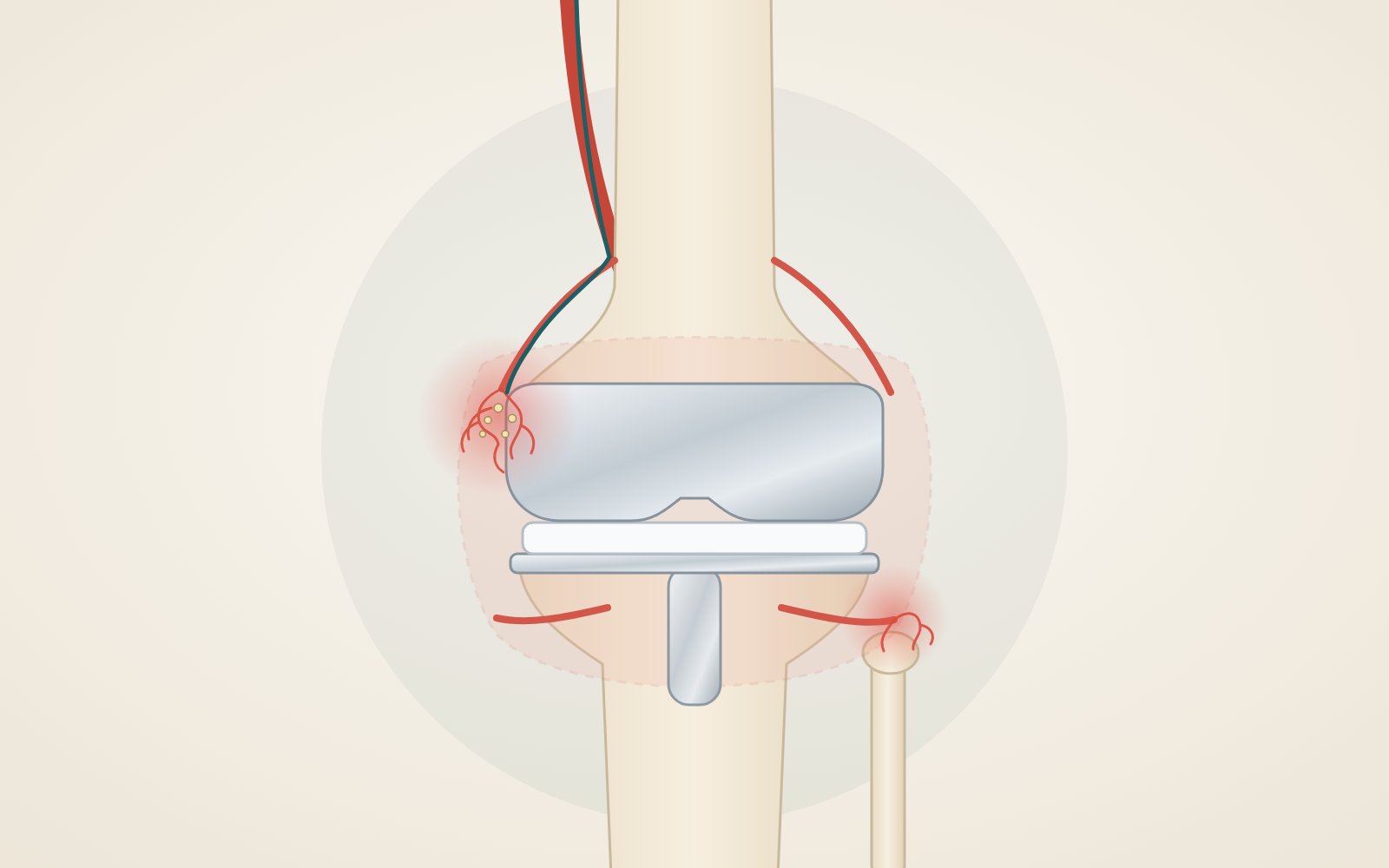
In some of these patients the tissues around the prosthesis remain inflamed: the residual synovial membrane and the capsule develop a network of small abnormal vessels, accompanied by nerve fibres that amplify pain, the same mechanism seen in osteoarthritis. Musculoskeletal embolization, also known in the literature as TAME (transcatheter arterial micro-embolization), reaches these vessels from within with a microcatheter introduced through an artery and closes them selectively. It is the same procedure used for knee osteoarthritis: the metal prosthesis is not an obstacle, because the treatment works on the vessels, not on the joint.
What the first studies show
Studies dedicated to pain after knee replacement are still few and small, but they point in the same direction. In a French prospective pilot study of 12 patients treated with 75-micron microspheres, pain when walking fell on average from 73 to 38 out of 100 at six months, and 55% of patients achieved a clinically meaningful improvement in pain. An Argentinian multicentre series of 16 patients reported a reduction in pain from 7.0 to 3.4 out of 10, with pain halved in 62.5% of cases at six months and reduced painkiller use in as many patients. An American series of 37 patients with pain lasting more than a year observed a fall from 8.1 to 3.1 out of 10 at three months, with at least a 50% improvement in 65% of cases, but with very short follow-up. None of these studies reported major complications.
How long the benefit lasts
The study with the longest follow-up, a German series published in 2026 of 15 patients treated with imipenem/cilastatin, is also the most cautious. Pain fell sharply in the first month (from 7 to 1 out of 10, median values) and remained lower at three and six months, but at twelve months it had risen back to 5: only just over half of the evaluable patients kept a meaningful improvement at one year, and 20% had the procedure repeated. Four of the seven patients who were taking opioids had, however, stopped them. The authors describe an early benefit of variable duration, and that is the right way to present it.
A closely related indication: effusion and bleeding after knee replacement
Embolization of the vessels around the prosthesis has a longer track record in a different but related problem: recurrent effusions and bleeding in the replaced knee. A systematic review of 214 patients with recurrent joint bleeding after knee replacement reported improvement in symptoms in 72.6% of cases, with the procedure having to be repeated in about one in three. In a series of 18 knee replacements with recurrent effusion, the effusion resolved completely on ultrasound in 77.8% of cases. These data confirm that the technique is feasible and safe in these patients.
The limitations, stated clearly
None of the studies on pain after knee replacement has a control group, the patients number a few dozen at most and follow-up rarely goes beyond one year. This matters, because in knee osteoarthritis our meta-analysis published in 2026 showed that the three randomised trials against a simulated procedure, taken together, did not show a significant benefit over placebo: in pain after knee replacement, too, part of the improvement may be due to this effect. Reported side effects include a transient change in skin colour around the knee (in about four patients in ten in one study) and, in some cases, a temporary increase in pain in the following days, managed with painkillers.
Who it may suit
Embolization is an option to consider when pain has persisted for many months after knee replacement, the orthopaedic surgeon has excluded infection, loosening and mechanical problems, conservative treatment has not been enough and a further operation is not indicated or the patient would rather avoid it. In these cases it can offer real relief with a procedure under local anaesthesia and same-day discharge, but it should be offered with realistic expectations: the benefit is often quick, its duration varies from person to person and sometimes the procedure needs to be repeated. The decision is made together with the orthopaedic surgeon who looks after the prosthesis.
Treatments discussed in this article
Scientific sources
- Beswick AD, Wylde V, Gooberman-Hill R, Blom A, Dieppe P. What proportion of patients report long-term pain after total hip or knee replacement for osteoarthritis? A systematic review of prospective studies in unselected patients. BMJ Open. 2012;2(1):e000435.
- Chau Y, Roux C, Gonzalez JF, et al. Effectiveness of geniculate artery embolization for chronic pain after total knee replacement: a pilot study. J Vasc Interv Radiol. 2023;34(10):1725-1733.
- Bertoni HG, Viso RG, Rosado M, et al. Genicular artery embolization for persistent pain after total knee arthroplasty: initial clinical experience. J Vasc Interv Radiol. 2026;37(3):107932.
- Konduru N, Hnatov A, Joshua SP, et al. Genicular artery embolization as a treatment option for refractory knee pain post total knee arthroplasty: a prospective series. Cardiovasc Intervent Radiol. 2026;49(7):1384-1390.
- Tuna HS, Reichardt B, Kabir K, et al. Genicular artery embolization for refractory pain after knee arthroplasty: clinical outcomes from a retrospective pilot study. CVIR Endovasc. 2026;9(1).
- Melian CM, Giannopoulos S, Tsouknidas I, et al. Geniculate artery endovascular embolization post-total knee arthroplasty for hemarthrosis treatment: a systematic review of the literature. J Endovasc Ther. 2024;31(6):1158-1164.
- Lutz RW, Post ZD, Thalody HS, et al. Genicular artery embolization: a promising treatment option for recurrent effusion following total knee arthroplasty. HSS J. 2024;20(4):508-514.
- Lanza E, Poretti D, Pedicini V, Kon E, Laghi A. Permanent vs. temporary embolic agents in genicular artery embolization for knee osteoarthritis: a systematic review and meta-analysis. Eur J Radiol. 2026;202:112968.
Want to know if it applies to you?
At the first consultation we review your clinical history and previous imaging together.
More articles
The information on this page is for general education and does not replace a medical consultation. The indication for any treatment must always be assessed individually.