
7 October 2026
Hip pain from osteoarthritis or trochanteric pain syndrome: what embolization (TAME) can do
The HipE study, just published in Cardiovascular and Interventional Radiology, provides the first one-year data on embolization for hip pain, from both osteoarthritis and greater trochanteric pain syndrome. What it shows, and how it fits with the rest of the literature.
Two common causes of hip pain
Hip osteoarthritis typically causes pain in the groin, morning stiffness and difficulty walking, climbing stairs or putting on shoes. Greater trochanteric pain syndrome, by contrast, is pain on the outer side of the hip, linked to damage to the gluteal muscle tendons and nearby bursae: standing for long periods, climbing stairs and above all sleeping on that side are painful. For both, treatment starts with exercise, weight control, medication and ultrasound-guided injections; for advanced osteoarthritis, hip replacement is the definitive solution. There remains, however, a group of patients with persistent pain who are not yet candidates for replacement, cannot have surgery or would rather postpone it.
Why embolization
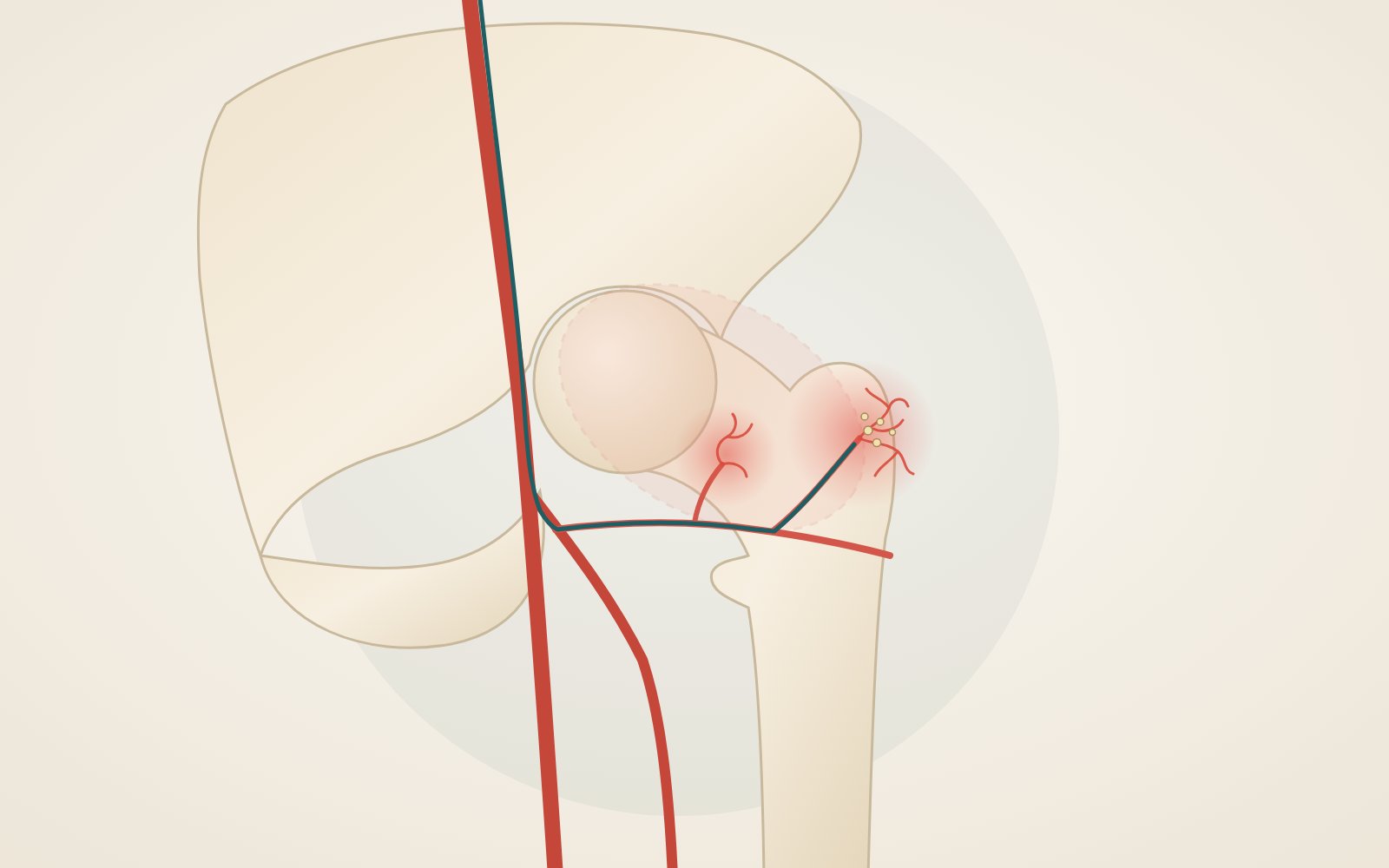
The principle is the same as genicular artery embolization in the knee: small abnormal vessels develop in the inflamed tissues around the joint and the tendons, accompanied by nerve fibres that amplify pain. With musculoskeletal embolization, known in the literature as TAME (transcatheter arterial micro-embolization), a microcatheter introduced through an artery reaches these vessels and closes them selectively. In the hip the main target is the branches of the lateral circumflex femoral artery, sometimes together with branches of the internal iliac artery. The most recent studies use temporary agents, such as imipenem/cilastatin, which close the vessels only for a limited time.
The HipE study
HipE is a prospective study carried out in Porto between 2023 and 2025. Of 49 patients treated with imipenem/cilastatin, 37 completed one year of follow-up: 31 with hip osteoarthritis, from mild to severe, and 6 with isolated trochanteric pain syndrome. At twelve months pain had fallen on average from 7.8 to 4.0 out of 10 and the WOMAC score, which measures pain, stiffness and function, from 54 to 24, with clear improvements in stiffness and daily activities too. Counting as a success a reduction of at least 50% in pain or in the WOMAC score, the procedure worked in 73% of patients. The only complications were two small bruises in the groin, and results did not differ between osteoarthritis and trochanteric pain syndrome.
The other studies point the same way
A series from the Charité in Berlin of 41 patients with hip osteoarthritis, treated with temporary agents, reported a fall in pain from 7 to 4 out of 10 at one year, with a clinically meaningful improvement in pain in 64.3% of cases; only two patients went on to need a hip replacement. In Italy, the FIRE-NEM study in Turin treated hip, knee and shoulder with the same technique, including 24 hip procedures: a clinically meaningful improvement in pain was present in 71.4% of procedures at six months, with no significant differences between joints. None of these studies reported major complications: the side effects described were small bruises at the access site and, in some patients treated with imipenem/cilastatin, a transient change in skin colour.
Not everyone responds in the same way
A non-randomised Romanian study published in 2026 compared embolization with conservative treatment alone in patients aged 60 or over with hip osteoarthritis who were not candidates for replacement, often with more advanced osteoarthritis. In this group the improvement was smaller: pain fell from 74 to 55 out of 100 in the first three months and then levelled off. This is useful for setting realistic expectations: when the joint is badly worn, embolization can ease pain but does not replace a hip replacement.
The limitations
For the hip there are not yet any randomised trials against a simulated procedure: the series are single-arm, with a few dozen patients and follow-up of no more than one year. This is an important limitation, because in knee osteoarthritis, where the technique is most studied, our 2026 meta-analysis showed that the three randomised trials against a simulated procedure did not show a significant benefit over placebo. The hip results are encouraging, but they need to be confirmed by controlled studies.
Who it may suit
Hip embolization is an option to consider when pain from mild or moderate osteoarthritis, or from trochanteric pain syndrome, persists despite exercise, medication and ultrasound-guided injections, and when hip replacement is not yet indicated, is not possible or the patient would rather postpone it. It is performed under local anaesthesia through an access of a few millimetres, with same-day discharge. A careful assessment is needed first, with a clinical examination, an X-ray and possibly ultrasound or MRI, to understand where the pain really comes from: the hip, the gluteal tendons or, not uncommonly, the lumbar spine.
Treatments discussed in this article
Scientific sources
- Cavalheiro F, Marinho Lopes P, Sousa F, Sousa P, Linhares D, Neves N. HipE study—hip embolization for pain control in hip osteoarthritis and greater trochanteric pain syndrome: 12 months follow-up. Cardiovasc Intervent Radiol. 2026;49(7):1295-1305.
- Fleckenstein FN, Maleitzke T, Oehme S, et al. Transarterial embolization for the treatment of symptomatic hip osteoarthritis. Cardiovasc Intervent Radiol. 2026;49(7):1352-1361.
- Discalzi A, Brino J, Nardelli F, et al. Multi-site efficacy and safety of transarterial microembolization with imipenem/cilastatin for refractory musculoskeletal pain: a single-centre analysis of hip, knee and shoulder (FIRE-NEM study). Radiol Med. 2026.
- Feier AM, Bloj F, Russu OM, et al. Periarticular embolization as an alternative treatment for surgery-ineligible patients with hip osteoarthritis: a prospective comparative study. J Clin Med. 2026;15(13):5108.
- Lanza E, Poretti D, Pedicini V, Kon E, Laghi A. Permanent vs. temporary embolic agents in genicular artery embolization for knee osteoarthritis: a systematic review and meta-analysis. Eur J Radiol. 2026;202:112968.
Want to know if it applies to you?
At the first consultation we review your clinical history and previous imaging together.
More articles
The information on this page is for general education and does not replace a medical consultation. The indication for any treatment must always be assessed individually.