
Varicocele, uterus and prostate
Prostatic artery embolization (benign prostatic hyperplasia, the enlarged prostate)
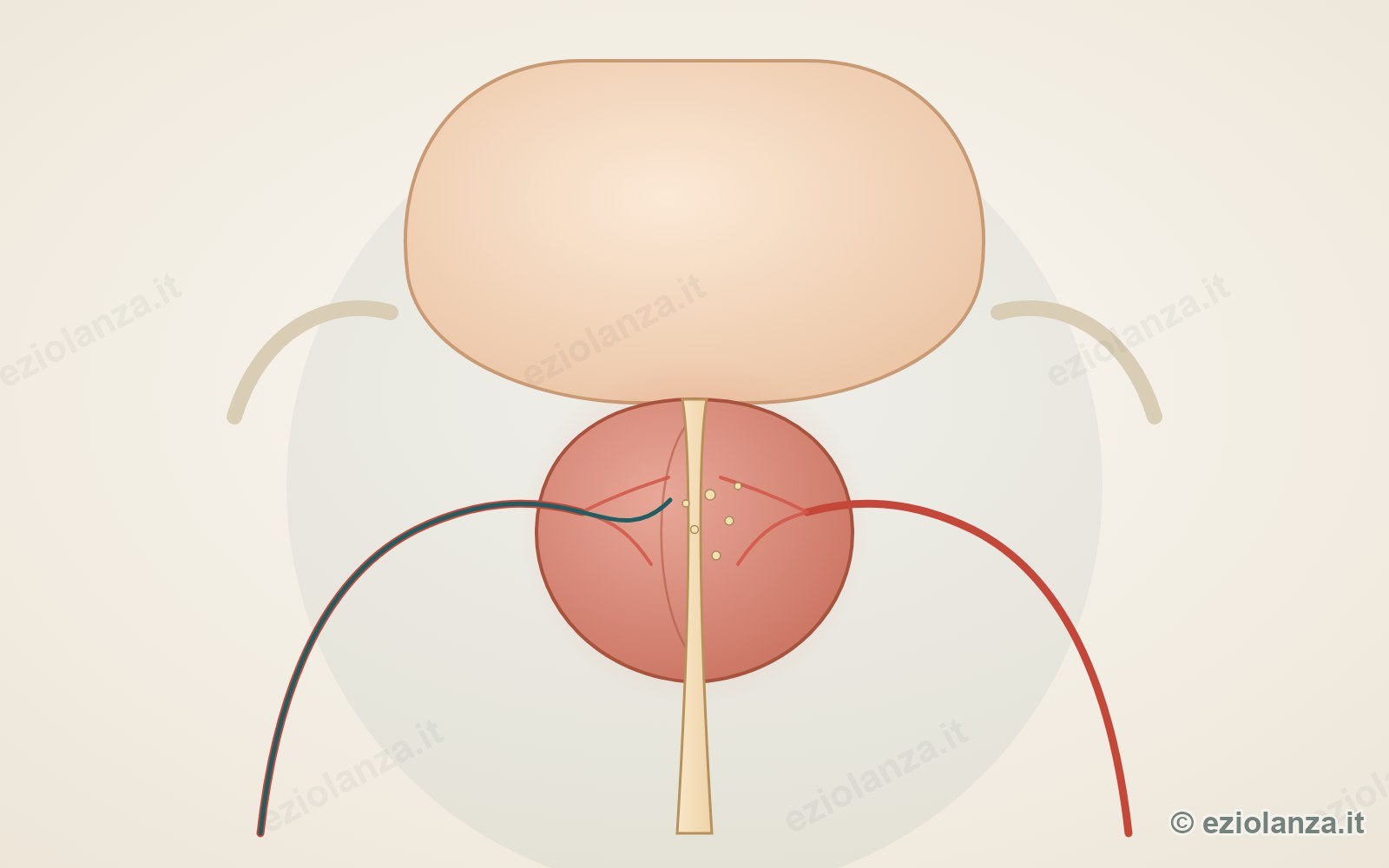
When benign prostatic hyperplasia makes urinating difficult, surgery is often proposed. But there is an alternative: from inside the vessels, the arteries feeding the prostate are closed and the gland shrinks. No cutting, no hospital stay, the prostate stays and ejaculation is preserved.
How it is performed
Through a puncture of a few millimetres at the groin or the wrist, a very thin catheter is guided to the prostatic arteries, the two small vessels that feed the gland. A CT scan performed in the room, on the table, identifies them precisely, because their anatomy varies from person to person. A microcatheter reaches them and releases microparticles that stop the flow to the enlarged part of the prostate. Deprived of blood, this part shrinks over the following months, by 20-30% in volume, and frees the urethra, which is never touched. The prostate is not removed: it stays in place, without scars. The procedure takes one to two hours under local anaesthesia, and you go home the same day or the next. If surgery were ever needed in the future, embolization does not prevent it.
Who it is for
- Moderate or severe urinary symptoms from benign prostatic hyperplasia, when medication is not enough or causes side effects
- Men who want to avoid endoscopic surgery and preserve the prostate and ejaculation
- Medium and large prostates, where endoscopic techniques are more demanding
- Men who cannot face surgery because of age, anticoagulant therapy or other conditions
- Urinary retention with an indwelling catheter and recurrent bleeding from the prostate
Recovery
Home the same day or the next, without a catheter in most cases. For a few days there may be burning on urination, urgency and a mild fever, which settle with simple medication. Normal activities within 2-3 days. Symptoms improve progressively over 1-3 months as the prostate shrinks. Follow-up is done together with the urologist.
Conditions treated in this area: chronic pelvic pain and pelvic varicocele, uterine fibroids with pain and bleeding, adenomyosis with heavy, painful periods, benign prostatic hyperplasia (enlarged prostate) with difficulty urinating.
Why choose embolization
Endoscopic surgery works well, but even when performed perfectly it carries consequences that do not depend on the surgeon: retrograde ejaculation in most cases, possible narrowing of the urethra and urine leakage, a hospital stay and spinal or general anaesthesia. Embolization works from inside the vessels: the urethra and the sphincter are not touched, the prostate stays and sexual function is preserved.
Before the procedure
A urological assessment, PSA and, when indicated, the tests that rule out a tumour are needed. A contrast CT of the pelvic vessels checks that the prostatic arteries can be navigated. It is not suitable in case of severe atherosclerosis of the pelvic arteries or a very small prostate.
Scientific evidence
In a randomised trial against a sham procedure (European Urology 2020, 80 patients) embolization improved symptoms by 13 points more than placebo. In the British UK-ROPE registry (305 patients) symptoms improved by 10 points at one year, against 15 with TURP, with rare complications and 71% of procedures done without an overnight stay. In the randomised trial published in the BMJ the improvement in symptoms at 12 weeks was close to that of TURP, with 36 adverse events against 70. The Cochrane review concludes that symptoms and quality of life are similar with the two options. Ten-year data on 1,072 patients show a lasting benefit, with a further treatment needed in about one case in five within five years. A 2026 systematic review of over 11,000 patients confirms that embolization does not alter erectile or ejaculatory function.
References on PubMed
- Randomised Clinical Trial of Prostatic Artery Embolisation Versus a Sham Procedure for Benign Prostatic Hyperplasia
Pisco JM, Bilhim T, Costa NV, et al. — Eur Urol, 2020 · PMID 31831295
- Efficacy and safety of prostate artery embolization for benign prostatic hyperplasia: an observational study and propensity-matched comparison with transurethral resection of the prostate (the UK-ROPE study)
Ray AF, Powell J, Speakman MJ, et al. — BJU Int, 2018 · PMID 29645352
- Comparison of prostatic artery embolisation (PAE) versus transurethral resection of the prostate (TURP) for benign prostatic hyperplasia: randomised, open label, non-inferiority trial
Abt D, Hechelhammer L, Müllhaupt G, et al. — BMJ, 2018 · PMID 29921613
- Prostatic arterial embolisation for men with benign prostatic hyperplasia: a Cochrane review
Jung JH, McCutcheon KA, Borofsky M, et al. — BJU Int, 2023 · PMID 35696302
- Long-Term Outcome of Prostatic Artery Embolization for Patients with Benign Prostatic Hyperplasia: Single-Centre Retrospective Study in 1072 Patients Over a 10-Year Period
Bilhim T, Costa NV, Torres D, et al. — Cardiovasc Intervent Radiol, 2022 · PMID 35778579
- The impact of minimally invasive surgical therapy for Benign prostatic hyperplasia on sexual function: a systematic review and meta-analysis
Cahill EM, Lindenbaum MM, Estright A, et al. — Prostate Cancer Prostatic Dis, 2026 · PMID 41776214
Published data describe average results in groups of patients and are not a prediction of an individual outcome. The indication for treatment must always be assessed during a consultation.
Further reading on the blog
Risks, costs and opinions
The three questions patients ask most often before deciding, with clear answers.
What are the risks of prostatic artery embolization (benign prostatic hyperplasia, the enlarged prostate)?
It is a minimally invasive endovascular procedure performed as a day-case, under local anaesthesia. The most common issues are transient: a small bruise or soreness at the access point, and in some cases a post-embolization syndrome with pain, a feeling of being unwell or a low-grade fever in the following days, manageable with medication. Relevant complications (contrast reaction, unintended embolization of nearby vessels, problems at the puncture site) are rare and are discussed one by one during the consultation, with the informed consent in hand.
How much does the prostatic artery embolization (benign prostatic hyperplasia, the enlarged prostate) cost?
The cost depends on the setting in which the procedure is performed: some treatments are available through the National Health Service or under agreement, others privately or through insurance. The quote is given clearly before scheduling the treatment, and includes the assessment, the procedure and the planned follow-up. During the consultation I tell you which pathway is available in your case: you do not have to decide before knowing the cost.
Does it really work? What patients and the literature say
The most frequent questions are "does it really work?" and "how long does the result last?". The answers come from the scientific literature cited on this page, not from online stories: they describe average results in groups of patients and do not guarantee an individual outcome. Reviews and experiences found in forums concern cases different from yours, often with different indications and techniques. During the consultation we review your imaging and I tell you whether you are a good candidate, what alternatives exist and when another pathway is preferable.
Want to know if it is right for you?
At the first consultation we review your clinical history and previous imaging together.