
Varicocele and uterus
Uterine artery embolization for adenomyosis
When medication is not enough, hysterectomy is often the next step. But there is an alternative: through a small puncture at the groin or wrist, the vessels feeding the adenomyosis are closed and the uterus is preserved.
How it is performed
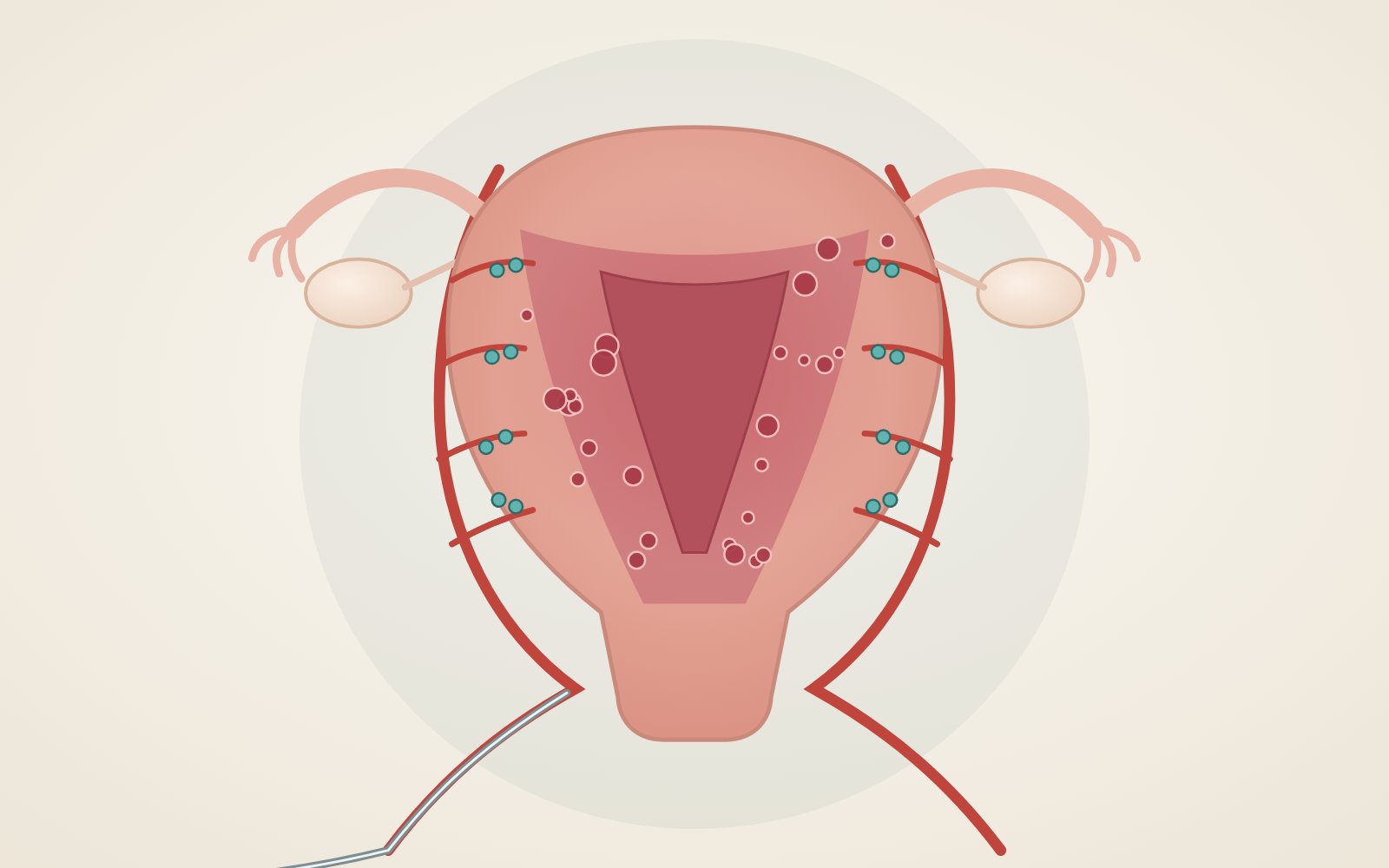
In adenomyosis the endometrium, the tissue lining the inside of the uterus, grows into the muscular wall: the uterus enlarges and periods become very heavy and painful, often with a feeling of heaviness in the lower abdomen. With embolization, through a small puncture at the groin or wrist, a thin catheter reaches both uterine arteries and calibrated microparticles are injected to close their smallest branches. The highly vascular adenomyosis tissue undergoes necrosis and shrinks, while the rest of the uterus keeps receiving blood from collateral vessels. Compared with fibroids, the vessels to reach are smaller and embolization has to be more complete: this is why good pain management in the following days is part of the procedure.
Who it is for
- Symptomatic adenomyosis, with heavy periods, period pain or a feeling of heaviness, not responding to medication or with medication not tolerated
- Wish to keep the uterus or avoid hysterectomy
- Adenomyosis together with uterine fibroids
Recovery
One night of observation or day-case admission. Cramping and pelvic pain are expected in the first days, sometimes more intense than after fibroid embolization, controlled with pain medication. Return to activities in about one week; periods usually improve within the first cycles, and the reduction in uterine volume is seen on MRI between 3 and 12 months.
Conditions treated in this area: chronic pelvic pain and pelvic varicocele, uterine fibroids with pain and bleeding, adenomyosis with heavy, painful periods.
Before the procedure
A pelvic MRI is needed to confirm the diagnosis, measure the thickness of the junctional zone, show how extensive the adenomyosis is and whether fibroids are also present. The decision is made together with the gynaecologist, after trying or considering medical treatments such as the levonorgestrel intrauterine device. If you wish to become pregnant, embolization should be discussed with particular care, because data on fertility after treatment for adenomyosis are still scarce.
Scientific evidence
A 2026 systematic review of 22 studies and 1,701 women with treatment-resistant adenomyosis reports a clear improvement in symptoms in 76%, technical success in 99.8%, an average 36% reduction in uterine volume and a later hysterectomy in 3.2% over an average follow-up of about two and a half years. Complications were mostly mild; adhesions inside the uterine cavity were described in 1.4% and early menopause in 2.6%, only in women over 40. In a Dutch study with 7-year follow-up, 82% of women avoided hysterectomy. The limitations are important: the studies are mostly retrospective, often include women with fibroids too, and randomised trials are lacking, as the Society of Interventional Radiology consensus panel also acknowledges.
References on PubMed
- Uterine artery embolization for the treatment of symptomatic adenomyosis: a systematic review
Ini' C, Timpanaro C, Foti PV, et al. — CVIR Endovasc, 2026 · PMID 42455259
- Uterine Artery Embolization for Symptomatic Adenomyosis: 7-Year Clinical Follow-up Using UFS-Qol Questionnaire
de Bruijn AM, Smink M, Hehenkamp WJK, et al. — Cardiovasc Intervent Radiol, 2017 · PMID 28516272
- Uterine Artery Embolization for Symptomatic Adenomyosis: Proceedings from a Society of Interventional Radiology Foundation Research Consensus Panel
Caridi TM, De la Garza-Ramos C, Brook OR, et al. — J Vasc Interv Radiol, 2022 · PMID 35489788
- Uterine Artery Embolization for Adenomyosis
Caridi TM — Tech Vasc Interv Radiol, 2021 · PMID 34147191
Published data describe average results in groups of patients and are not a prediction of an individual outcome. The indication for treatment must always be assessed during a consultation.
Further reading on the blog
Risks, costs and opinions
The three questions patients ask most often before deciding, with clear answers.
What are the risks of uterine artery embolization for adenomyosis?
It is a minimally invasive endovascular procedure performed as a day-case, under local anaesthesia. The most common issues are transient: a small bruise or soreness at the access point, and in some cases a post-embolization syndrome with pain, a feeling of being unwell or a low-grade fever in the following days, manageable with medication. Relevant complications (contrast reaction, unintended embolization of nearby vessels, problems at the puncture site) are rare and are discussed one by one during the consultation, with the informed consent in hand.
How much does the uterine artery embolization for adenomyosis cost?
The cost depends on the setting in which the procedure is performed: some treatments are available through the National Health Service or under agreement, others privately or through insurance. The quote is given clearly before scheduling the treatment, and includes the assessment, the procedure and the planned follow-up. During the consultation I tell you which pathway is available in your case: you do not have to decide before knowing the cost.
Does it really work? What patients and the literature say
The most frequent questions are "does it really work?" and "how long does the result last?". The honest answers come from the scientific literature cited on this page, not from online stories: they describe average results in groups of patients and do not guarantee an individual outcome. Reviews and experiences found in forums concern cases different from yours, often with different indications and techniques. During the consultation we review your imaging and I tell you frankly whether you are a good candidate, what alternatives exist and when another pathway is preferable.
Want to know if it is right for you?
At the first consultation we review your clinical history and previous imaging together.