
Varicocele, uterus, prostate and haemorrhoids
Haemorrhoid embolization (bleeding internal haemorrhoids)
When internal haemorrhoids have been bleeding for months, haemoglobin is falling and banding or sclerotherapy have not worked, surgery is often proposed. But there is an alternative: from inside the vessels, the branches of the artery that keeps the haemorrhoids swollen are closed. No cutting, no wound, home the same day.
Procedure performed by Prof. Ezio Lanza, Head of Interventional Radiology, Ospedale San Giuseppe - MultiMedica, Milan.
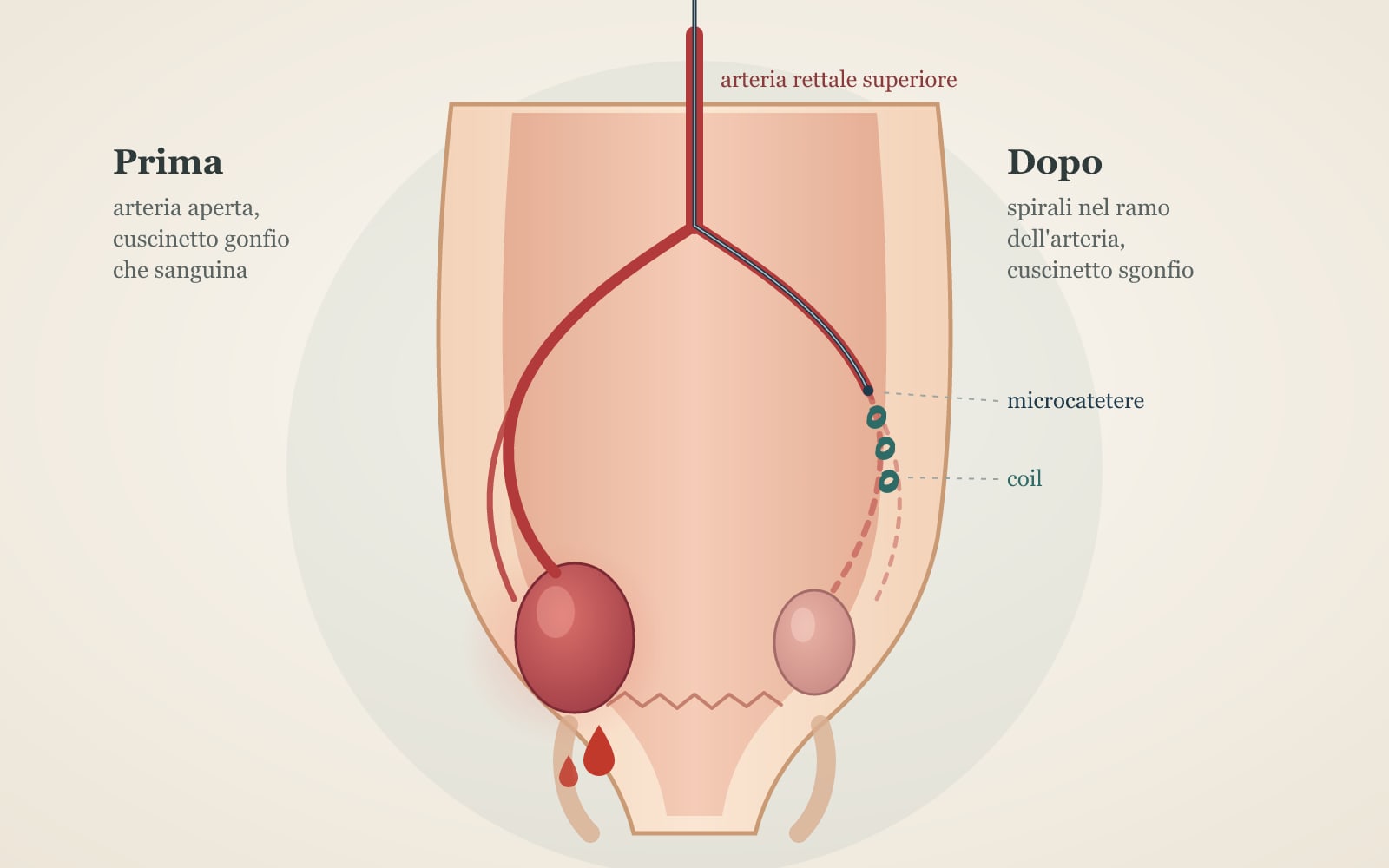
How it is performed
Haemorrhoids are normal vascular cushions of the anal canal; they bleed when the artery that feeds them, the superior rectal artery, brings too much blood and keeps them swollen. Through a puncture of a few millimetres at the wrist or the groin, a very thin catheter is guided to the superior rectal artery and, with a microcatheter, into its terminal branches a few centimetres above the anus. Small metal coils and, when needed, microparticles are released there to reduce the flow to the haemorrhoidal cushions. No tissue is cut or touched from the outside: the sphincter and the anal canal stay intact. The procedure takes less than an hour and a half under local anaesthesia, and you go home the same day or the next morning. It is the endovascular equivalent of the haemorrhoidal artery ligation (HAL) that proctologists perform from inside the anus, with the advantage of leaving no wound. It is also known as emborrhoid.
Who it is for
- Grade I-III internal haemorrhoids with chronic bleeding, anaemia or the need for transfusions
- Bleeding that continues after rubber band ligation or sclerotherapy
- People who cannot face surgery: heart disease, anticoagulants that cannot be stopped, cirrhosis
- People who could have surgery but do not want the pain and the weeks of recovery of a haemorrhoidectomy
- Bleeding grade IV haemorrhoids when surgery is contraindicated
Recovery
Home the same day or the next morning. In the first days there may be a feeling of heaviness or an urge to defecate (tenesmus), a mild fever and pelvic discomfort, which settle on their own or with common painkillers. There are no wounds to dress and work resumes within one or two days. Bleeding decreases in the first weeks; follow-up with the proctologist is at one, three and twelve months. If bleeding returns, the procedure can be repeated.
Conditions treated in this area: chronic pelvic pain and pelvic varicocele, uterine fibroids with pain and bleeding, adenomyosis with heavy, painful periods, benign prostatic hyperplasia (enlarged prostate) with difficulty urinating, bleeding internal haemorrhoids, with anaemia or when surgery is contraindicated.
Why choose embolization
Haemorrhoidectomy solves the problem but is one of the most painful operations in general surgery, with two to four weeks of recovery and risks of bleeding, stenosis and, rarely, continence problems. Embolization works from inside the vessels: no wounds, no pain on defecation, no contact with the sphincter. It works on bleeding, not on prolapse: if the main problem is a haemorrhoid that comes out, mucopexy or surgery are needed. If surgery were ever needed in the future, embolization does not prevent it.
Before the procedure
A proctological assessment with anoscopy is needed, because the bleeding must be attributed with certainty to the haemorrhoids: over 45-50 years of age, or with risk factors, a recent colonoscopy is required. Blood count and clotting are checked. In the angiography suite the anatomy of the superior rectal artery is studied with angiography, because its branches vary from person to person and an incomplete embolization is the first cause of recurrence.
Scientific evidence
The technique was born in Marseille in 2014 and in ten years has been studied in almost a thousand patients. A 2026 meta-analysis of 25 studies and 908 patients reports 100% technical success and 81% clinical success, with a further treatment needed in 14% of cases; the bleeding score falls by 3 points out of 9 and quality of life improves. An earlier meta-analysis (CVIR 2022, 381 patients) confirms 82% clinical success with no major complications. In the prospective Spanish registry of 80 patients, 69% had no bleeding at twelve months and 21% had a repeat embolization. The only randomised trial against haemorrhoidectomy (JVIR 2023) found zero pain at the first bowel movement against 6 out of 10 after surgery, with 2 doses of painkiller against 29, and the same symptoms at twelve months. Serious complications are rare: the systematic reviews report no ischaemia or incontinence, with single cases described in very frail patients. The certainty of the evidence is low because most studies are observational and direct comparisons with banding and surgery are few: this is the main limit of the technique, together with recurrence, which affects up to one patient in three at one year.
References on PubMed
- Emborrhoid: a new concept for the treatment of hemorrhoids with arterial embolization: the first 14 cases
Vidal V, Sapoval M, Sielezneff Y, et al. — Cardiovasc Intervent Radiol, 2015 · PMID 25366092
- Clinical Outcomes Following Rectal Artery Embolisation for the Treatment of Internal Haemorrhoids: A Systematic Review and Meta-Analysis
Nguyenhuy M, Xu Y, Kok HK, et al. — Cardiovasc Intervent Radiol, 2022 · PMID 35551442
- Catheter-Directed Hemorrhoidal Dearterialization Technique for the Management of Hemorrhoids: A Meta-Analysis of the Clinical Evidence
Makris GC, Thulasidasan N, Malietzis G, et al. — J Vasc Interv Radiol, 2021 · PMID 33971251
- Outcomes of embolization therapy of superior rectal arteries for the management of grade 1 to 3 internal hemorrhoids: a systematic review of clinical studies
Al Jnainati M, Ikkurthy N, et al. — Int J Colorectal Dis, 2025 · PMID 40877526
- Catheter-directed hemorrhoidal embolization for rectal bleeding due to hemorrhoids (Goligher grade I-III): prospective outcomes from a Spanish emborrhoid registry
De Gregorio MA, Guirola JA, Serrano-Casorran C, et al. — Eur Radiol, 2023 · PMID 37458757
- Embolization of the Superior Rectal Arteries versus Closed Hemorrhoidectomy (Ferguson Technique) in the Treatment of Hemorrhoidal Disease: A Randomized Clinical Trial
Falsarella PM, Nasser F, Affonso BB, et al. — J Vasc Interv Radiol, 2023 · PMID 36736690
- Outcomes of Hemorrhoidal Artery Embolization from a Multidisciplinary Outpatient Interventional Center
Bagla S, Pavidapha A, Lerner J, et al. — J Vasc Interv Radiol, 2023 · PMID 36736822
Published data describe average results in groups of patients and are not a prediction of an individual outcome. The indication for treatment must always be assessed during a consultation.
Risks, costs and opinions
The three questions patients ask most often before deciding, with clear answers.
What are the risks of haemorrhoid embolization (bleeding internal haemorrhoids)?
It is a minimally invasive endovascular procedure performed as a day-case, under local anaesthesia. The most common issues are transient: a small bruise or soreness at the access point, and in some cases a post-embolization syndrome with pain, a feeling of being unwell or a low-grade fever in the following days, manageable with medication. Relevant complications (contrast reaction, unintended embolization of nearby vessels, problems at the puncture site) are rare and are discussed one by one during the consultation, with the informed consent in hand.
How much does the haemorrhoid embolization (bleeding internal haemorrhoids) cost?
The consultation is private, also with health insurance or health funds. The cost of the procedure depends on the setting in which it is performed: some treatments are available through the National Health Service or under agreement, others privately or through insurance. The quote is given clearly before scheduling the treatment, and includes the assessment, the procedure and the planned follow-up. During the consultation I tell you which pathway is available in your case: you do not have to decide before knowing the cost.
Does it really work? What patients and the literature say
The most frequent questions are "does it really work?" and "how long does the result last?". The answers come from the scientific literature cited on this page, not from online stories: they describe average results in groups of patients and do not guarantee an individual outcome. Reviews and experiences found in forums concern cases different from yours, often with different indications and techniques. During the consultation we review your imaging and I tell you whether you are a good candidate, what alternatives exist and when another pathway is preferable.

Who performs these treatments
Prof. Ezio Lanza, EBIR-certified diagnostic and interventional radiologist, Head of Interventional Radiology at Ospedale San Giuseppe - MultiMedica in Milan and Coordinator of Interventional Radiology for the MultiMedica Group. Over 12 years at IRCCS Humanitas Research Hospital, author of international studies on embolization and ultrasound-guided procedures. Consultations and procedures take place at Ospedale San Giuseppe.
Ospedale San Giuseppe - MultiMedica, Via San Vittore 12, 20123 Milano
Bookings: 02 99961999
Want to know if it is right for you?
At the first consultation we review your clinical history and previous imaging together.