
Embolization: what it is, how it works and how much it costs
Embolization is an interventional radiology procedure that closes a blood vessel from the inside to treat a symptom or a disease, without a scalpel and without scars. It is performed under local anaesthesia, through a puncture of a few millimetres, with continuous radiological imaging control.
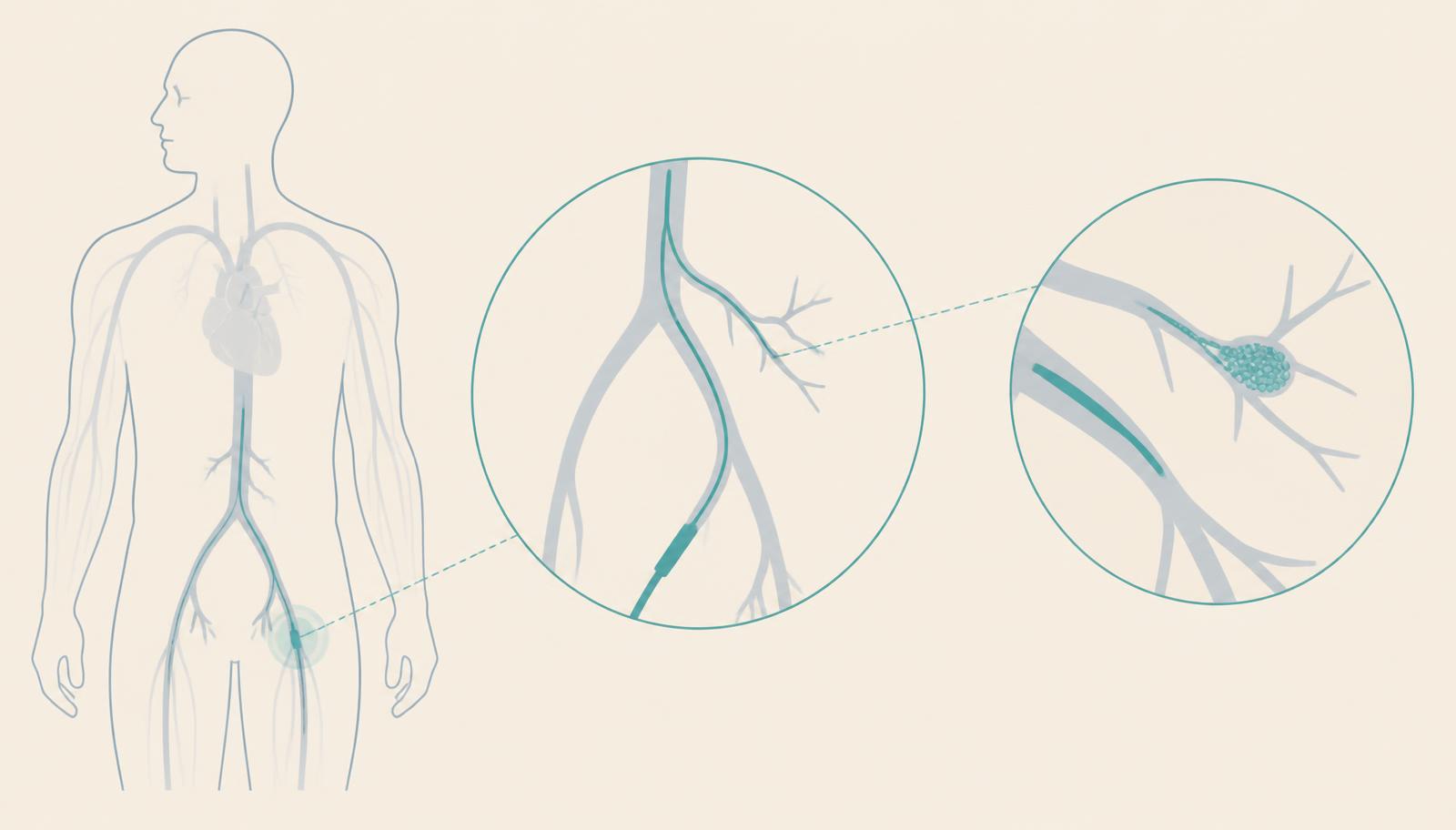
How it works
- 1. Assessment. Consultation, ultrasound or colour-Doppler ultrasound and any imaging already performed define the indication and the vascular map of the problem.
- 2. Local anaesthesia and access. Only the skin is anaesthetized; through a puncture of a vessel (usually femoral or a peripheral vein) a thin catheter is introduced.
- 3. Navigation and study. With microcatheters and a small amount of contrast the responsible vessel is reached selectively and its territory is studied.
- 4. Occlusion. The embolic agent is released — cyanoacrylate glue, calibrated microparticles or coils — chosen according to the target.
- 5. Observation and discharge. A few hours of monitoring in a day-case setting and return home the same day, with no surgical wound.
Which conditions it is used for
Varicocele
Closure of the internal spermatic vein with cyanoacrylate: the reflux responsible for the feeling of testicular heaviness and, in some cases, of semen analysis changes is interrupted.
Pelvic veins (pelvic congestion)
In women with chronic pelvic pain, worsened by standing, embolization of the incompetent ovarian and pelvic veins reduces venous stasis.
Uterine fibroids
Embolic particles reduce the blood supply to the fibroids, which shrink in volume: an alternative to hysterectomy or myomectomy in selected patients. Femoral access.
Joint pain (genicular embolization)
In knee osteoarthritis and some chronic tendinopathies, embolization of the newly formed small vessels — also known as TAME (transcatheter arterial micro-embolization) — reduces inflammation and pain when conservative therapies are not enough.
Plantar fasciitis
Embolization (TAME) of the neovessels of the calcaneal pad in chronic cases resistant to physical therapy and injections.
How much it costs
There is no single price, because the cost depends on the delivery setting. Some indications — including varicocele and pelvic vein embolization — are available through the National Health Service or under agreement; others are performed privately or with insurance coverage.
When the procedure is private, the quote includes the session in the angiography suite, the single-use material (microcatheters and embolic agent), the local anaesthesia, the day-case observation and the follow-up. You receive the full amount in writing before scheduling the treatment: no costs are added later.
If you have health insurance, during the consultation we check together the documentation needed for a reimbursement claim or direct coverage.
Frequently asked questions
How much does varicocele and pelvic vein embolization cost?
There is no single price: the cost depends on the setting in which the procedure is performed. Some treatments are available through the National Health Service or under agreement, others privately or with insurance coverage; in the private setting the fee includes the procedure, the single-use material (microcatheters, embolic agent) and day-case observation. The quote is given clearly and completely before scheduling the treatment, after the consultation and colour-Doppler ultrasound.
What is embolization?
It is an interventional radiology procedure that closes a blood vessel responsible for a symptom or a disease from the inside. The vessel is reached with a very thin catheter introduced through a puncture of a few millimetres and occluded with a dedicated material (cyanoacrylate glue, particles or coils), under real-time radiological guidance.
Is general anaesthesia needed?
No. Embolization is performed under local anaesthesia at the puncture site, possibly with light sedation. The patient stays awake and cooperative.
How long does it take and when do I go home?
Most embolizations take between 30 and 90 minutes. The usual setting is day-case: after a few hours of observation you go home the same day, with no surgical wound to dress.
What are the risks?
It is a minimally invasive procedure with a favourable safety profile. The most frequent complications are minor and transient: a haematoma at the puncture site, pain or a feeling of tension in the following days, a low-grade fever (the so-called post-embolization syndrome, typical after fibroid embolization). Major complications are rare and are discussed during the consultation, together with the informed consent.
Is embolization covered by the National Health Service?
Several indications are available through the NHS or under agreement, with the access times and criteria of the facility. During the consultation we clarify which pathway is available for the individual case.
What is the difference between embolization and surgery?
The goal may be the same, but the route is different: surgery reaches the target with an incision, embolization from inside the vessels through a puncture. The result is no surgical scar, local anaesthesia instead of general, and usually a faster recovery.
Want to know if embolization is right for you?
Bring the imaging already performed to the consultation: we assess together the indication, the alternatives and the costs, with no obligation.
Find out more
The information on this page is for general guidance and does not replace a medical consultation. The indication for treatment must always be assessed individually.